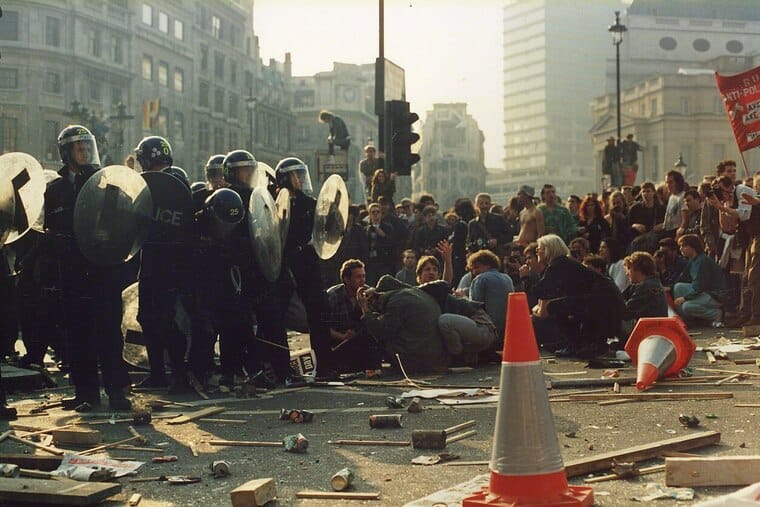
The Poll Tax riots in the early 1990s shook the British state (Photo: James Bourne/WikipediaCommons)
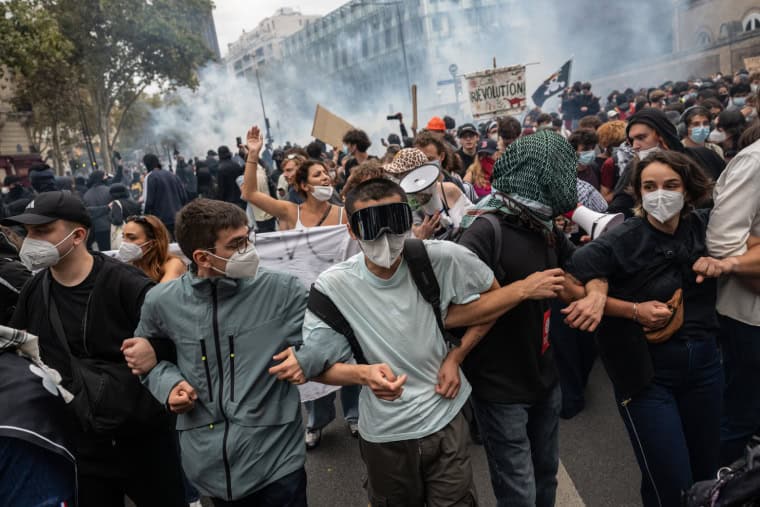
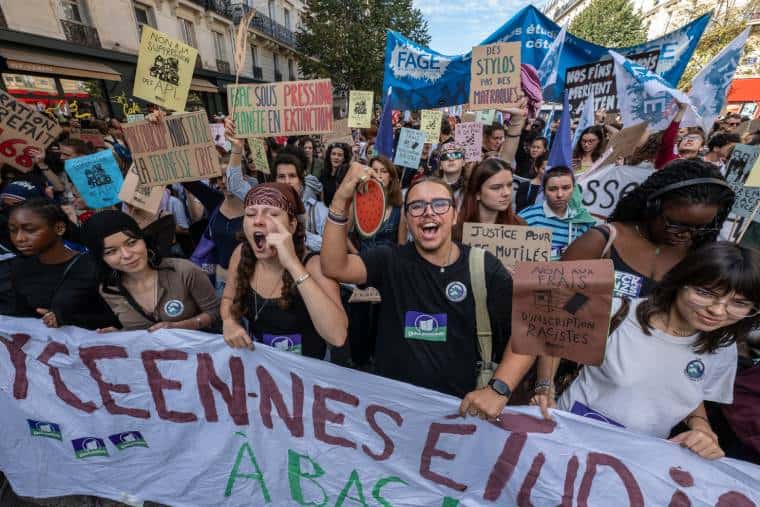
Looking across the Channel at the magnificent mass eruptions in France on 17 and 24 October, and the other protests across Europe, one is tempted to ask—“Why not here?” Is it something about the British?
The writer GK Chesterton cynically suggested that even during the English Revolution of the 1640s and 1650s “a few men talked of freedom, while England talked of ale.”
Equally cynically, the Paris-based journalist Simon Kuper writes about the French events in the Financial Times newspaper—“In France, the first question to ask about revolutionary action is always—is this real or just theatrical? The French are raised to revere and re-enact their past uprisings.”
In other words, there are deeply entrenched cultural differences that explain why some peoples revolt and others don’t.
I’m not persuaded. If we stick just with the neoliberal era in Britain, Margaret Thatcher’s government saw inner-city risings in 1980, 1981 and 1985, the epic struggle of the miners in 1984-5 and the mass movement against the Poll Tax in 1990 that brought her down.
Fast-forwarding to after the financial crash in 2007-08, the Tory-Liberal coalition was greeted by massive and violent street protests by university and college students against increased fees in 2010, and another bout of inner-city riots and two public sector mass strikes in 2011.
Nevertheless, one could say that there is more of a puzzle around the past 15 years. British capitalism has, like the main continental European capitalisms, been stuck in a post‑financial crisis economic rut, with their mainstream political systems fragmenting and the welfare state shrinking.
So why has France stood out with the Yellow Vests movement before the pandemic, the huge strikes against president Emmanuel Macron’s pension “reforms” in 2023 and now these new mass upheavals?
An explanation that won’t wash is the displacement of discontent onto racism.
One of the paradoxes of the French situation is that Marine Le Pen of the fascist National Rally is running at 36 percent in the latest poll for France’s presidential election next year. France is marked by extreme socio-political polarisation to the left and right.
Two inter-connected factors may help explain the difference. One is that Labour isn’t quite as decrepit as many other social-democratic parties in Europe. In government, despite being locked into appeasing the financial markets, Keir Starmer threw a few scraps to the trade unions. Andy
Burnham has taken this balancing act to new levels as he tries to give the impression of caring while actually offering very little more.
And, one of the British ruling class’s greatest assets remains that Labour is buttressed by the dead weight of the trade union bureaucracy holding back the workers’ movement. It sold out the 2011 mass strikes and made sure that the pay revolt in 2022-23 didn’t develop into a bigger challenge.
If we look at France and Italy, the two big European countries to have seen militant struggles, it’s not just that organised reformism is weaker, giving openings to a right wing chancer like Macron or the fascist Giorgia Meloni.
It’s also that the trade union movement in both countries is fragmented into rival federations. This allows cracks to develop that can be exploited by small left unions—for example, Si Cobas in Italy, which organises especially migrant workers and has driven the solidarity strikes with Palestine.
In Britain, by contrast, anger at where society is going has been expressed by a series of mass popular movements around political issues. This started with the revival of the Campaign for Nuclear Disarmament in the 1980s, developed especially with the Stop The War Coalition’s campaign against the Iraq War and continues today with the Palestine solidarity movement. Palestine remains a lightning conductor of mass radicalisation.
Western ruling classes’ complicity in the genocide offers a window into the reality of imperialism.
The differences I’ve been talking about are mainly at the level of what Karl Marx called the political superstructure—the institutions that ruling classes use to manage their populations.
But material suffering, hatred of the super-rich and their hangers-on and anger aroused by the genocide feed into each other, cutting across national frontiers.
This volatile mix could ignite here too.


The real scandal is around Nvidia’s pivotal role in the AI boom and inter-imperialist competition between the US and China
Why is Labour increasing repression?
What did Burnham do?