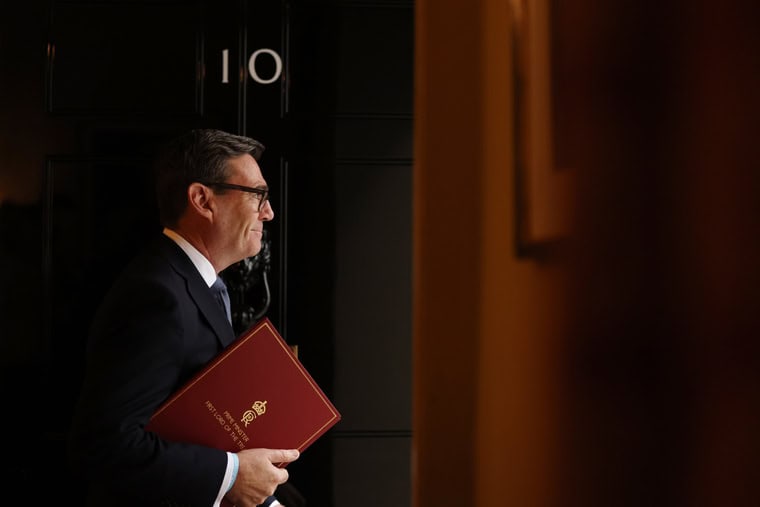
Greater Manchester mayor Andy Burnham is positioning himself as the ‘soft left’ alternative to Starmer (Photo: Wikimedia commons)
Can Labour’s sinking ship be saved? If you doubt that it is sinking, just look at the casualty rate among Keir Starmer’s personal team.
According to the Financial Times newspaper, “In place of a diehard band of ‘Starmtroopers’, as they were once known, there is now a withered rump.
“Only six out of 20 unelected aides who helped bring Starmer to power are still working for or advising the prime minister. Starmer’s tenure has turnover more akin to a fast‑food takeaway.”
This has a lot to do with what is often called Starmer’s ruthlessness. Sacrificing subordinates as scapegoats for his own mistakes is perhaps better described as cowardice.
In any case, this method won’t work anymore. After the debacle of Peter Mandelson’s sacking as United States ambassador, Starmer has been put on notice by many of his MPs. If he doesn’t improve his government’s performance by the time of the local elections next May, he will be out.
Getting rid of Starmer is easier said than done. Labour has elaborate safeguards to protect a sitting leader from removal. Andy Burnham, mayor of Greater Manchester, is learning this the hard way. He has rapidly moved to position himself as a moderate left alternative to Starmer.
His track record doesn’t make this claim particularly plausible. A New Labour minister under Tony Blair and Gordon Brown in the 2000s, he twice ran unsuccessfully for party leader. The second time, in 2015, he was trounced by Jeremy Corbyn. While he’s been a reasonably progressive mayor, it’s not hard to seem more left wing than Starmer.
Anyway, Burnham set out his stall last week. He proposed what he described as the strategy Starmer has lacked—a higher rate of income tax and increased council tax for the better off, plus a £40 billion programme of publicly-owned social housing, financed by higher borrowing.
He told the Telegraph newspaper, “We’ve got to get beyond this thing of being in hock to the bond markets.”
Burnham was referring to the vice into which Starmer and his chancellor Rachel Reeves have locked themselves. To appease the financial markets, they adopted “fiscal rules” requiring them to cut net government debt as a share of national income by 2029-30.
According to ITV’s Robert Peston, government borrowing is currently projected to rise by £30 billion, forcing Reeves to raise taxes and cut spending in her November budget.
Starmer and Reeves are desperate to avoid the fate of Tory prime minister Liz Truss three years ago. She was forced from office when the gilts market—where the government borrows money by selling bonds—crashed in response to her announcement of tax cuts without any explanation of how they would be paid for.
Governments worldwide spent their way out of the 2007-8 financial crash and the pandemic by borrowing heavily. The price of bonds has been falling throughout the advanced capitalist economies, not just Britain. This increases the interest governments must pay, which in turn adds to the debt burden.
Starmer and Reeves seized on Burnham’s remark. Without actually mentioning his name, Starmer compared Burnham to Truss, while Reeves accused him of “crashing the economy”.
Burnham quickly retreated, saying that he had been “deliberately misinterpreted”. He told the Financial Times he supports Reeves’s fiscal rules, but wants “a long-term approach to regaining stronger public control of essential services, re-establishing a tighter grip on the public finances and reassuring the markets”.
The episode made it clear that Burnham operates within the same ideological framework as Starmer and Reeves. All accept that markets rule economically. Burnham just believes there is more wiggle room to achieve some reforms.
Burnham’s caught in the same fiscal vice as Starmer and Reeves. A genuine left alternative would start from recognising that there’s a fundamental conflict between ordinary people’s wellbeing and freedom and the logic of a capitalist system driven by the search for profits.
Even the most basic programme must aim at replacing markets, not appeasing them.


Learn from mistakes of Corbynism
What do we learn from his speech?
US imperialism is struggling to maintain its grip on the Middle East
Conquest, war, famine and death