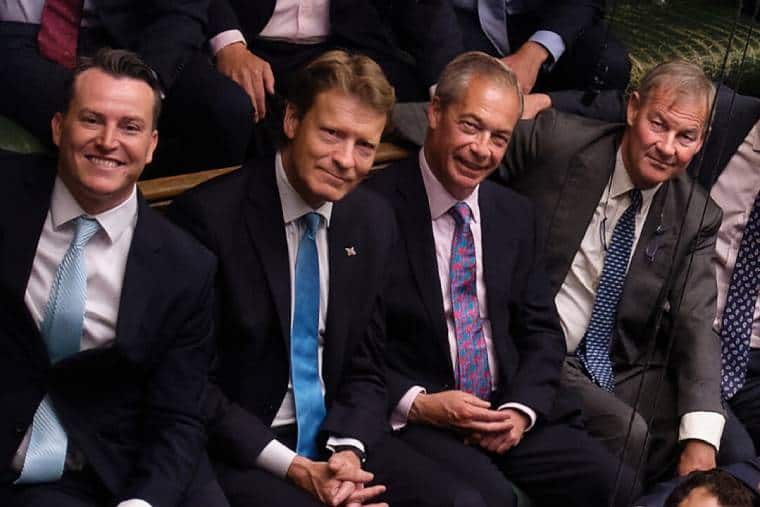
Reform UK leader Nigel Farage and Andrea Jenkyns with the newly elected Sarah Pochin
The Tories weren’t as downhearted after last July’s general election as they should have been. This was because Labour’s landslide election victory was a consequence of the fragmentation of the party system.
The contest wasn’t dominated by the two giants of British politics, the Conservatives and Labour. There were other players—the Liberal Democrats in the centre, Reform UK on the far right, the Greens and independents to the left of Labour.
Under Britain’s first past the post system, when you have multiple players, a party can win big with quite a small share of the vote. Keir Starmer secured a third of the vote, but two thirds of the seats.
The Tories comforted themselves with the thought that they could achieve a similar result at the next election. After all, they won big in 2019. Their new leader, Kemi Badenoch, decided to take her time redefining the Tory offer to voters.
Well, it looks like her time has run out. On the projected national share of the vote in last week’s partial English local elections, the Tories came fourth with 15 percent, while Reform UK came top, with 30 percent, followed by Labour on 20 percent and the Lib Dems on 17 percent.
If this distribution of votes were repeated in the next general election, the racist xenophobe Nigel Farage could end up in 10 Downing Street.
The Tories were subject to the same double squeeze that crushed them in July’s election. They lost to Reform UK on the right and the Lib Dems in the centre. These parties picked up respectively 677 and 163 council seats, the Tories lost 674.
Robert Shrimsley intoned in the Financial Times newspaper, “The Conservatives can no longer be in any doubt. The world’s most successful party is currently losing a fight to the death.”
The remarkable feature of the present situation is that Labour too was subject to a similar double squeeze. It lost the Runcorn and Helsby by-election to Reform UK, and under pressure from the Lib Dems and the Greens as well.
It lost 65 percent of the council seats it was defending. Perhaps the most devastating result was in Durham, a historic centre of the workers’ movement. Labour went down from 52 to 4 seats, while Reform went up from 4 to 65!
The main responsibility for this lies with Starmer and chancellor Rachel Reeves. The Tories have been essentially passive and widely despised, with an inept leader.
Reeves has sought to demonstrate “fiscal responsibility” to the financial markets by attacking Labour’s working class base. “On every door it was the same story—winter fuel and Pip disability benefits”, a Labour activist in Runcorn told the BBC.
In a period of deep systemic crisis, the New Labour attempt to combine economic neoliberalism and social welfare has collapsed.
Farage is a very nasty piece of work but he understands this. So he plays down his Thatcherite economics. Instead he offers a mix of anti-migrant and anti-“woke” policies and calls to renationalise British Steel and privatised utilities in the hope of attracting disgruntled Labour supporters.
Election expert John Curtice says that, after last Thursday, “we certainly cannot rule out the possibility” that the results “herald the end of the Conservative’s and Labour’s joint dominance of British politics”. This is quite a cautious way of putting it. Presumably he’s thinking of the 2017 election, when, after a period of fragmentation, the Tories and Labour won back the lion’s share of the vote.
But Jeremy Corbyn was Labour leader then, striving to offer a real alternative to the neoliberal mainstream.
It’s almost inconceivable that the current Labour government will reverse its current course. Starmer’s crawling to Donald Trump means he can’t follow the examples of centrist prime ministers in Canada and Australia and brand Farage with Trump’s unpopularity. He’s more likely to steer rightward towards Reform UK.
Reform UK definitely needs to be challenged from the genuine left. But that can’t come from Labour, or even the Greens, who didn’t do particularly well last week.
It’s urgent that the radical left gets its electoral act together to pose an alternative.


What do we learn from his speech?
US imperialism is struggling to maintain its grip on the Middle East
Conquest, war, famine and death
Farage has a tricky balancing act