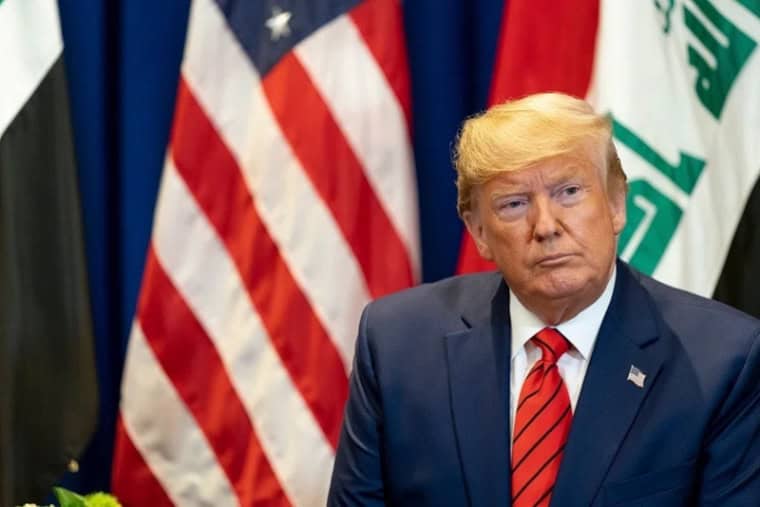
Zelensky and Trump had a disastrous meeting at the White House (Picture: The White House)
The setting of Donald Trump and Volodymyr Zelensky’s latest meeting was even more dramatic than their disastrous Oval Office encounter a couple of months ago.
The most spectacular image from Pope Francis’s funeral proved to be that of the two presidents huddled together, dwarfed by the splendour of St Peter’s Basilica in Rome.
Trump said afterwards that it had been a “beautiful meeting”. But the symbolism doesn’t alter the realities of power. Rome has seen it all before. In May 1527 the Papacy’s weakness was demonstrated when the city was brutally sacked by the army of the emperor Charles V.
Last Saturday’s meeting may turn out to be an important step in the winding down of another imperial war. Even the New York Times newspaper now admits Ukraine was “a rematch in a long history of US-Russia proxy wars”.
The Times newspaper details the extent of the involvement of the Pentagon—and also the British military—in supplying the Ukrainian armed forces and helping to direct them. An article says that one European intelligence chief “recalled being taken aback to learn how deeply enmeshed his Nato counterparts had become in Ukrainian operations. ‘They are part of the kill chain now,’ he said”.
Sometimes people respond to the description of the Ukraine war as a proxy war between the United States and Russia by saying this denies the Ukrainians “agency”. This isn’t true. The Ukrainians showed great courage, skill and determination in preventing the Russian army seizing the whole country—especially in the first weeks after the invasion.
But despite all the weapons systems, intelligence and advice Nato has provided, they have been unable to push Russia out of the territory it holds in south eastern Ukraine.
The Ukrainian military’s incursion into Russia’s Kursk region has been largely repelled with the aid of North Korean troops.
Recapturing the whole of Ukraine—including the Crimean Peninsula seized by Vladimir Putin in 2014—would require a level of Western involvement that could easily provoke a nuclear war. US president Joe Biden was content to keep the pot boiling in the hope of weakening and isolating Russia.
Even this more limited objective has failed.
Trump, in his usual crude, brutal and incompetent way, has drawn the necessary conclusion. He claims to be a peacemaker. As his secretary of state Marco Rubio put it last week, “This is not a president that ran on the promise of starting wars or armed conflicts.”
But Trump has been quite happy to let the genocide continue in Gaza. And he’s threatened to support an Israeli attack on Iran if the negotiations over Iran’s nuclear programme collapse. “If we don’t make a deal, I’ll be leading the pack,” Trump said.
Nevertheless, Trump definitely wants to end the Ukraine war. For both strategic and economic reasons, his administration is seeking to rebuild relations with Moscow.
Rubio has expressed the hope—almost certainly illusory—that the US can prise Russia away from its alliance with the real challenger, China.
A model for a peace deal could be the end of the Korean war in 1953. The war was stalemated after Chinese intervention stopped the US drive to conquer North Korea.
President Dwight Eisenhower authorised a settlement that reflected the military balance on the ground. The Trump administration’s peace proposals would leave Russia in control of most, if not all, the Ukrainian land it has seized—about a fifth of the country.
There are two difficulties with this. One is whether Zelensky can politically survive if he accepts such a partition. The other is that, in the case of Korea, the US lent its muscle to underwriting the settlement.
It still maintains a substantial military presence in South Korea. By contrast, Trump and Rubio want to dump propping up Ukraine onto the Europeans. But all the meetings Keir Starmer has brokered can’t conceal the fact that Britain and the European Union simply lack the necessary military capabilities.
Maybe there will be peace in Ukraine. But it will be a bitter and uncertain one, brokered by the empires whose clashes will continue globally.


Learn from mistakes of Corbynism
What do we learn from his speech?
US imperialism is struggling to maintain its grip on the Middle East
Conquest, war, famine and death