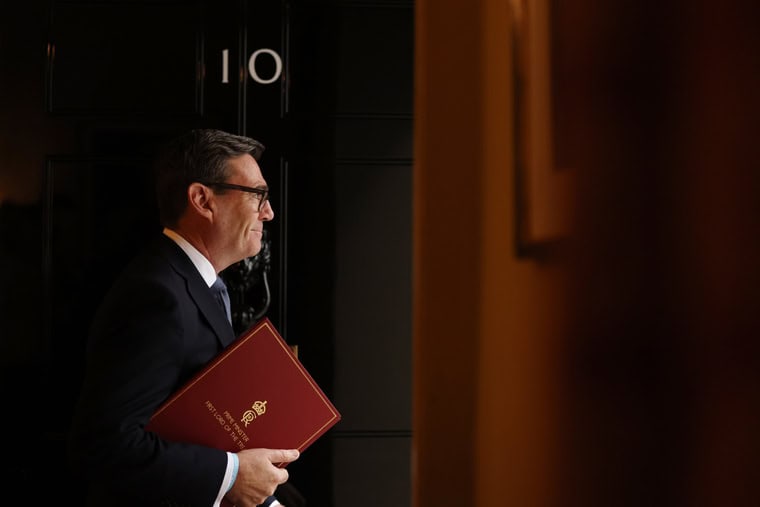
The Tories are a deeply divided party trying to manage British capitalism’s weakness (Picture: Number 10/Flickr)
The Tory government’s crisis is a story of capitalism today. As the economist Krishna Guha told the Financial Times, “This marks the first time in decades that the financial markets have forced the government of a big developed economy with its own central bank to capitulate on core fiscal ambitions.’”
What’s happened is the product of two bigger trends. The first is the decline of the historic party of British capitalism, the Conservatives.
It may seem strange to say this after the 2017 and 2019 general elections. After all, the Tories had regained the absolute size and share of the popular vote they had enjoyed in the 1980s and early 1990s.
But this was a deeply divided party, increasingly alienated from its traditional business base as the right pressed for a break with the European Union. The 2016 referendum saw the right get their way, thanks in large part to the austerity imposed by the Tory-Liberal coalition. The past 15 years have also seen other centre-right parties wilt in the flames of economic instability and popular unrest.
In Britain the political chaos after the referendum ended with Boris Johnson seizing the premiership, forcing through hard Brexit, and winning the 2019 election handsomely. A complete opportunist, he used the state to boost the economy.
But his negligence and corruption first paralysed and then destroyed his government. Johnson’s decline, after the bitter internecine struggles over Brexit, shattered the Tory party into a cluster of factional fragments united mainly by mutual hatred.
This allowed a small ultra-Thatcherite grouplet led by Liz Truss and Kwazi Kwarteng to seize control. But this gang has collided with the second trend—the end, for the time being at least, of the cheap money era.
Since the global financial crisis of 2007-9, central banks have kept capitalism afloat by pushing interest rates ultra-low and pumping new money into the system. But in the past few months the US Federal Reserve Board has led the central banks in a drive to reverse the sharp rise in inflation since 2020.
This has involved large and continuing rises in interest rates that have helped dramatically to boost the dollar against other currencies. It has destabilised financial markets and economic policy-making.
Previous Tory prime ministers David Cameron and Johnson could rely on the Bank of England as a backstop, providing the cheap money needed to avert disaster. But Truss and Kwarteng discovered they couldn’t count on Bank governor Andrew Bailey.
His priority now is, like other central bankers, to prove his anti-inflation credentials and keep pushing up interest rates. Kwarteng’s disastrous “fiscal event” moved the government in exactly the opposite direction.
It increased government debt to pay for his tax cuts when rising interest rates were making extra borrowing much more expensive. When the resulting panic threatened many pension funds Bailey intervened to help them by buying British government bonds.

Now Kwarteng’s gone, leaving Truss hanging by her fingernails. But there’s no hope of a reset for the Tories. The past few weeks’ bungling has exposed the long-term weakness of the British capitalism—above all its dependence on foreign borrowing to cover its huge balance of payments deficit.
The new chancellor, Jeremy Hunt, is in a very powerful position because Truss can’t afford to sack him. It’s a remarkable sign of her weakness that she had to appoint one of the few surviving senior Tory Remainers after Johnson had purged most of them.
One ex-minister said, “Hunt would act as ‘chief executive’ of the government with the prime minister more of a ‘chairman’”. But Monday’s emergency package was designed to reassure the markets that he will fill the £70 billion gap in government finances with austerity and reversing tax cuts.
Meanwhile higher mortgage payments will take a tenth of the income of 1.8 million households. We’ll be paying for Truss’s and Kwarteng’s Thatcherism long after they have returned to well-deserved obscurity.


What do we learn from his speech?
US imperialism is struggling to maintain its grip on the Middle East
Conquest, war, famine and death
Farage has a tricky balancing act