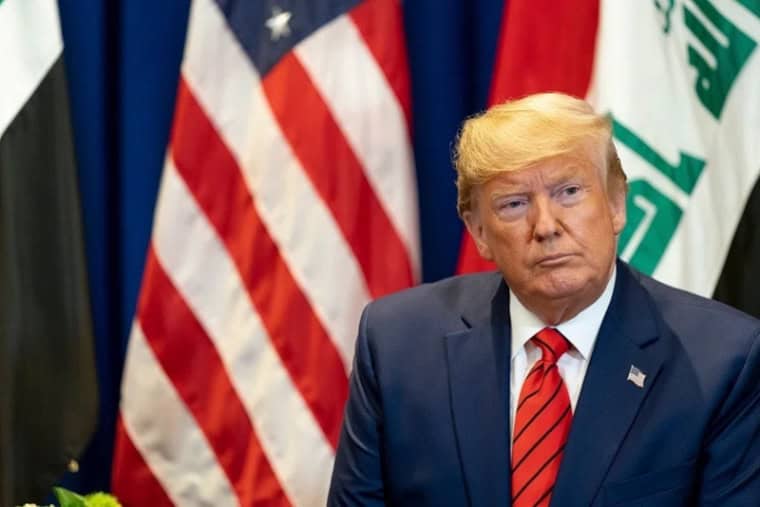
Trump could push Ukraine to make a deal with Putin (Pic: Wikipedia Commons)
Donald Trump’s re-election sent a shockwave around the world. It’s especially concentrated in the liberal imperialist bloc—the advanced capitalist states mainly in western Europe and east Asia that are closely aligned to the United States.
Francis Fukuyama became famous when he announced in 1989 that the collapse of Stalinism represented the “end of history”, as liberal capitalism triumphed over its rivals. Now he’s bemoaning “a decisive rejection by American voters of liberalism”.
The Financial Times newspaper announced, “Trump’s victory signals end of US-led postwar order.” It quoted “a senior EU official” saying, “It’s very, very bad for everyone… Nobody is a winner. Except, perhaps, Putin.” They were mourning what these days is called “the rules-based international order”. In fact, this order was constructed by the US after 1945 to band together the advanced capitalist states under its leadership as junior partners in global domination. Its rules were made by institutions such as the International Monetary Fund, the World Bank and the Nato military alliance.
The US, however, has never regarded itself as bound by these rules. For example, in 2002 Congress passed a law authorising the president to use force to prevent US military personnel standing trial for war crimes before the International Criminal Court.
What is nevertheless true is that the “rules-based order” has been fragmenting over the past 20 years. The fundamental cause is a series of blows to the hegemony of US imperialism—the global financial crisis of 2007-9, defeat in Iraq and Afghanistan and the rise of a serious “peer competitor” in the shape of China.
Trump’s first presidency was a reaction to these developments. Hence his slogan, “Make America Great Again”. His method was to use tariffs to negotiate more favourable terms with the states—friends and foes alike—whom he believed were ripping the US off.
Joe Biden sought to smooth down the feathers that Trump had ruffled among the US’s allies. But it’s interesting how far he continued his predecessor’s policies. This is most obvious in the case of China, where he escalated Trump’s trade war.
A less well-known example is provided by the World Trade Organisation. This was established in the 1990s to roll back the kind of protectionism Trump advocates. The US was its most active promoter at the start. But the Biden administration has been blocking new appointments to the WTO’s Appellate Body, which settles disputes between members, because of fears that its judgements were infringing US sovereignty.
Still, Biden sought to brigade US allies together through Nato to wage a proxy war against Russia in Ukraine. Indeed, Nato—the North Atlantic Treaty Organisation—was increasingly used to coordinate the US’s campaign against China in the Asia-Pacific region.
Trump is a notorious sceptic about the utility of Nato. Moreover, it’s pretty clear he will push Ukraine to make a deal with Putin that would probably leave Russia in control of the territory it’s conquered.
It’s much less clear what Trump will do in the other two zones where liberal imperialism is on the offensive—the Middle East and East Asia. He’s belligerent towards both Iran and China. But his so-called “transactional” approach to international politics, which he treats as a series of deals, might lead to engagement with China.
The European Union has much to fear from Trump. He’s promised to raise tariffs by 20 percent, which would inflict what one economist calls a global “macro-shock”.
But the Financial Times Unhedged column makes the interesting point that “Trump likes to use markets as a measure of his performance”. “We simply do not know how he will behave in the face of sustained market hostility. It might scare him into economic conventionality,” it says.
Amid all this uncertainty, one thing’s for sure. Trump’s second presidency will accelerate economic and geopolitical fragmentation as states manoeuvre to protect themselves and bargain for advantage. This will further weaken the hegemony of US imperialism that Trump wants to strengthen.


What do we learn from his speech?
US imperialism is struggling to maintain its grip on the Middle East
Conquest, war, famine and death
Farage has a tricky balancing act