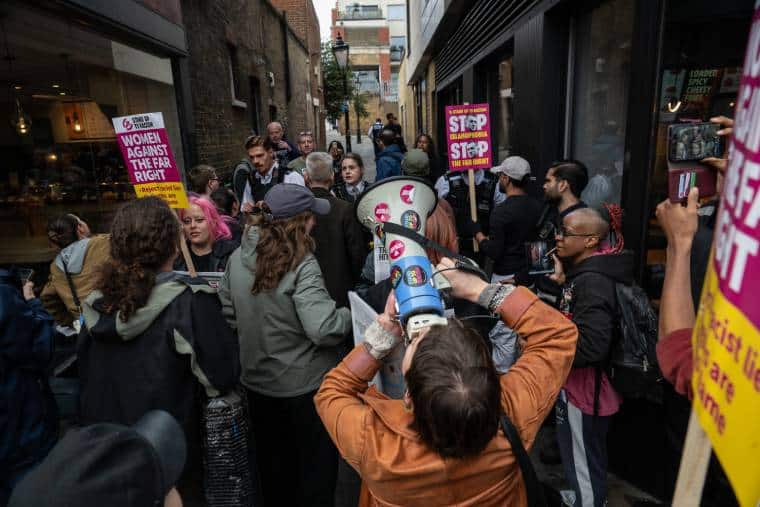
The Northern Carnival, organised by the ANL and Rock Against Racism, in Manchester, in July 1978 (Picture: John Sturrock)
The Anti Nazi League (ANL) was launched in November 1977. What was the context that it was founded in?
Racism was extreme. There was casual violence of many different kinds. It is difficult to talk about it without mentioning Tory politician Enoch Powell’s notorious Rivers of Blood speech” in 1968.
This shifted the ground of political debate to the right, it strengthened the racists and the fascists.
There had been a global recession that led to growing unemployment. This created real opportunities for racists to argue that immigrants were the problem.
The fascists grew rapidly. The National Front (NF) was able to argue that it was the third biggest party in Britain.
It was pushing the Liberals into fourth place in more and more by-elections and then famously in the 1977 May local elections and elections for the Greater London Council.
The NF won 119,000 votes and was seen as a potential threat at the next general election.
It had a core of people who were very serious Nazis who came out of the tradition established in the 1930s—a tradition that had never been properly crushed.
The NF, when established in the 1960s, was able to draw on a real fascist tradition. There was an emphasis on street politics.
The leadership was clear that they wanted to keep marching through immigrant areas. That was their main driving effort for keeping themselves in the news.
How was the ANL initially launched and built?
There was a reactionary wave in the aftermath of the Battle of Lewisham in 1977, which was a huge event.
Organised by the Socialist Workers Party (SWP), thousands of people came together to be a determined force.
They broke through police lines and smashed up the NF, who were attempting to march through Lewisham in south London. It was a real victory, but at the price of leading Labour Party figures calling the demonstrators fascists, all of which is lies.
In that situation, we recognised that winning one battle on the street doesn’t stop the fascists. You have to build an organisation that can confront them at every opportunity. This was the idea behind the ANL.
Russian revolutionary Leon Trotsky had the idea of the united front, linking groups that are very different, reformists and revolutionaries, together.

On one evening, Ernie Roberts, a senior activist in the engineering union, went around and signed up 30 Labour MPs and a whole bunch of trade union leaders. Then everyone realised that this had legs.
The question arises—how do you seize on every opportunity?
The idea of sponsors was seized upon and got a whole lot of people sponsoring the ANL. The two most important sponsors were football managers Brian Clough and Jackie Charlton.
But there was a problem—you have the publicity, but have you got the people on the ground?
It’s a huge job of work to make sure it does take off. People go around talking to local anti-racist and anti-fascist committees saying, “We are not trying to replace you, we are trying to work with you because we don’t have a national organisation for what is a national task”.
There were serious forces in the Labour Party. Labour MPs didn’t just sponsor the ANL but went and did ANL launch meetings.
Within three months, discussion took place with the Communist Party that had this huge base at the time. They had 30,000 members and a lot of people who are union officials, elected and unelected.
Their general secretary became a sponsor and their industrial organiser joined the ANL steering committee. They seriously made it work so that you had this moment where the left was in agreement that we could now mobilise.
Rock Against Racism was set up in the summer of 1976—there was real energy there.
What were the most effective political strategies that the ANL used?
One of my responsibilities as ANL organiser in Manchester was making sure we had thousands of badges. You couldn’t walk through Manchester in the summer of 1978 without seeing people wearing an ANL badge.
It made every NF sympathiser and member feel that they were losing. Few things had a bigger impact on the street.
The idea of the carnival worked amazingly. You had all kinds of people in joining. Around 80,000 people from all over the country came to the first carnival in April 1978, marching from Trafalgar Square to Victoria Park in east London.
The Rock Against Racism rule was that you set up a group and nobody told you what to do.
People would ring up and ask about Rock Against Racism in their areas, and organisers would respond with, “You are Rock Against Racism. You organise it and I’ll send you some stickers, a few badges and a guide on how to organise your own gig.”
The main objective here was to make sure the NF was defeated at the polls. To achieve that they had to be confronted whenever they tried to march. Thousands and thousands of leaflets were distributed.
The whole history of those months from the launch in November to the first carnival in April is really of students deciding they were going to get involved.
There was also the activity in workplaces, rooting out NF members from Silverwood mine in Yorkshire or getting rid of them at Longbridge car factory in Birmingham. If you couldn’t get them sacked you made sure they kept their head down.
But the book tries to describe the full creativity of people, how people can organise themselves as a force.
Everyone tends to focus on the big events, the Battle of Lewisham and the first carnival.
But actually what I really wanted to capture is the strength of the movement. There are thousands of people whose names we will never know who carried out an uncountable number of actions. That is what a real movement does.
What was the success of the ANL?
Organisation was the success of the ANL.
We had to admit that we would not win through more Battles of Lewisham. It wouldn’t work. It would only work if we crushed them at the ballot box. And you can only do that if you have millions of leaflets out there.

The objective was to stop a specific organisation that is going to stand 300 candidates at the general election.
There were no secret agendas. What we say is what we do. We were running it as a united front. We couldn’t do anything that was going to undermine the agreement, we had this basic agreement that we were focusing on the NF.
This made it possible to get numbers that previously nobody had imagined. After the first carnival it was possible to write that we were now a mass movement—after the summer of 1978 we never lost that public hegemony, that wide acceptance of our ideas.
Every so often the far right, such as Nigel Farage today, makes a huge push and there are waves of racism.
But we know that we can go anywhere, put up a stall and we will find that most of the people walking past us are with us.
Racists to this day have to say “I’m not a racist, but…” if they want to make a statement. After the ANL carnival in Manchester, this was the day it was cool to be anti-racist.
And if you want to sum up the achievement of the ANL that is it. We moved from being small local organisations to a national organisation that was a serious force.
We were able to raise the whole level qualitatively to a point that enabled it to win. We had an incredible connection to our sister organisation Rock Against Racism. You cannot counterpose the two. And revolutionary socialists were in many cases the glue that held it all together.
The way in which it connected with young people was key. The first carnival was a historic demonstration, a young working class demonstration.
Part of the achievement was to specifically use the music and the general seriousness in which we took the culture, the art and so forth. The ability to win young people and to connect Rock Against Racism and the ANL was incredibly powerful.


Far right is still a threat
Fanning the flames of Islamophobia and racism is hardly restricted to the far right
An interview with Minnesota-based trade union organiser Todd Dahlstrom