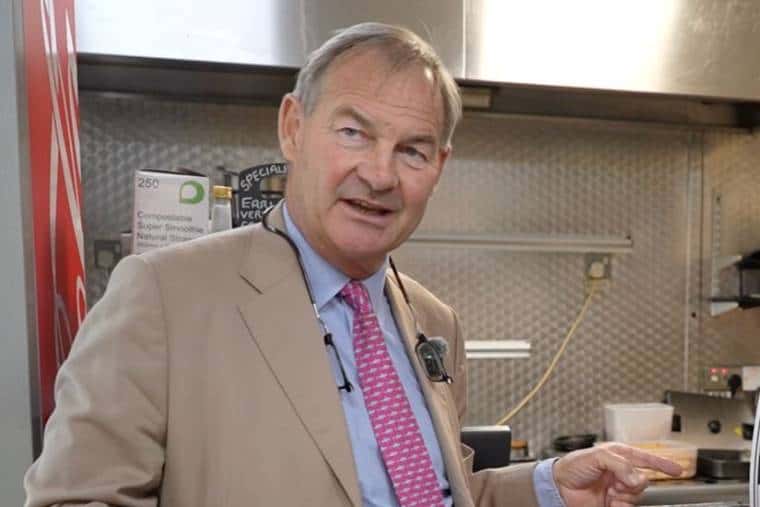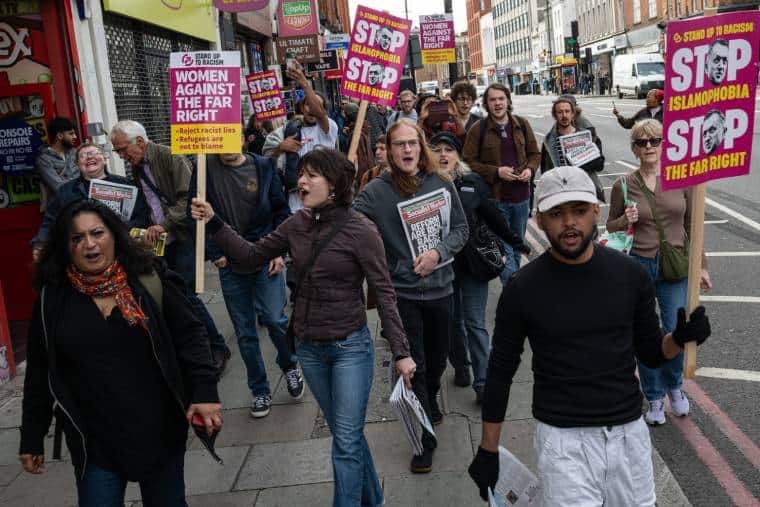
Stand Up To Racism confronted Restore Britain in Camden (Pic: Guy Smallman)
Restore Britain leader Rupert Lowe hasn’t stopped crying on social media since Stand Up To Racism confronted canvassers in the Holborn and St Pancras by-election in north London last Saturday. Here are three reasons why we were right to chase Restore Britain off the streets—and why we’d do so again.
Restore Britain welcomes fascists
Lowe claimed that the campaigners we confronted in Camden, north London, were “decent Brits”.
But an SUTR investigation exposed that those running Restore Britain’s campaign in the by-election include former members of the fascist British National Party (BNP).
One of the fascists we confronted last Saturday was Patrick McGinnis who says that “Jewish ideas are destroying our country” (see left).
Lowe’s party is a right wing split from Reform UK that openly embraces known fascists.
The leadership and elected councillors are all former Reform UK members who think Nigel Farage doesn’t go far enough, particularly on mass deportations.
But Restore Britain is a hybrid formation where electoral politics and the street movement converge.
The party openly welcomes known fascists—and could develop in a more openly fascist direction.
Fascists represent a unique threat
The aim of the Nazi faction in Restore Britain is to build a street movement of thugs that can terrorise migrants, attack Muslims and ultimately crush all forms of political opposition and working class organisation.
Being part of an electoral project allows them to disseminate their racist calls for mass deportations. But it also provides an opportunity to grow a fascist core out of the wider pool of activists who are pulled around Restore Britain.
A scroll through Restore Britain’s social media channels shows meetings across Britain attended by dozens of activists. In each of these, fascists such as McGinnis are trying to draw people around the harder Nazi politics that advocates the terrorising of minorities and the crushing of the left.
If they are allowed to succeed, they will pull British politics even further to the right.
Fascists can’t be reasoned with
The confrontation on Saturday was condemned by Reform UK’s Zia Yusuf, but it wasn’t just the far right who pleaded outraged.
Labour MP for Dover Mike Tapp wrote on social media, “If you don’t like the views of a political party, tough, campaign harder and within the laws of our great country.”
But the fascist threat cannot be dealt with through discussion and persuasion alone.
Historically, fascism has included a dual strategy. Fascists stand in elections to pursue respectability while aspiring to build a street movement that can act as a battering ram against opposition.
The rise of Hitler in the 1930s showed that such a threat can’t be debated away, or exposed by the “democratic process” it seeks to destroy.
It has to be confronted head on through mass mobilisations. Our aim is to isolate the fascists from a wider audience and break their street movement before it can do serious damage.
We now face a threat on three fronts in Britain. The most urgent danger comes from Daniel “Tommo” Thomas, who launched a new fascist street movement in Dover and Portsmouth two weeks ago.
His new outfit, Patriot Platform, attempts to cohere permanent networks from the national marches led by Nazi Tommy Robinson, and local mobilisations, such as the protests outside hotels housing migrants.
Thomas said Patriot Platform was “building a voting bloc” that “will go to the candidate who can bring this country to order”.
And Restore Britain praised the mobilisations in Dover and Portsmouth.
This all adds pressure on scandal-ridden Reform UK to radicalise rightwards.
We need to combine challenging the far right’s racism at the ballot box with a militant anti-fascism that confronts the Nazis every time they appear on our streets.


Fanning the flames of Islamophobia and racism is hardly restricted to the far right
An interview with Minnesota-based trade union organiser Todd Dahlstrom
Reports from anti-racists in Bradford, Croydon and Southampton
Interview with key organiser