Reform UK stokes the fires of racism for political gain (Photo: Wikimedia commons)
The ambition of Reform UK, a far right and racist party, is to mobilise division and hate for its advantage. Nigel Farage and the party’s other MPs never hesitate to spread their vile lies whenever they have a platform.
And they are currently having success in doing so.
Reform UK grabbed five seats and well over four million votes at the general election. The party is now winning local elections—it currently has 50 councillors. In opinion polls, Reform UK sits on 22 percent, behind the Tories on 23 percent and Labour on 30 percent. It is well ahead of the Lib Dems on 12 percent and the Greens on 9 percent.
What is driving its popularity?
Racist ideas about migrants and refugees, disillusion with the current status quo and resentment towards mainstream parties—these are the lifeblood of Nigel Farage’s party. Reform UK thrives on the idea that Britain is “broken”—one of Farage’s common refrains. Working class people in Britain are experiencing a cost of living crisis, miserly pay offers, collapsing public services and soaring rents.
For decades mainstream political parties have failed to improve working class living standards. This has generated a deep-seated disillusionment with both Labour and the Tories.
This economic misery combines with a widespread distrust of mainstream parties to make Reform UK dangerous—the class anger that the far right party is tapping into is very real. But the racist solution it offers—migrants and refugees are causing these problems—is not.
Farage sees these hardships as an opportunity. He tells people that the issue lies with too many migrants, with people crossing the Channel in small boats and a loss of national pride. The transcripts of Reform UK MPs’ speeches in parliament show how they unrelentingly link immigration to issues such as primary school availability or housing.
And their solutions? Ramping up deportations, border security and other repressive measures.
Reform UK’s success is built on refracting class anger through a racist lens. The horrors of capitalism will always breed despair. It whips up that despair and focuses it on blaming migrants and refugees for miseries created by the capitalist system of profit.
This can be seen in its general election manifesto. The very first pledge starts with “uncontrolled immigration has pushed Britain to breaking point”. Reform UK is weaponising anti‑migrant racism—but this is not happening in isolation. Labour and the Tories are also using racism to divert people’s attention away from the real causes of hardship—the bosses and the rich.
The more the Tories and Labour promote racism, the more they give confidence and respectability to the ideas of Farage and drag British politics to the right.
Racism is central to Reform UK, but the party is also entangled with anti‑establishment fakery, climate change denial, transphobia, misogyny and pro‑corporate policies.
The anti-establishment fakery was on display last November, when Farage posted on social media, “Big business and big government work together. There is nothing about Sir Keir Starmer that represents change.”
Farage likes to paint Reform UK as the insurgent force in British politics. He claims that Reform UK is “very much on the side of the little guy or woman”. Its MPs often denounce the two-party system and multinational corporations in favour of “real entrepreneurship”. This language is an attempt to mobilise the historic base of the far right, which has typically built among small producers and independent professionals.
But Reform UK is as establishment as it gets. Four out of the five Reform UK MPs—Nigel Farage, Richard Tice, Rupert Lowe and Lee Anderson—are millionaires.
Its policies are a mish-mash of pro-corporate proposals. Tax cuts for business, austerity measures totalling £50 billion a year, a massive programme of deregulation, tax relief for private healthcare, abolishing inheritance tax for property under £2 million and scrapping net zero climate targets.
It’s clear the party stands for putting more money in the pockets of the bosses and the rich.
And it uses climate denial to drive further division. Deputy leader Richard Tice is one of the worst for this. At one point he stated “there is no climate crisis” and claimed “CO2 isn’t a poison. It’s plant food”.
Adding to this already vile concoction of politics is misogyny and transphobia. This was on display at Reform UK’s recent regional conference in Leicester, where Tice opened his speech with a transphobic joke about pronouns. The result is an over-arching package of the politics of division. This is hardly a surprise from a party whose senior members say they look to Marine Le Pen’s fascist National Rally (RN) and the far right Alternative for Germany (AfD) as inspiration.
A shift has occurred. Reform UK’s support was previously made up of disillusioned Tory voters. But now it seems that it may be taking votes from Labour as well.
At the general election, Reform UK won 14 percent of the vote. Polling analysis showed that 11 percentage points came from previous Tory voters. Some 2 percentage points came from other parties and just 1 percentage point came from previous Labour voters.
And when Reform UK voters were asked who they’d side with if Reform UK wasn’t on the ballot, 31 percent said the Tories, 27 percent said they wouldn’t vote and only 3 percent said Labour.
But in December the media outlet LBC polled people who said they regretted voting for Labour in the general election. Some 28 percent said they would now vote for Farage’s party, 20 percent said the Lib Dems, 17 percent said the Tories, 15 percent said none of the above and 10 percent said the Greens.
And local election results show a decline in Labour’s vote that is mirrored by gains for Reform UK. In a council by-election in St Helens, for example, Reform UK won a seat from Labour. Reform UK gained 41.1 percent, having not previously stood, while Labour dropped 18.4 percentage points to 34.7 percent and the Tories dropped 10.2 percentage points to 7.7 percent.
These are signs that Reform UK is capitalising on the growing resentment towards the Labour government and expanding its support. While its base is likely to still be largely disillusioned and reactionary Tories, it appears to be making inroads among previous Labour voters too.
If this is the case, it is a worrying shift. Adding to the concern is that in the 98 parliamentary seats where Reform UK came second in the general election, 89 were won by Labour.
A far right party that draws upon disillusioned Tory and Labour voters would be a formidable challenger at the next general election—the need for action is urgent.
The racism of Reform UK runs deep. This is especially true of Farage, a privately educated stock broker who has made a political career out of spewing anti-migrant racism. During the general election, he claimed that migrants crossing the Channel amounts to an “invasion” from countries “with terrorism, gang culture and war zones”.
Last June Farage claimed that Muslims “do not share British values”, giving Oldham as an example. “I could take you to the streets of Oldham where no one speaks English,” he said.
Deputy leader Tice, a multimillionaire who was previously a CEO of a property investment group, is no better. He said last year that Britain is facing “cultural pillage” and migration is “making us poorer culturally”. “We’ve got to freeze non‑essential immigration—one in, one out,” he went on to say.
Rupert Lowe, a Reform UK MP and former banker, said last week, “There should be no doubt that multiculturalism has failed Britain… The days of tolerating the intolerable in the name of diversity is over.”
Momentum is on the side of Reform UK, but its success is by no means inevitable. It is the job of anti‑racists to stop the far right party.
This will take relentless campaigning by the organised working class. And it means exposing Reform UK’s racism and lies, celebrating migrants and refugees as welcome in Britain and directing class anger at the real enemy—those at the top of society.
This means pointing the finger at Farage’s mates in big business. The rich amassed vast wealth and backed politicians who slashed and privatised the NHS, allowed landlords to jack up rents and left public services to crumble.
It means pointing to research that concludes that immigration has had little impact on average wages. And highlighting the fact that migrants are more likely to be treating you as NHS doctors than waiting in line with you.
A crucial component of this campaign must be its strength in numbers. It will take mass mobilisations to win. The strategy of the united front is key to this. A united front organises people to unite in action to fight for specific aims.
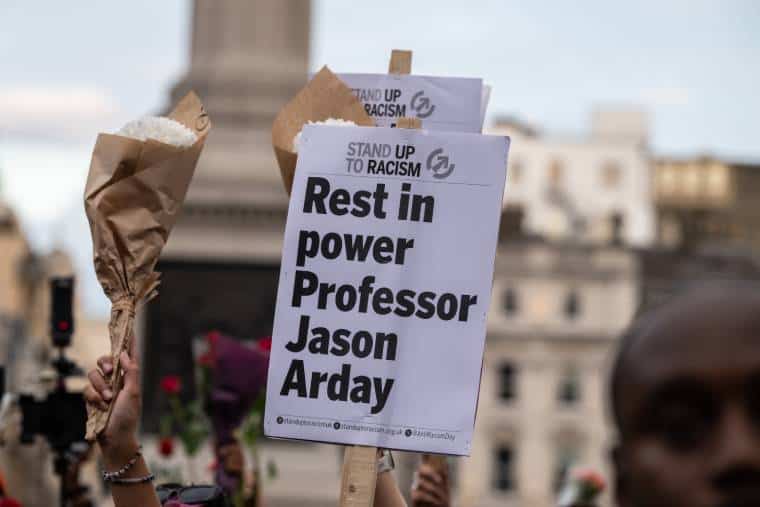
Stand Up To Racism (SUTR) is an example of this united front, where workers unite against fascism, the far right and racism. This doesn’t mean everyone has to share the same political ideas. It means a practical unity in defence of the working class, which in turn can raise confidence and combativity.
The ambition must be that wherever the far right party tries to build or stand for election, whether that be local or parliamentary, the left fights against it. This means protests, campaign stalls, leafleting sessions, social media campaigns, cultural events and more, all aimed at deepening anti-racism in Britain and opposing the far right.
But beating Reform UK requires more than self-defence. The working class must go on the offensive too. Strikes and struggle can point to a radical alternative to Reform UK’s racist scapegoating.
For example, the Palestine movement has brought millions of people onto the streets in support of a different set of politics. This movement directs anger towards the system and the people at the top. It fed into strong votes for independent candidates in several constituencies at the general election.
The left must not despair in the face of Reform UK’s rise. Over the summer, coordinated anti-racist action pushed far right rioters off the streets. In October, anti-racists denied Tommy Robinson a victory in central London.
The anti-racist movement has the potential. Reform UK can, and must, be beaten.


Democrats win in Republican strongholds
Home secretary forced to make concessions
Interview with author Jonathan Darling about his new book
Protest against Nathan Cofnas on 17 November