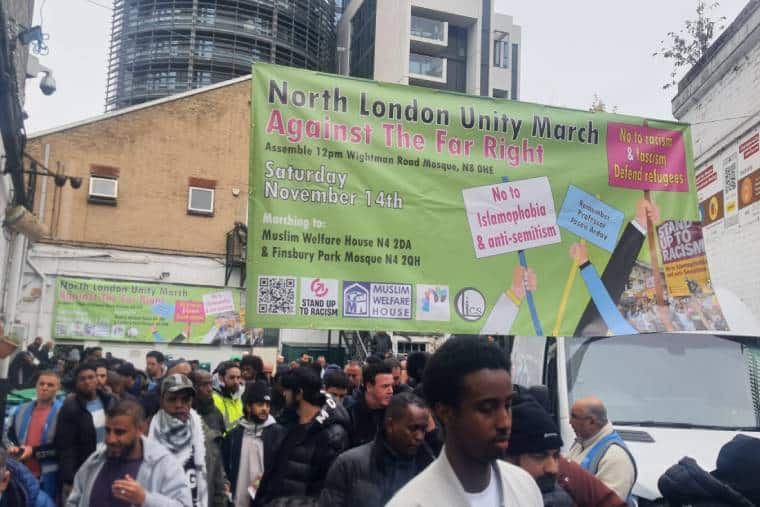
Protesting against the AfD outside the Reichstag in Berlin, Germany, in January (Picture: Flickr/Magnus Hagdorn)
The Alternative for Germany (AfD) party was set up as a mixture of fascists, racists and traditional conservatives. What sort of party is it today?
You are right, the AfD was a mixture of fascists, right wing conservatives and neoliberals in the beginning in 2013.
From 2015 onwards, mainly Eurosceptic leaders were replaced. Its racist program became more obvious and the AfD has moved sharply to the right since then.
The fascist Bjorn Hocke, who’s leader of the AfD in Thuringia, led the fascist faction Der Flugel (The Wing) inside the party.
He triumphed at the AfD’s conference in 2022 in Riesa. Co-chair Alice Weidel previously wanted to expel Hocke but now she’s with him. There are still some arguments, for example, over the AfD’s opposition to the war in Ukraine, exit from the European Union or pensions.
But the neoliberals can’t win anything against the fascist core. The open fascists are determining its policy and are setting the tone. The electoral successes in east Germany, in Thuringia and Saxony in particular, have silenced any opposition to Hocke’s course. The AfD isn’t a purely fascist party yet, but it is a mainly fascist party.
How big is the AfD and how does it organise?
The AfD has around 48,000 members, many of whom have joined in the last couple of months. They expect to reach 50,000 in the next couple of weeks.
It has 77 MPs in the federal parliament, the Bundestag, and 275 MPs in state parliaments across Germany. The MPs of the Bundestag alone employ over 100 Nazis and activists from the far right Identitarian movement as parliamentary staffers. It gives the Nazis money and allows them insights into confidential matters.
The AfD is now represented in almost every local parliament, at least in East Germany. It has local branches and meetings and during the elections campaign had book stalls nearly every day.
Thuringia and Saxony are the most right-wing branches of the AfD—led by fascists—and have a high proportion of Nazis in their ranks. For example, Arthur Oesterle, who played a leading role in the fascist demonstrations in Chemnitz in 2018, is now an AfD MP in Saxony’s parliament.
There is a massive polarisation in society and a race between fascist and anti-fascist forces. AfD representatives met with open Nazis and Martin Sellner from the Identitarian movement and discussed mass deportations. When it was revealed, hundreds of thousands took to the streets. At the same time, the AfD was able to organise more people.
Does the AfD have a relationship with fascist street thugs?
The AfD is the parliamentary arm of right wing terror—and encourages and empowers Nazis to attack on the streets.
The racist and fascist demonstrations in Chemnitz in 2018 marked a turning point. For the first time, the AfD marched openly with Nazis and it has been taking part in weekly demonstrations in many towns since then.
The topic is always changing—be it Covid, the energy crisis or the war on Ukraine—and the number of people taking part varies. But the core of it is the establishment of a fascist street movement.
The AfD has focused on attacking refugees, Muslims and LGBT+ people with racist and homophobic speeches in parliaments.
In Bautzen, a town in Saxony, around 700 Nazis wanted to attack an LGBT+ Christopher Street Day march of 1,000. The organisers had to cancel their after-show party because of the Nazi threat.
In Leipzig, the Nazis tried to attack again, but were stopped by anti-fascist mobilisation.

We had a lot of attacks on refugees in the first half of this year already—41 in Saxony and 35 in Thuringia.
There are small villages and little towns where the AfD got 40 to 50 percent of the vote in the regional elections. And in these places, there is a growing movement—in particular of young people—who form Nazi gangs and attack people of colour, Muslims, queer or left wing people.
After the killing of three people in Solingen by a refugee, the AfD felt even more vindicated and increased their harassment on refugees.
We expect that there will be even more attacks after the regional elections in Brandenburg at the end of September.
What role has the coalition government of the Labour-type SPD, the Greens and liberal FDP played?
There is rightly a great deal of discontent with the coalition. It has not alleviated social hardship, does not dare to increase taxes for the wealthy—and is instead preparing cuts.
At the same time, following Russia’s invasion of Ukraine, it pushed through an £84 billion rearmament programme in addition to annual military spending.
After the Solingen knife attacks, all the parties apart from left wing Die Linke wanted to tighten the right to claim asylum. By pandering to racism, they hoped to take votes from the AfD. But people don’t vote for the copy, they vote for the original.
There hasn’t been a real movement on the streets because the trade union leaders don’t want to attack “their own” SPD-led government. They have not fought against the war and the social problems that came with inflation.
At the same time, 25 percent of trade union members vote for the AfD! Some unions don’t tackle it, saying, “We’re a union for all our members”. Other unions try to address it by taking on the social and economic questions, but without addressing racism and fascism directly.
It is a huge task to back those trade unionists that are willing to confront the AfD and Nazis in the workplaces.
Why is the AfD growing in eastern Germany in particular?
The AfD’s rise in east Germany is rooted in what happened after the fall of the Berlin Wall in 1989.
We had a lot of hopes after the fall of the Stalinist regime in East Germany. But all the talk of blooming landscapes after German reunification in 1990 was not fulfilled.
Instead, what we got was deindustrialisation and massive unemployment of about 20 percent. At the beginning of the 1990s there were demonstrations against deindustrialisation and for social security, but the state used racism to undercut them.
The CDU conservative government said, “The boat is full so we can’t take more refugees from the eastern European countries.”
They wanted to direct anger towards migrants. This racism fell on fertile ground because in the old East Germany, the Stalinist regime treated contract workers from Vietnam, Mozambique or Cuba badly.
They were the first to get kicked out of the factories, and without a job they didn’t have a place to live or social security. The regime tried to make them responsible for the economic crisis and the shortages.
There were brutal attacks on migrant people in the 1990s. In what we called “the baseball bat years”, the Nazis started to gain ground and we had to organise demonstrations against them.
In the 2000s, the Labour-type SPD party introduced the Agenda 2010—a package of neoliberal “reforms” to suppress wages and cut benefits.
This came on top of 20 percent unemployment and had a devastating impact. When workers were made redundant, they had to spend all their savings before they could claim benefits. Many were even losing their flats or had to sell their cars. And while the rich were getting richer, spending on the infrastructure was decimated.
In rural areas, there’s no bus, no hospital, no shop, the infrastructure—it is horrible. It’s worse in the east, but it’s bad in the west too.
Why didn’t the left gain?
There were huge protests against the reforms, mainly in the former East Germany, at the beginning of the 2000s, and the left had an influence.
The left party, Die Linke, was formed out of this movement in 2007 and gained ground initially. It nearly got 12 percent in the general election in 2009.
At the beginning, Die Linke expressed hopes and aspirations of people to change something and had a clear anti-war stance.
But some people in Die Linke had illusions that we could form a government. In Berlin, Die Linke was already in a government with the SPD. In other places, it began behaving like a government in waiting. Where it went in coalition with the SPD at the state level, it behaved like a normal German government and disappointed its voters.
During Covid, there wasn’t really a fight from Die Linke to shut factories and shops and save lives. Many people began to think Die Linke was no longer on their side.
It didn’t have a clear position on the Ukraine war. This allowed the AfD to fill the void and pretend to be the only anti-war party and the only real opposition to government policies.
How do we stop the fascists?
Some people argue that because the AfD is democratically elected, you have to give them democratic rights. They think, when the AfD takes parliamentary positions, they will show that they are useless or they will become respectable politicians.
This is dangerous and repeats the mistakes of the 1930s and rise of the Nazis. The democratic process doesn’t make fascists democratic.
We must not allow the AfD to be normalised. We must tear off their bourgeois mask to reveal their fascist face. In this fight we cannot rely on the state—we have to build a mass movement against the fascists and have to confront and stop them in the streets.
Anti-fascists have taken to the streets and had successes. For example in Jena, 2,000 people blocked an AfD meeting and stopped Hocke from speaking—it was a big success.
We organise with Aufstehen Gegen Rassismus (Stand Up To Racism) and mobilise opposition to the AfD. There was a big demonstration and blockade of the AfD conference in Essen in June—and we want to blockade the next conference in spring.
There are already many groups working together—and I think people have realised that we need to do something.


Refusing to stay quiet about Islamophobia
Democrats win in Republican strongholds
Home secretary forced to make concessions
Interview with author Jonathan Darling about his new book