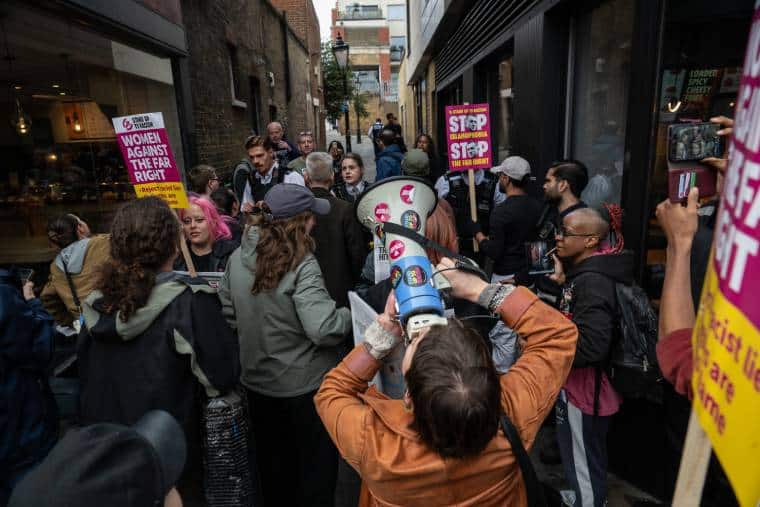
Racists rally in Epping (Photo: Guy Smallman)
How should socialists react to news this week that a planned demonstration by the far right Ukip party has been banned from the east end and moved to central London?
The Met police said it relocated the hate march because it bore a “realistic prospect of serious disorder”.
Many people will no doubt feel relieved at the news. They know that the fascists wanted to march into a Muslim community to provoke a fight. And they understand well the threat the far right poses to black and brown people—and all those that stand up against them.
But the increased use of police powers to ban demonstrations and prevent gatherings is more of a danger to the left than it is to the right. And the state is already preparing even tougher laws.
You need only to look at who it currently targets with its anti-protest legislation. More than 2,100 people have been arrested under terror laws for supporting the banned group Palestine Action.
Many more have been hounded by cops and courts for showing support for the Palestinian right to resist occupation.
Meanwhile, dozens of climate change campaigners are now serving long prison sentences even just for talking about radical protests.
Labour will no doubt use the threat of the far right as an excuse to drive through worse laws and longer sentences.
This should not surprise us. The National Government, which included Labour and Tories, in 1936 used the menace of Oswald Mosley’s Blackshirt movement to pass the Public Order Act.
Among other provisions, it gave the cops the right to ban or reroute protests.
Yet instead of the fascists being its main target, police used the Act against workers’ picket lines they thought were “intimidating”. And it banned demonstrations against the far right.
In the face of growing racism in the 1960s, the state passed the Race Relations Act, which was to outlaw racial discrimination in certain contexts.
Some people celebrated its introduction, saying it would make it easier to stop hate speech and discrimination.
But in the hands of racist police, the Act was turned on its head. The first person prosecuted under its terms was British black power activist, Michael X. He was jailed for a speech in which he called white people “savages”.
These examples point to a big problem for those trying to use the law to undermine racism—that the state itself is the main instigator of it.
Look, for example, at its inhumane treatment of migrants and asylum seekers, and its repeated brutalisation of black people.
Cops saturated with prejudice are the ones expected to implement anti-racist laws. Are the same officers, who privately joke about how much they hate foreigners and support the fascist Tommy Robinson, really going to defend us from the far right?
Can anti-racists genuinely afford to trust them with the security of black and Asian communities?
The state will occasionally use its powers against the right, but even here its real target is the left.
It hopes that bans will mean the organisation that flows from resistance to racism will, for many people, no longer seem necessary. The initiative will instead pass to the police.
State bans are designed to demobilise people and empower the cops. But coming together in large numbers, and directly confronting the fascists, remains the only way to stop them.


Plus: 500 on Leeds unity march
Far right is still a threat
Fanning the flames of Islamophobia and racism is hardly restricted to the far right