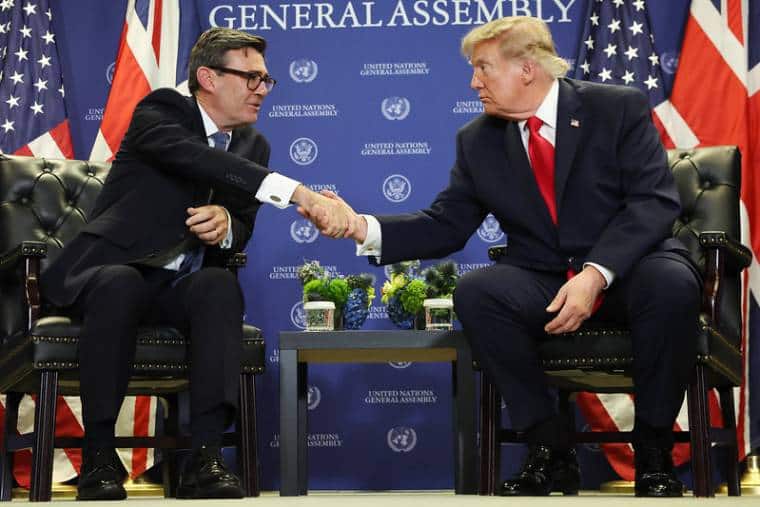
Tory prime minister John Major was asked in 1993 if his government would talk to Irish Republicans.
He replied, “The thought would turn my stomach.” At the time his government was holding secret talks with the IRA.
Tory Northern Ireland secretary Peter Brooke had announced in 1990, “The British government has no selfish or strategic or economic interest in Northern Ireland. Britain’s purpose is not to occupy, oppress or exploit.”
While the second sentence was a lie the first had truth in it. The industries that had encouraged the British to cling to a part of Ireland were in decline.
The sectarian state it had created was a cost rather than a benefit. The army had probably learnt all it was going to about torture and counter-insurgency. And the resistance of the IRA, supported by many Catholics, had not been crushed.

This pushed some Unionist politicians into accepting peace talks with Sinn Fein as part of the process. It was a torturous process.
Repeatedly people took to the streets to push the process forward when establishment politicians were blocking it.
But by 1998 a deal was done, which Tony Blair took credit for.
Northern Ireland became trapped in the peace process.
The peace was not based on drawing ordinary Protestants and Catholics together, but on policing people apart and dividing them politically on sectarian lines.
The way that politics and society in Northern Ireland are organised makes it seem “common sense” to blame the “other side”. This helps hold back anyone questioning inequality within their “own” side. So Northern Irish Assembly members have to declare themselves Unionists or Nationalists or others.
The government is formed with parity between Unionists and Nationalists, the others are ignored.
Unionists accepted the need for limited accommodation with Catholics because they wanted to make Northern Ireland “stable” for big business. But the parties of unionism were built on vicious anti-Catholic sectarianism.
And radical republicans have become government ministers responsible for jointly running a failed state.
Dividend
From New Labour neoliberalism to Tory austerity there wasn’t a “peace dividend” for ordinary people. Politicians have met crises with lurches to sectarianism.
The Stormont Assembly has collapsed a few times before, lacking any alternative, it restarts. Each time it brought parity of esteem on increasing privatisation and cutting both the public sector and tax on profits.
Sectarianism is not inherent. It was created and fostered from the outside, but it hasn’t gone away.
Peace came with its own walls—literally. There are over 100 peace walls—or more accurately segregation walls—stretching over
20 miles, more than during the Troubles.
There is continued segregation in Northern Ireland’s education system—92.5 percent of pupils are in segregated schools.
On either side of the Shankill Road/Springfield Road peace wall in west Belfast, two thirds of pupils living in the predominately Catholic side and 70 percent in the predominately Protestant side did not get five GCSEs or an equivalent qualification.
Rates of late teens not in education or employment are up to 17 percent in some areas. At least one in five children living in around half the parliamentary constituencies were in relative poverty in 2019.
That rose to more than a quarter (26 percent) in Belfast West, Belfast North and Foyle constituencies. At a ward level that rises to over more than a third of children in some areas.
Managers still make 20 percent more and workers earn 10 percent less than in Britain.
The peace process pushed Protestant workers down to an equality of poverty.
For a genuinely radical solution to the problems created by capitalism and imperialism, workers must unite through struggle and opposition to sectarianism.


Why is the British government worried about this activist?
What did Burnham do?
Learn from mistakes of Corbynism
Build for the Palestine national demonstration on 10 October