The police were frustrated at the Defend Our Juries protest against the Palestine Action ban (Picture: Defend Our Juries/Gareth Morris)
The mass defiance of the ban on Palestine Action last weekend was magnificent. Organised by Defend Our Juries (DOJ), it marked a new phase of a deliberate and focused challenge to the British state.
It showed the potential to inflict a major defeat on the Labour government and boost the whole Palestine movement.
The scale of the protest is escalating qualitatively. On 5 July, the day the ban came into force, 29 were arrested in London for holding signs reading, “I oppose genocide, I support Palestine Action”.
On 9 August, police seized 532 for the same offence as over 1,000 people held signs—a huge leap to mass action.
Last Saturday, around 1,500 people held signs and cops say they arrested 857 under the Terrorism Act and 33 for other reasons.
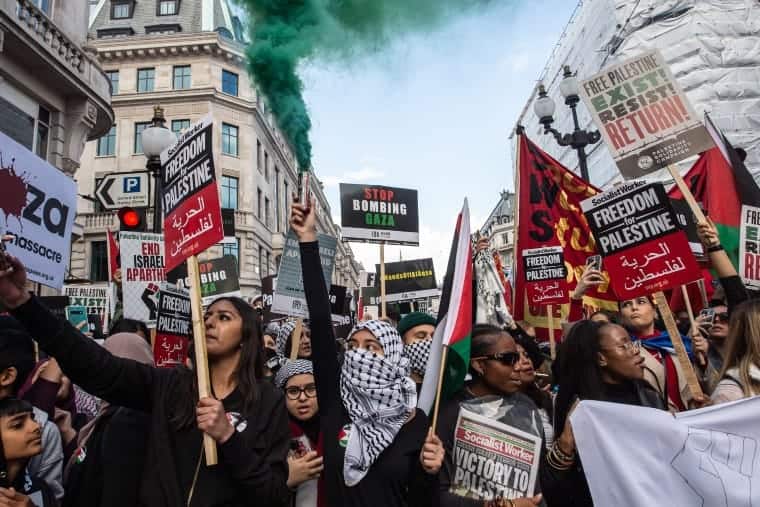
From before the mass action began at 1pm, parliament square was a sea of solidarity, including trade unionists.
The organisers of the 200,000-strong national demonstration that marched to nearby Whitehall came to Parliament Square as a delegation. And thousands more marchers joined to show solidarity as well as the leaders of the Palestine Solidarity Campaign (PSC), Stop The War (STW) and other groups.
It would be legally dangerous to comment on the actions of any of the individual cops in the photos, but let’s make the general picture clear.
How do we understand the first photo (above)?
For five hours, the police could only nibble away at the protesters and make a relatively small number of arrests. That’s not because they were sympathetic to those involved or felt conflicted about their role—it was because they faced resistance.
Every time they waded into the crowd, groups of people who had come in solidarity with the DOJ action blocked their path into and out of the square. It took ten or sometimes 20 cops to make an arrest, and for them it was painfully slow and difficult.
Police had to move their vans away from the immediate boundaries of the square fearing that protesters would block them.
The police had believed the sign-holders would be easy prey. They received a stinging rebuke. Frustrated, angry and sweating, some cops did what they always do when humiliated—hit people.
But the violence did not work at first. It was only later, with the Met and City of London police reinforced by others from Durham, South Wales, Humberside, Hertfordshire and elsewhere, that the mass arrests began.
As darkness fell and the conveyor belt of arrests sped up, exhausted cops took revenge on some of those who had shown solidarity with the sign-holders.
The Met is trying to claw back their reputation. Deputy Assistant Commissioner Claire Smart led the policing operation on the day. “I’d like to thank all officers involved in yesterday’s operation for their professionalism and tireless work despite the level of abuse that they faced,” she said on Sunday.
“The violence we encountered during the operation was coordinated and carried out by a group of people, many wearing masks to conceal their identity, intent on creating as much disorder as possible.”
And this was buttressed by the lie that the police actually help and support other Palestine protests.
Smart went on, “The contrast between this demonstration and the other protests we policed yesterday, including the Palestine coalition march, was stark. You can express your support for a cause without committing an offence under the Terrorism Act or descending into violence and disorder.”

These same cops arrested leaders of the Palestine coalition at a national demonstration on 18 January. The British state is prosecuting PSC director Ben Jamal, STW vice chair Chris Nineham, STW chair Alex Kenny and CND general secretary Sophie Bolt.
The cops routinely deny the coalition the routes it wants for protests because they allegedly go past synagogues.
Police tried to impose conditions on the Palestine coalition last Saturday, including a ban on drums and pots and pans. Fortunately, most protesters ignored this.
Ministers previously called Palestine mass demonstrations “hate marches”—now they say they’re an example to follow.
It is the purest hypocrisy and an attempt to split the movement to say there are now “good” and “bad” protesters.
Yvette Cooper’s shift from home to foreign secretary will not see any political shift from Labour. Her successor, Shabana Mahmood, said it had been “an honour to visit the Met police and to see them at work policing protests yesterday.”
So, we will see more of the repression that took place last week when the cops arrested DOJ spokespeople in the run-up to the mass action. Six of the seven arrested were bailed with incredibly draconian conditions—curfews, ankle tags, no access to tech and 42 charges.
But there is a second, and much less noticed, process going on—the cops are scared. Look at the second picture (below).

The cops felt scared, isolated and impotent on the day (Picture: Defend Our Juries/Gareth Morris)
How do the police look as they grab a protester? In charge? Certain? Secure? Not a bit of it. They reflect the greatest fear of any repressive instrument of the state. They fear there are more mobilising against them than on their side—and that people are not taking it anymore.
The fear, the sense of isolation and impotence, explains why some officers have doubts about what they are doing.
The cops don’t want to be made to enforce laws that become unworkable. That bolsters the dangerous idea that defiance works—and that’s why smashing the ban would be such a big victory.
The key question now is to mobilise even greater numbers to defeat the ban and escalate the Palestine solidarity movement.
Zarah Sultana and Jeremy Corbyn should come to the next DOJ protest and urge all those who signed up for information on Your Party to join them.
Trade unionists showed solidarity with the DOJ protests, but we should push for much more of that and for national unions to mobilise. And union leaders could be among the sign holders, laying down a challenge to the British state.
In Edinburgh last Saturday, 100 people joined a DOJ and Scottish Palestine Solidarity Campaign protest holding the same signs.
The cops could not make a single arrest. Why? A 2,500-strong national demonstration organised by Stop The War and others marched to where it was taking place, overwhelming the police.
Let’s generalise from that. Let’s mobilise the whole force of the Palestine movement to smash the ban, turn the cops’ fear into a rout. That would be a picture we all would treasure.


Learn from mistakes of Corbynism
Build for the Palestine national demonstration on 10 October