Fanning the flames of Islamophobia and racism is hardly restricted to the far right
Reaction to the school students’ uprising has added to the flow of racist filth stemming from French politicians, from the centre to the far right.
Jordan Bardella, of the fascist National Rally party (RN), could barely conceal his “told you so” glee as he tweeted last week. He said the riots show “what France has become after decades of laxity and mass immigration.”
“How long are we going to tolerate this barbarity? How long are we going to let our country sink without reacting?”
For the RN, the riots are proof that its twin themes of opposition to migration and Muslims are correct.
Its calls for radical action include removing French citizenship from any dual national found guilty of violence, and removing basic rights and entitlements from immigrants.
But fanning the flames of Islamophobia and racism is hardly restricted to the far right.
All mainstream parties, except the radical left La France Insoumise, accept the idea of a racialised working class, with migrants separated and stigmatised as “the other.”
That’s why, when there is an explosion of anger in France’s poor suburbs, known as the banlieues, protests are written off as a Muslim or ethnic problem, rather than an expression of class rage.
Community anger, argue the politicians, reflects immigrants’ failure to integrate and their self-segregation.
Knowing this, last month the Republican presidential candidate Bruno Retailleau deliberately confronted Muslim students.
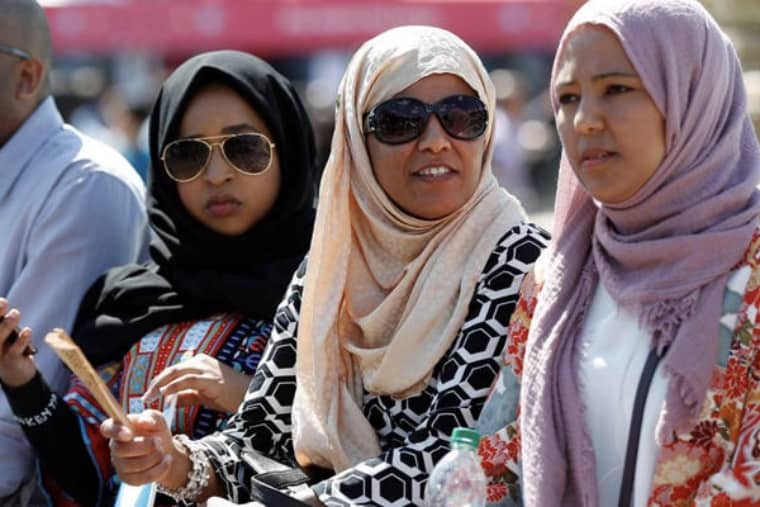
In the name of “integration” and “secularism,” the leader of the mainstream right demanded a ban on hijabs at universities, on school trips and in sport.
But, he insisted that in his vision of secularism, the “Judeo‑Christian tradition of France” must be recognised in the country’s constitution.
The far right uses the term “Judeo-Christian” as a way of distinguishing religious traditions it sees as compatible with the West from those such as Islam, which it argues are not.
Back in May, the former government minister said, “Islamism is not a religion. It is an ideology that must be fought as such.”
The French centre parties are on a similar page to the right, and are seemingly obsessed with the invented issue of “separatism.”

President Emmanuel Macron last year backed a state-commissioned report that accused the Muslim Brotherhood of waging a covert campaign to subvert secular values.
The report called for action to stop the slow-burning spread of “political Islam.”
A day before the Muslim Brotherhood report was published, Gabriel Attal—head of Macron’s Renaissance party and a former prime minister—demanded that under-15s be banned from wearing the hijab.
He insisted that the state show even more “firmness” on the issue.
Macron’s policing of “separatism” has involved banning groups which merely acknowledge the existence of Islamophobia, and which record instances of it.
The state has similarly used its powers to restrict and sanction associations, while officials have attacked unions and others for talking of “state racism.”
The state set up some 101 special departmental units dedicated to combating “Islamism and community withdrawal”.
The Collective Against Islamophobia in France (CCIF) was one of the organisations banned by the state in 2020. It became important during the state of emergency following the 2015 terror attacks.
CCIF provided legal defence for Muslims who faced discrimination because of their religion. It also kept a database of Islamophobic acts.
The group also played a central role in organising one of the largest protests against Islamophobia in France, in November 2019. This mobilised significant sections of the political left, unions and human rights groups, alongside Muslims.
The centre parties denounced the march as “Islamo-leftism.”
The increased willingness of the state to use Islamophobia as part of a broader crackdown reflects a general trend towards authoritarianism in neoliberalism.
Since the 2007-08 financial crisis, capitalism has moved from one calamity to another with no end in sight. This in turn has driven the ruling class to demand workers make ever greater sacrifices.
Growing anger at the system has required increased repression and laws that make it more difficult to mount effective resistance.
As if to match their vicious austerity, so too the racist language of the ruling class has also toughened, argues Ugo Palheta in his recent book, Why is Fascism on the Rise—from Macron to Le Pen.
“Has not the French ruling class, led by Macron and his ministers, already borrowed heavily from neofascist language, when it speaks of ‘growing savagery,’ ‘de-civilisation,’ the ‘great replacement,’ or of a France ‘drowning in migration’?” he writes.
However, the right turn has only bolstered the fascists, giving them the respectability they crave, and the ability to claim that the mainstream copies tomorrow what they say today.
The resistance seen across France this week provides us with a vision of how the working class can overcome the racist divisions imposed on it.
The scenes of working people blocking streets to protect their children is a brilliant antidote to the politicians’ racist poison.
But to really land a blow on the enemy, the working class must now prove to its most oppressed sections that solidarity is both dependable and permanent.


Democrats win in Republican strongholds
Home secretary forced to make concessions
Interview with author Jonathan Darling about his new book
Protest against Nathan Cofnas on 17 November