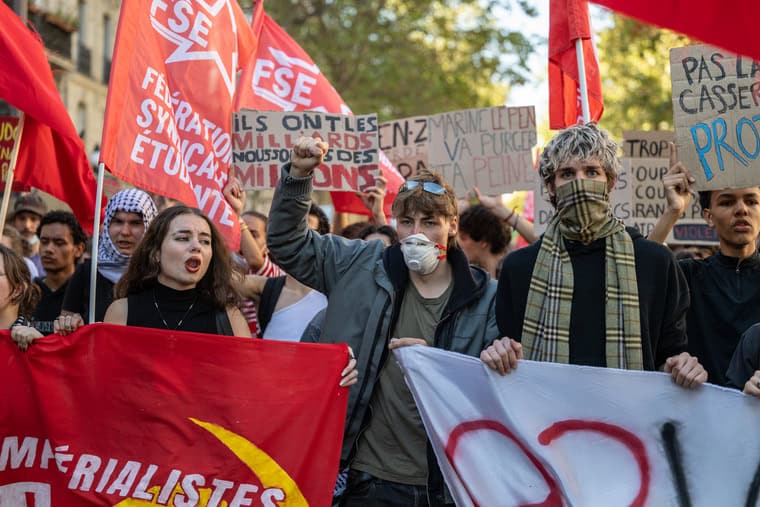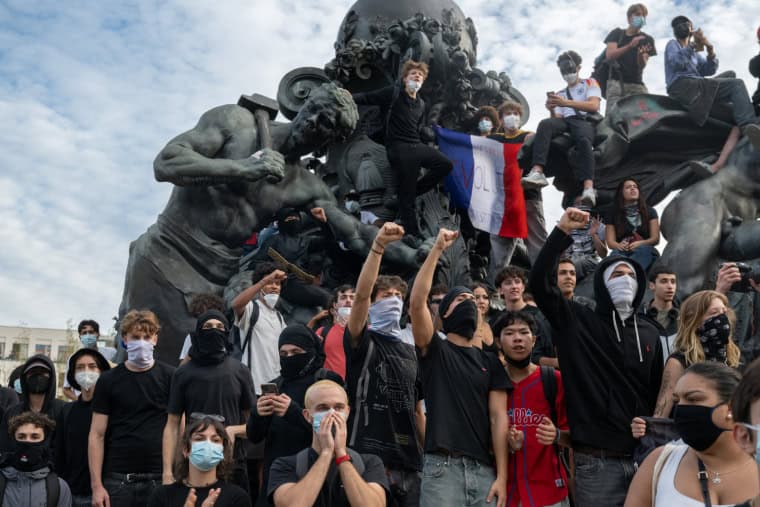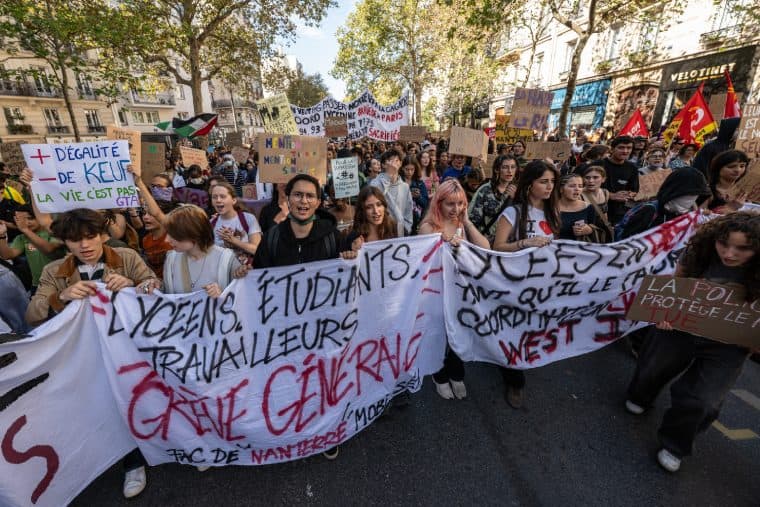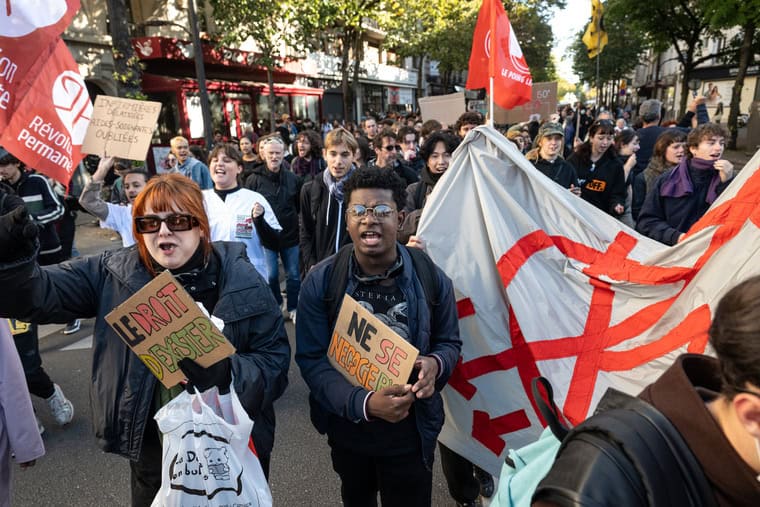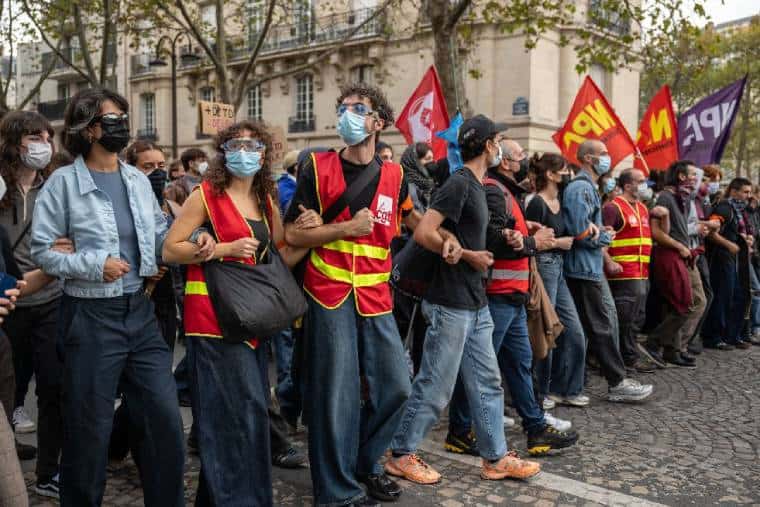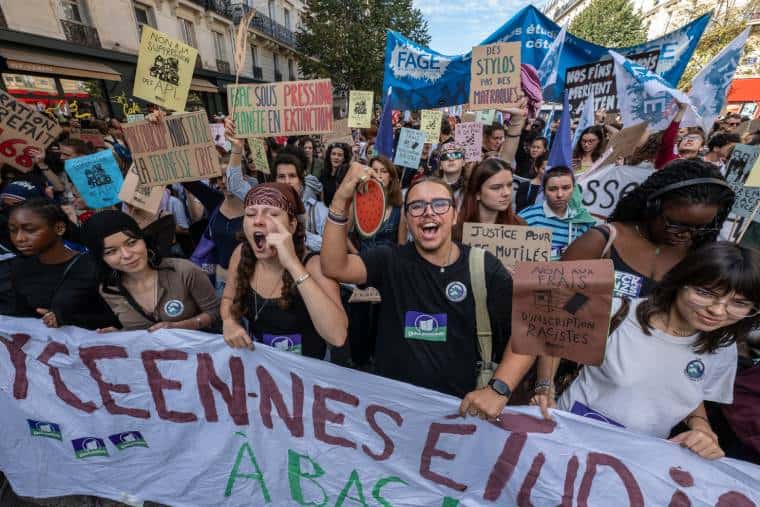
School students march in Paris on 6 October (Pic: Guy Smallman)
Eyewitness reports said, “Armed police had attacked the previous demonstrations, using batons and tear gas and making many arrests.
“Students had begun to fight back by throwing cobble stones at the police and building improvised barriers out of traffic signals and metal grilles.”
This could be describing the resistance that has spread across France in recent weeks—but is actually Paris in 1968.
This month’s uprisings in France have echoed May 1968—students take to the streets to demand more from their education, inspire workers to join them and begin to make political demands.
The student uprising in 1968 turned into the biggest general strike in French history. Ten million workers brought the country to a halt for two weeks, forcing the president to flee.
It set the standard for revolutionary upheaval for a generation. And created new openings for the French left.
But there are key differences between then and now.
The earlier rising came during the economic boom that followed the Second World War—hailed by France’s rulers as the Thirty Glorious Years. Capitalism rebuilt itself, employment rose and the working class could reap the benefits of an expanding welfare state.
Between 1950 and 1975, French workers’ wages rose by 170 percent. But for most people, this period was not “glorious”.
France, like Britain, was in a period of relative decline in the 1960s. The government tried to stay profitable by banning unions inside factories and introducing emergency legislation and brutal policing to break strikes.
The minimum wage was held down for young workers.
Women were not allowed to open bank accounts without male approval until 1966. The right to abortion on request was not won until 1975.
Abroad, the French state committed atrocities in its colonial wars in Vietnam and Algeria.
May 1968 was a major setback for France’s rulers, but over the last few decades, neo‑liberalism has enabled the ruling class across the world to reassert its power. We have endured Thirty Tragic Years.
We have suffered decades of economic insecurity, unemployment and the increasing threat of war. Neoliberalism has organised capitalism around privatisation and the free market. Living standards have been squeezed .
The drives of accumulation and competition can seen in the wars that tear apart the Middle East, as global actors seek to control key resources and influence.
Another illustration is the 2008-09 crash. In France, this was met with protests, with some three million people out in March 2009 protesting against the impact.
Since the crash brought the world economy to its knees, repeated shockwaves—whether from Covid-19 or the Russian-Ukraine war—have left the global economy unstable. An uncontrollable market has to be reined in. Crisis management has become permanent policy. This has forced states to move away from neoliberalism.
But biting austerity remains. The protests in France take place against the background of proposed cuts of £46 billion.
Anger, disillusion and alienation are features of society.
In France, this has taken the expression of near annual protests. In 2006, efforts to force young people into employment by stripping them of their rights sparked fightback and was defeated within two months.
The financial crash brought three million workers onto the streets in early 2009.

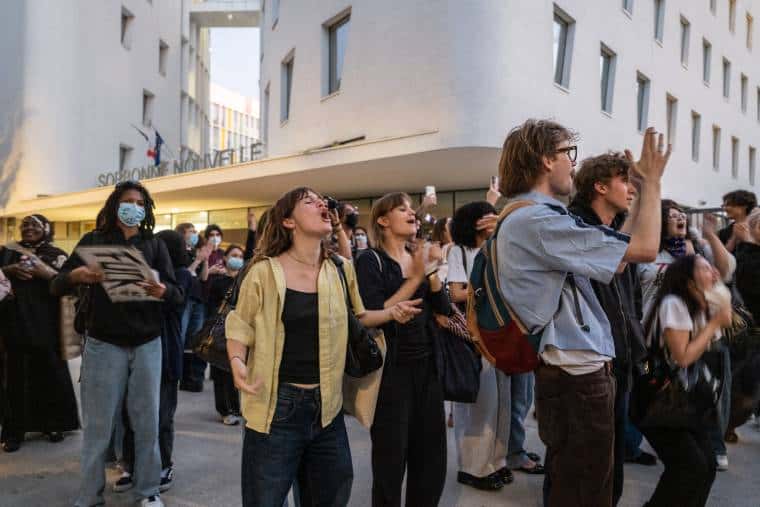
Students at the Sorbonne in Paris faced police repression (Pic: Guy Smallman)
The militant Yellow Vest protests forced the government to retreat numerous times since 2018 despite immense repression from the police and state.
2023 saw massive protests at the institutional racism and brutality of the French police after the fatal shooting of 17-year-old Nahel Merzouk.
The same year, the decision to push the pension age from 62 to 64 led to huge push back with millions out on strike.
The masses have shaken the state again and again. Last year, French prime minister Sebastien Lecornu resigned after only 27 days in office.
He was the third prime minister to resign since president Emmanuel Macron called a snap election in the summer of 2024. Lecornu has been reinstated as prime minister, but only because Macron’s government has no one left to fill the position.
Macron’s government is deeply divided and the state cannot make a concession big enough to quell the anger.
This is why the brutality of the police has been so extreme—the government has nothing but brute force left.
But tens of thousands have been spurred on to support the students because of the viciousness of the police.
Parents, teachers and workers cannot stand by as teenagers lose teeth, eyes and hands to government-backed violence.
In 1968, the trade union federations were forced by pressure from below to come out in support of the students. This transformed the protesters’ aims.
Students’ demands turned to workers’ demands and vice versa. Women’s liberation, anti-war and workers’ rights were all a part of it. Today, too, tens of thousands of people are generalising from education to wider political issues and making the links to the capitalist system.
A key difference today is the class basis of the students leading the protests.
In 1968, the student protests centred on the Sorbonne, a prestigious university full of the children of professionals and the elite.
This month, black teenagers and students from migrant backgrounds, living in the poorer districts of Paris burst onto the streets.
They’ve been joined by hundreds of better off students. They told Socialist Worker last week, they are protesting “for solidarity. Lots of high schools have conditions ten times worse than they have here.”
This centres questions of class that are now at the heart of the uprising.
A huge part of the success of 1968 was the way unions were able to call out millions of workers. Trains, buses and the postal service all stopped running, banks were closed, hospitals, museums and television companies all ground to halt and there was an acute petrol shortage.
Workers identified with the Communist Party and the Social Democrats. The sellout of the strike movement exposed the weaknesses of socialist parties that rely solely on elections, rather than on revolutionary organisation.
Another difference today is the threat of fascism.
In 1968, many workers could remember the liberation from the Nazis. Racism stained society, but opposition to racism was not central to the students’ or workers’ struggle.
Last week, Mathieu, a socialist in Paris, told Socialist Worker the protests are “against budget cuts and Emmanuel Macron, against Marine Le Pen and fascism—and for Palestine.”
There is a real threat the fascist RN win the presidential elections set for April 2027.
The far right party scapegoats Muslims and migrants. It threaten to strip basic human rights from migrants, and deny them welfare and housing.
This is buoyed by a street movement, with thousands of fascists marching and attacking left wing politicians and migrants.

Anti-racism and anti-fascism at the heart of the protests (Pic: Guy Smallman)
Today, anti-racism and anti-fascism are at the heart of protests. When the protests were sparked by black teenagers in poor Parisian districts, the far right seized on this to characterise the protests as led by “invaders”.
But soon, thousands of anti-racists came out in support of them. Cries of “We are all anti-fascist” filled the streets.
A generation has been transformed by anti-imperialism and genocide in Gaza.
Another threat that cannot be avoided now is ecological disaster. In the summer, more than 120,000 hectares in France burned. The country’s first “firestorm thundercloud” spread toxic smoke that left the city of Limoges, 125 miles away, covered in dust and smog.
In September, more than 260 protests were held simultaneously to demand a national plan of climate action.
The protests represent a break with mainstream politics and the idea that voting is the only mechanism for political change.
Huge numbers of people are being drawn to Jean-Luc Mélenchon, the leader of the left wing LFI. This represents a break with the mainstream. For years, Mélenchon has been ostracised by left, right and centre alike.
Now, it is important that a left wing presidential candidate is seen to be standing with the protestors and defending them from accusations of violence.
The danger is that the logic of the system will try and channel the anger on the streets into electoral politics only.
This radicalism and the potential for activism are the most striking similarities between now and 1968.
As in 1968, tens of thousands of people are recognising that the power to change the system lies in the streets and is in their own hands. The movement has the potential to be even more militant than it was in 1968. People are no longer willing to put up with politics as usual—and they know they’re the only ones who can change it.


Workers and students unite in a huge general strike
French students blockade schools ahead of the general strike on Thursday
A necessary step towards working class power