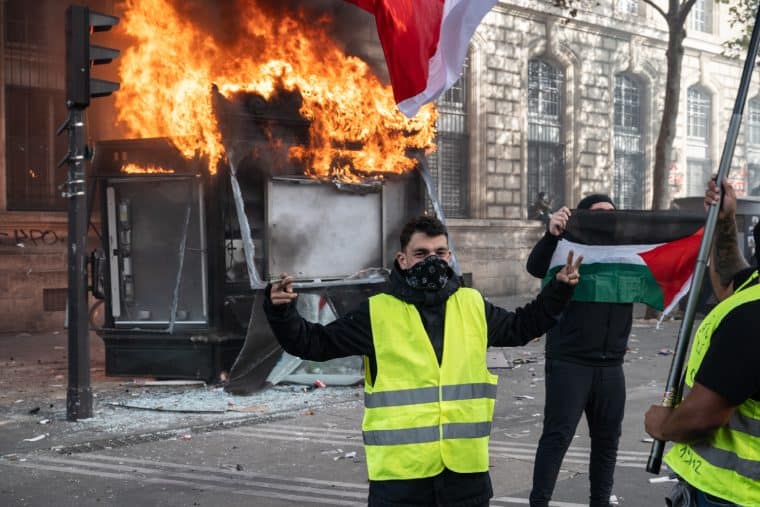
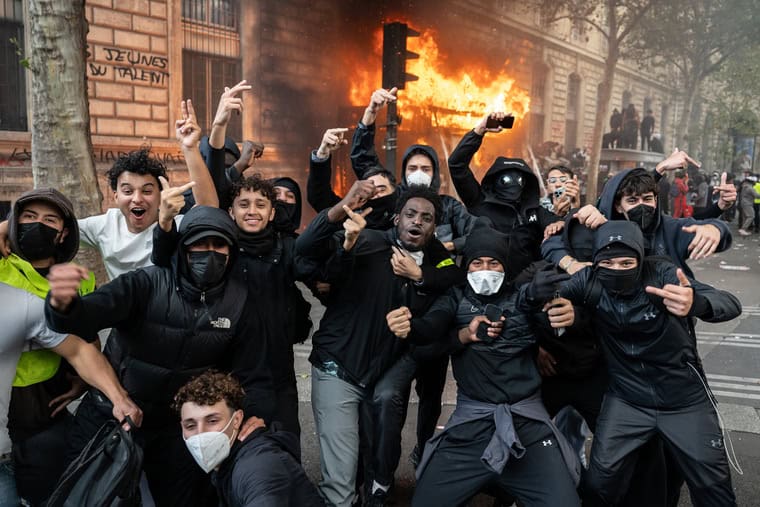
Building confidence and organisation at the base is key (Photo: Guy Smallman)
The revolt in France has rocked the ruling class—but it has to overcome major obstacles to win.
The school students’ demands over staff shortages, crumbling buildings and poor job prospects has fused with anger over police violence, genocide, the threat of fascism and climate collapse.
All of these fears—and more—combine to give people a sense that capitalism does not offer them a future.
But the different elements of the struggle all move at different speeds.
The trade unions called strikes on 17 October in a day of action alongside students. It was a glimpse of the potential power of workers to shut down the country and stop the flow of bosses’ profits.
But the trade union bureaucracy is a major obstacle to the struggle.
French union leaders have put out very militant statements calling on everyone to take to the streets and strike.
There have been dramatic scenes of union members—including parents—linking arms in the face of tear gas to defend students during mass demonstrations.
But whatever the bravery of French working class militants, their leaders show the same tendency as leaders here to want to negotiate a deal and return to business as usual.
The key division in the unions is not between left and right, but the rank and file made up of ordinary workers and the paid officials.
Socialist Workers Party founder Tony Cliff emphasised that the bureaucracy was “a distinct, basically conservative, social formation”.
This social layer balances between bosses and workers. Its role is to try to negotiate a settlement between the two groups, often by securing a deal in the workplace that falls short of what could have been won.
That same bureaucratic pressure can affect layers wider than the officialdom, for example, those elected to leadership bodies.
France has multiple union federations, rather than one single TUC federation as in Britain. The largest are the CGT—historically associated with the Communist Party—and the more moderate CFDT.
The different federations sometimes call actions jointly and tend to prioritise unity between them—even if it means moving at the pace of the slowest.
Chris Harman discussed the French general strike of 1968 in the book The Fire Last Time. He explained that the role of the leaders of the union federations is to establish themselves to the bosses as their preferred negotiating partner.

To prove themselves to the employers they need to show that they can turn on and turn off working class struggles. And, they need to present themselves as a respectable section of the movement.
But they also face a competing pressure from the base of the unions. Today this can mean visibly being on the side of young demonstrators with legitimate demands.
This means rank and file militants have to “work with and against” the bureaucracy. But this doesn’t mean working with the bureaucracy over one issue and against it on another.
Nor does it mean cheerleading the bureaucracy when it leads struggle on the way up, then critiquing it on the way down.
Take the general strike on 5 November. Revolutionary socialists welcome that union leaders have called it—but are pushing a strategy that goes beyond the horizons of the trade union bureaucracy.
Denis Godard, a revolutionary socialist in France, told Socialist Worker, “The 5 November was a bureaucratic attempt by the union leaders to take control back of the movement.
“But it is important. The question now is how to build it as an actual strike in the workplace and locally, not just as a reason for people to take the day off work and join the protests in their union contingent.”
“We need to recreate the tradition of fighting unions, we argue for strikes and occupations on the 5 November,” he added.
Building confidence and organisation at the base is key.
In 1968, the CGT ended the strike movement by negotiating a return to work in key sectors of industry. Even the biggest strike in the country’s history could be wrong-footed by union leaders.
In 2026, the unions haven’t betrayed the movement to this extent, but there are cracks starting to show.
On 13 October, union blocs assembled for a demonstration in Paris and marched off separately from the young people gathering nearby, ensuring that the two groups couldn’t meet.
After the scenes of rioting and looting last Saturday, the CGT described this as “unfortunate” and “immediately condemned” the violence. Although it also condemned violence from the police.
This move will cut the union federation off from the young people who rightly wanted to fight back against the capitalist system in the best way they know. And it will put the unions on the back foot when it comes to defending the rioters as the state hounds and represses them.
Now, the Paris CGT has pulled out of supporting protests against the fascist National Rally (RN) at its conference in Orléans this Saturday. Instead, it has asked all members to go to the centre of Paris and take part in planned demonstrations that were called following last weekend’s huge protests.
The union federation wants to “demonstrate its commitment to this mobilisation”. But it also wants to try to tame the movement by showing up in union vests to ensure that the protests remain orderly.
A different problem is illustrated by the CFDT. The union federation denounced violence on 17 October even more strongly than the CGT.
“Those responsible for the violence witnessed yesterday are hijacking the legitimate social demands expressed in recent week,” it said.
And it has more openly tried to call for a peaceful end to the street movement by negotiating with the state.
“For the CFDT, the time is not to denounce those responsible for the current situation, but to build solutions,” it says.
“The prime minister must meet as soon as possible with representatives of high school, university, labour and employer organisations to provide concrete solutions.”
The CFDT was not as involved in the protests last Saturday, although individual members must surely have attended. Instead, the union federation prefers to put its efforts into building for the 5 November.
Key CFDT activists have said that the social movements are part of political organising but their role is to focus on organisation as trade unionists.
This attitude mirrors the separation between politics and economics that characterises “reformism” everywhere. It argues that trade unions should focus on economic questions and leave politics to parties and elections.
Denis explained that there has also been an erosion of a culture of organising within workplaces. They have lost a layer of local activists who know how to mobilise union members, including for political protests.
The trade union bureaucracy is not the only challenge the movement faces.
French political leaders tend to avoid actively trying to offer a way forward for the movements. Many on the French left talk of the “autonomy” of social movements where parties do elections and political propaganda, not argue for a strategy within movements and unions.
Jean-Luc Mélenchon, presidential candidate for the left wing LFI party, has remained a consistent supporter of the movement started by working class students.

But he also reflects the tendency to refuse to “lead” the movement. He said recently, “We are not leading the popular movement. It leads itself through its unions and its assemblies.”
This attitude is partly a response to past criticisms of the CGT, which acted as a transmitter for the policies of the Communist Party into the workers’ movement. But it also leaves open the question of who can offer a direction to the movement.
Another political challenge is building the kind of movement in France that can directly confront the fascist RN.
The Paris CGT’s decision to pull out of protesting at its Orléans conference reflects a view that the movement alone can beat back the fascists.
But the experience of history shows the need to confront them and prevent them from trying to build a street movement. Preventing fascists from marching or harassing picket lines and student blockades can demoralise their supporters and grow the confidence of the anti-fascist side. It can make it unpopular to support the RN.
The anti-fascist movement in France is big enough to do this. There are tens of thousands of people in Paris chanting against them on a weekly basis. But it would take organisation and argument to persuade those people of the need for a distinctive anti-fascist movement.
Denis told Socialist Worker that the RN is exposing its claims to be an anti-establishment force and that this is useful for anti-fascists. “During the pensions movement they pretended to be on the side of the movement, even though they weren’t welcome within it,” he said.
“Now the need to beat the fascists has become clearer. They have said they are against the movement and are the party of law and order.”
“The reason for protesting in Orléans is to show that we are bigger than them and we are the majority. Then we need to do that locally in every marketplace where they organise before the election.”
All of these questions would be more easily answered with a larger revolutionary socialist organisation in workplaces and neighbourhoods across the country. If revolutionaries aren’t organised, reformist leadership will limit the movement’s potential.


Recent years have seen an explosion of young people’s anger. But what is it that’s special about young people? And what is it that is making them radical?
The neoliberal centre has created the political space for the RN to grow
The widespread rioting after Saturday’s protests shouldn’t be dismissed as the actions of a small minority
Where next for the movement?