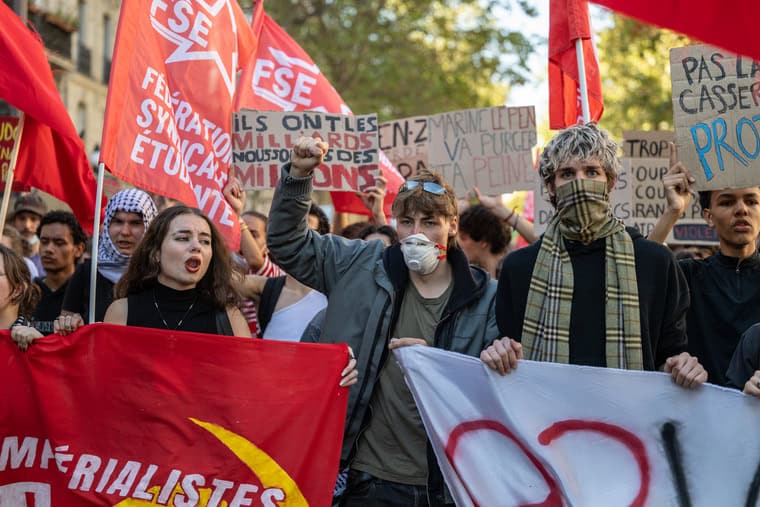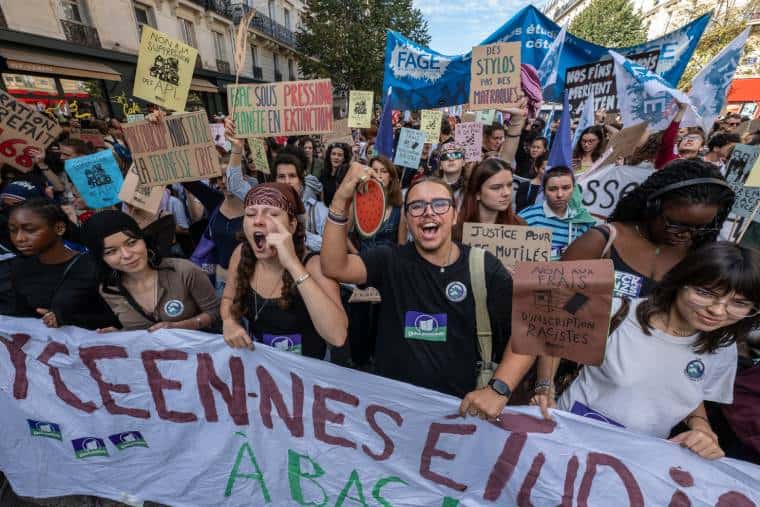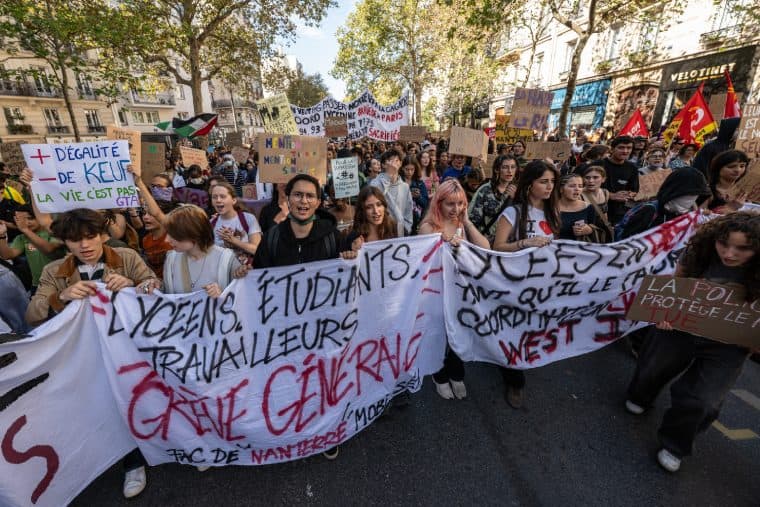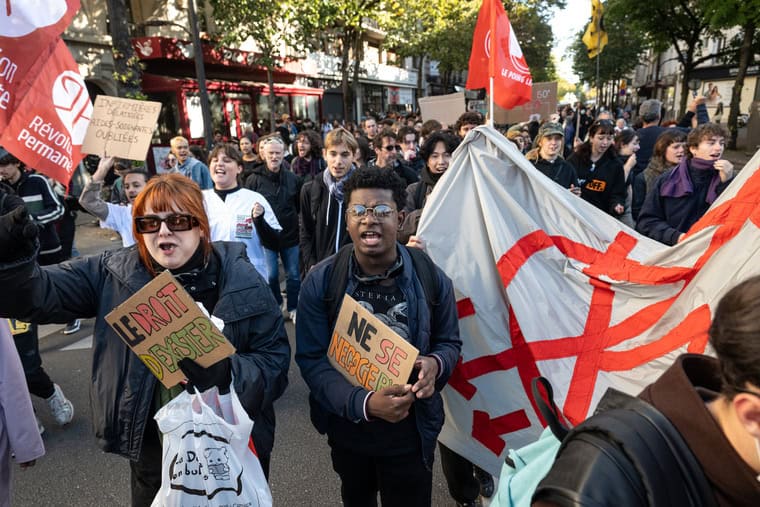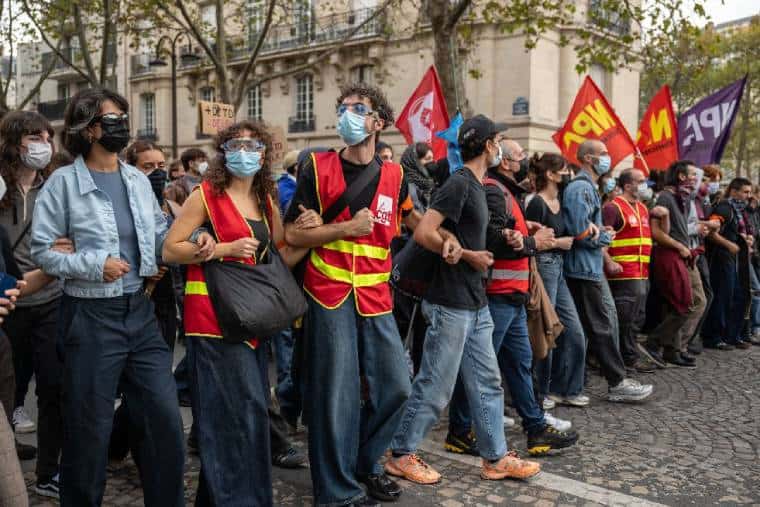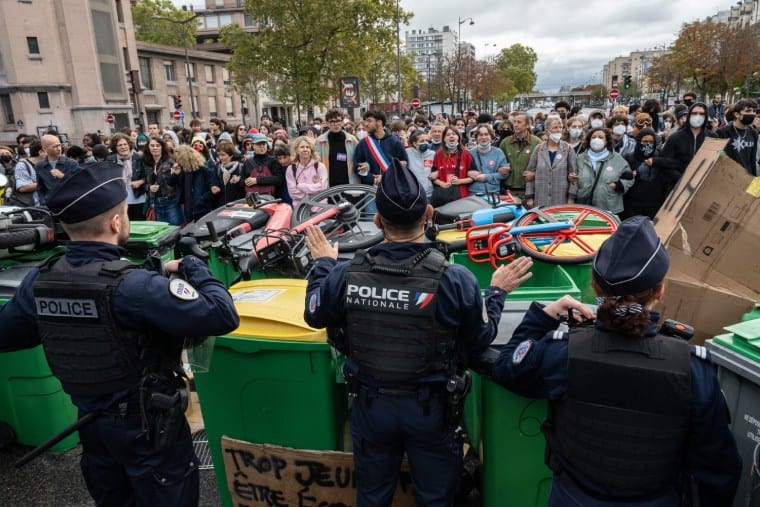
On the streets of Paris ahead of the march on Tuesday (Picture: Guy Smallman)
Young protesters rocked France on Tuesday in another round of militant protests.
The movement of blockades that started in secondary schools in the poorer suburbs of Paris has spread across the country, pulling in university students and workers.
School blockades took place on Tuesday ahead of mass marches across the country that were joined by union members. At Hélène Boucher school in Paris, hundreds gathered at the entrance to the building, blocking it with green plastic wheelie bins.
When the signal was given, they took their barricade into the road to block Cours de Vincennes, one of the main routes through the city. The students outnumbered police, who were forced to direct traffic around the main junction in all four directions as they awaited reinforcements—which eventually arrived in the form of several van loads of CRS riot cops.
“We hope for the resignation of Emmanuel Macron and his government,” one school student in Paris told Socialist Worker, “As well as apologies to the families of the injured children.
“If I am optimistic, I hope for a revolution, and if we are dreaming, Macron to the guillotine.
“Because we are too pacifist and we are waiting for change from a state that does not listen to us, treats us like criminals and is violent towards us.”
Basile, another secondary school student, told Socialist Worker, “The movement was formed around the blockades. That’s our method of action, and we’re going to continue like that. We know we can’t keep this up forever, but we’ll think about what to do next later.
“Right now, at least until the holidays, we have to stay here. Some people are saying that the unions shouldn’t join us because the movement is student-led, and they’re afraid the unions will co-opt it.
“I also understand that we need everyone to win and that we’re also fighting for public services. I don’t know what I think about it. Because it’s true that to have the strength to continue, it would be good if teachers went on strike a lot and we weren’t all alone in carrying the burden.”
The movement has faced fierce repression from the police and some young people have been left with horrific injuries. They include a 15 year old whose hand was blown off and a 14 year old with a fractured jaw after being hit in the head by a tear gas grenade. There have been over 6,000 arrests since the movement began last month, mostly of under 18 year olds.
Late on Thursday last week, the state pledged to send 3,000 more teachers to the schools as an emergency measure to fill staffing gaps. But the government’s measures have done little to quell people’s anger.
They mean little when prime minister Sébastien Lecornu is trying to push a budget through in parliament that promises £46 billion worth of cuts.
“We need all the workers to join the students,” student Hélia told Socialist Worker on the Tuesday morning blockade. “We need everyone to converge in our fights. And we need to go as far as we need to get what we want.
“I want to see all the union federations, the left parties join. We want their help. We desperately need them because we are students and it’s been two and a half weeks already of us blocking everything.”

Students, parents and workers link arms outside the school on Tuesday (Pic: Guy Smallman)
Hélia explained that police have targeted certain neighbourhoods more than others. He said, “We don’t see a lot of police brutality. It’s only when we block the whole road. But in the poorer suburbs they do what they want. They hit everyone, they shoot with flash balls. The police are racist, homophobic, transphobic.”
Emily, a young worker for a not for profit organisation said, “It’s important when you are an adult to come to these things and to support them, because I know it can get a bit rough. Even apart from the physical violence I know a lot of students are getting tired.”
“I’m also part of an anti-fascist group from this neighbourhood. Being here is a way to talk about this with them, talk about the upcoming presidential election with a far right party in the lead. That’s also something we have to fight collectively.”
Danielle Simonnet, a member of the French parliament in the left wing party L’Après, was also at the school to show her support for the students.
She told Socialist Worker that students’ demands go beyond wanting more funding and teachers in schools. “It’s like ‘68. It’s a historic movement. In every country around the world young people are for Palestine. In every country young people are for the climate. And on every demonstration we are against the Rassemblement National, against the extreme right, against racism and against antisemitism. We are for equality.”
CGT general secretary Sophie Binet has raged against the state repression of students whose futures are being stolen.
She said, “Rarely have the living and studying conditions of young people been so degraded. This generation has grown up with the climate crisis, terrorism, Covid, wars, and now the prospect of a world of work disrupted by artificial intelligence.”
Olivier Clément from the CFDT union federation in Paris told Socialist Worker, “It’s important for trade unions to be in solidarity with the high school students’ demands.
“We are there to protect the young people. And, their demands cross ours with some of the same concerns. So, we’ll be in the Parisian streets with young protesters.”
The movement has shown how action by young people can be a lightning rod for wider anger at the system.
Last Thursday huge crowds gathered at the Bastille in Paris where they faced police baton charges.
University students blockaded their campuses and held mass assemblies, including one in Nantes with thousands of people. And some 10,000 people gathered for a rally led by left wing presidential candidate Jean-Luc Mélenchon in the city of Clermont-Ferrand on Sunday.
In Vitrolles, near Marseille in the south of the country, truck drivers have restarted go slow protests bringing traffic to a standstill over rising fuel prices.
This Saturday there are calls for protests over the cost of living, which are drawing comparisons with the Yellow Vest movement that exploded across France in 2018, where tens of thousands of people in high-vis yellow vests took part in road blockades.

Students got to the school to set up blockades from early in the morning on Tuesday (Pic: Guy Smallman)
Some figures on the left have condemned violence from the school students. So Binet says, “We can debate their methods, and we must of course condemn the violence committed against staff or institutions.”
But university students and workers overwhelmingly recognise that the violence comes from the police and want to show their solidarity with the school students.
There are questions about where the movement goes next. After Friday this week, schools will break up for two weeks of holiday. Can the movement of blockades sustain itself?
Will workers join in larger numbers that could really shut down sections of industry and force the government to roll back its budget plans?
And can the movement stop the threat of the fascist RN. School students are chanting against the fascists. But will they march and disrupt their conference on 24 October and stop them from building a base?
All that is possible—but it requires the movement to deepen and develop into a confrontation with the French state and the system it defends.


Workers and students unite in a huge general strike
French students blockade schools ahead of the general strike on Thursday
A necessary step towards working class power