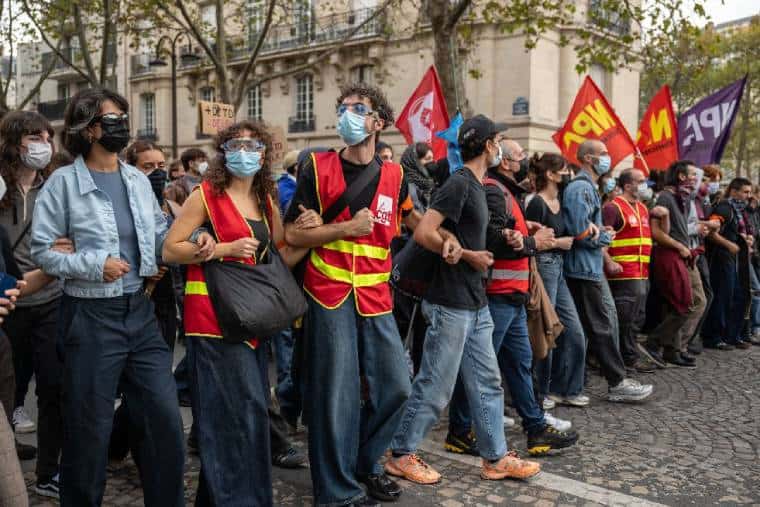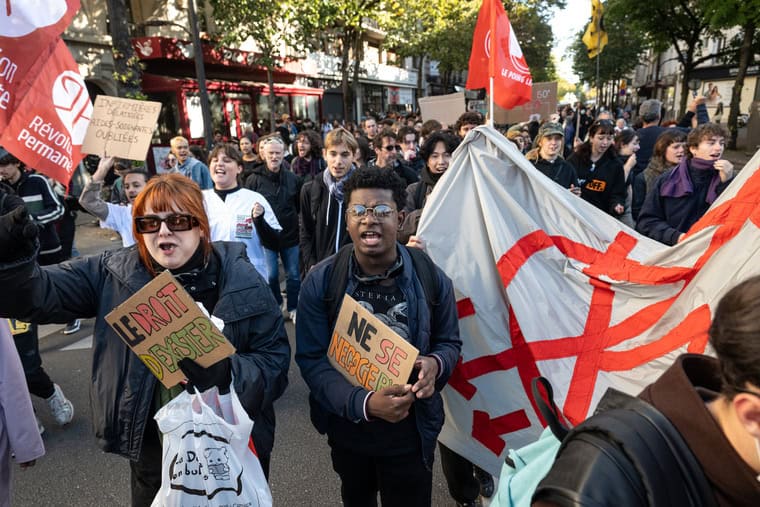
Though the blockades paused, protesters have come out in their tens of thousands (Photo: Guy Smallman)
Revolt is growing in Europe—and workers are showing their power. Hundreds of thousands of workers in France are preparing for a general strike on Thursday (see below).
It comes after dockers across the Mediterranean struck last week against arms sales to Israel and the European drive for rearmament.
The call for the day of action came from dockers in Italy, France, Greece, Turkey, Morocco and the Basque Country in the Spanish state. But it was taken up by workers in the US, Australia, India and elsewhere.
In Spain, rail workers struck for safety last week after the second fatal crash this year.
In Italy, the dockers’ action was part of a general strike called by the smaller USB, ADL Cobas, Clap, SIAL Cobas and Cobas unions.
Roberto is a rail worker and USB union member in Livorno, where some 15,000 people took part in protests. He told Socialist Worker, “It was a major day of mobilisations—it’s likely more than one million people took part.
“Transport workers joined the strike, defying the ban imposed by the minister of transport Matteo Salvini.
“Salvini wielded law 146/90—one of the most repressive pieces of legislation on the right to strike in Europe.”
There is widespread fury with Italy’s far right government, led by fascist prime minister Giorgia Meloni. The protests in Italy, like those in France and the Spanish state, erupted over better funding for education and schools.
But the explosion has fed off the general strikes for Palestine last year.
Roberto added, “The spirit of last year’s Block Everything movement—organised in solidarity with the Palestinian people—echoed again in the public squares.
“This time, the squares were filled with a focus on the cost of living that we, the working class in the imperial heartland, are enduring.
“This is a direct consequence of the wars being unleashed in the Middle East.”
Thousands of workers and students in Turin, northern Italy, rallied against the spike in fuel prices and to oppose rising defence spending.
Leda, who attended the demonstration in Turin city centre, told Socialist Worker that the day’s actions were “heartwarming” with tens of thousands “rising up against this government”.
She said that farmers unloaded barrels of manure in front of Turin’s city hall before the demonstration.
A banner with the inscription, “Stop high cost of living, no to war, no to rearmament. We produce wealth, you thieves of the future,” led the march.
“It was ordinary working class people who showed up,” said Leda.
Police brutality—and ever-expanding state repression—have galvanised large numbers of people. And opposition to the Italian state’s racism runs through the protests.
The government passed a decree earlier this year aimed at capping the number of “migrants” in classrooms to 30 percent and banning the burqa and niqab in schools. Leda said, “One of the biggest topics of discussion has been anti-racism. The young people protesting are being called ‘maranza’ by right wing politicians and the press. The word is a slur used to describe second‑generation migrants.
“There is a connotation that immigrants are causing chaos in cities, that they are the problem.
“But people were carrying signs that read, ‘You call them maranza, we call them by their names’. They are saying we know them, they are our friends—they are all of us.”
The general strike this week follows an eight day strike by lorry drivers in Italy that disrupted fuel and food deliveries.
Leda said that some people who voted for Meloni are now turning on her government. “When the gas prices went up in September, truck drivers in southern Italy went on strike,” she argued.
“They blocked roads in protest because it didn’t make sense to move produce because of high gas prices.
“The important thing for us to do now is to unite the struggles in the south with those in the north.”
Blockades returned to French schools on Monday after a two week break for the holidays.
According to the education ministry, 41 schools were affected by blockades and protests on Monday morning, with more schools joining the movement by Tuesday.
The government has made some concessions. It has promised more teachers, and a cap on the number of students in classrooms, as well as a replacement for the hated Parcoursup university admissions system.
But it doesn’t go far enough to fix the education system.
Across the country around half a million people protested last Saturday for the third weekend of marches in a row.
Authorities in Paris demanded that marchers follow an approved route that avoided the city centre. But some defied these orders.
At the end of the official march a large group headed towards Place de la Bastille before being blocked by the paramilitary gendarmerie.
Protesters fought against the 70,000 cops sent to police them and, in one case, a rioter used a Molotov cocktail.
Six union federations have backed the general strike this Thursday as they face a proposed budget with £45 billion worth of cuts.
The revolt in France begun by the school students has ignited wider anger over the cost of living, war and the fascist threat.
There are important questions about where the movement goes next. Will the school student blockades regain momentum after the holiday break? And will the strike movement be a one‑day event or will workers push for continuous action, known as a renewable strike?


Workers and students unite in a huge general strike
French students blockade schools ahead of the general strike on Thursday
A necessary step towards working class power