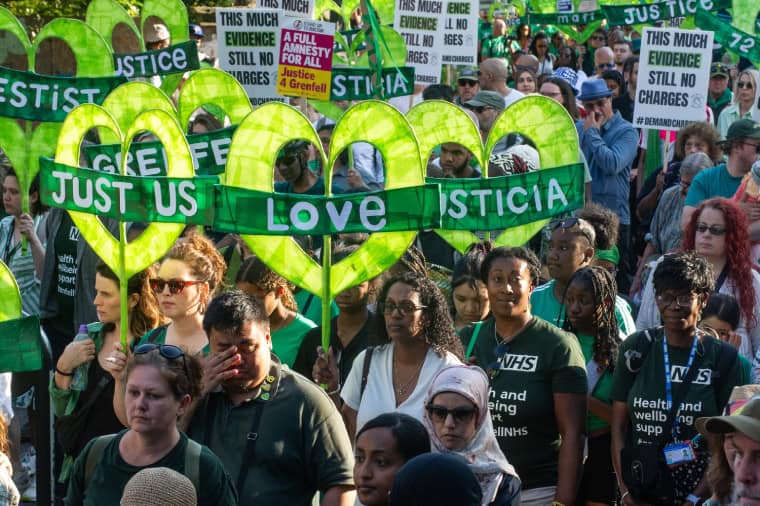
Memorial to the 72 people, including 18 children, who died in Grenfell Tower, 2017 (Picture: Matt Brown)
Six years on from the Grenfell Tower fire that killed at least 72 people, there’s no guarantee a similar tragedy won’t happen again. Another fire may differ in detail, but the lack of care and regard for the lives of ordinary people from construction companies and housing bosses hasn’t changed.
Despite an ongoing public inquiry, six years on, not one person responsible has truly paid the price for what happened at Grenfell. Some measures have been introduced by the Tories to respond to the lessons of Grenfell—but too slowly, and not enough.
Deputy editor of Inside Housing, Peter Apps said at a book launch recently, “Grenfell can feel like a past story—it’s not. It’s something that needs to be kept in the public eye if we want to see the companies responsible held to account.”
He said the inquiry, announced 24 hours after the fire, “has been a process to slow down the process of change”. “The fact this evidence is in the public domain gives us the best possible chance that there might be justice—but whether that happens, I don’t know,” he added.
The second stage of the public inquiry into the blaze won’t release its final report until next year and prosecutions, if any, won’t start until after then.
The Grenfell Tower fire was the result of profiting, negligence and a lack of regard for people living in social housing. A raft of construction companies, regulators, the Tory-led council and the government have blood on their hands.
Residents’ concerns about the 2015 refurbishment were purposefully ignored, despite a residents’ blog warning of a “future major disaster”.
Companies such as Arconic, Celotex and Kingspan knowingly made and sold insulation and cladding that was as flammable as petrol. Apps said, “That’s the most shocking thing to come out of the inquiry.” He added, “The emails were worse than that—Arconic was fully aware of the consequences.” One email even estimated that its product would kill “between 70-80 people”.
A Fire Safety Act came four years after the fire. This included providing the fire services with floor plans and building material information and checking lifts and fire doors—things not provided for Grenfell.
But more is needed to implement real change and save lives. The government said it will finally introduce measures that mean buildings over 30 metres must have two staircases. But there are no regulations to ensure fire alarms in high rise buildings.
Sprinkler systems were also supposed to be introduced in buildings taller than 11 metres. Back in 2013, the coroner’s report into the 2009 fire at Lakanal House that killed six, recommended sprinklers in all high-rise buildings over 18 metres. That hasn’t happened.
Show Me The Bodies: How We Let Grenfell Happen tells the story of Grenfell and the people who lived in it. At a book launch last month, author and Inside Housing deputy editor Peter Apps explained how despite glaring opportunities to avoid the tragedy, the government failed to act.
“Grenfell didn’t have to happen,” Apps said. “This was a problem people were worried about—adding combustible materials onto the outside of buildings.
“The book brings together the story that has emerged about how a tower block in one of the richest parts of the richest cities in the world clads a building in material that is chemically similar to petrol.”
In 2001 a 30-minute government funded test of ACM cladding had to be stopped after nine minutes because the flames reached 20 metres high. Sixteen years later it was burning on the walls of Grenfell.
Apps said the cladding “tells us something quite important about the country we live in”. From the rule of Margaret Thatcher in the 1980s, the aim was “minimum interference and maximum self-regulation” for the construction industry.
That meant the people doing the checks on safety were the people who wanted to profit.
The book also details how the council and its tenant management organisation ignored tenants’ warnings. Instead they labelled them “troublemakers” when they raised concerns about the refurbishment of the tower from 2015.
And the book looks at how companies knew their cladding was deadly. “They knew what they were doing, but they were able to manipulate the regulatory regime,” Apps said. Show Me The Bodies is important reading to understand the failures and to remember the victims.
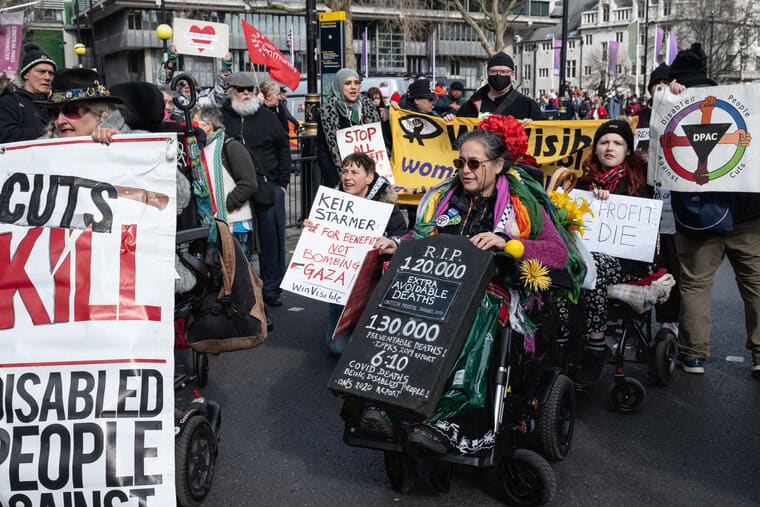
Some 40 percent of Grenfell residents who were disabled people died in the fire. The first phase of the inquiry was clear that high-rise building owners had to have personal emergency evacuation plans (PEEPs) for all disabled residents.
But this time last year, the Home Office revealed it wouldn’t go ahead with this to “cut costs”. It claimed there were “significant issues” with the “practicality, proportionality and safety” of PEEPS.
The disabled residents that died had no individual plans to aid their escape, so were forced to “stay put”. The controversial stay put policy, which was kept on Grenfell for over an hour and a half despite the out of control fire, is still in place.
In September 2018 the government banned combustible materials on the external walls of new blocks of flats, hospitals, care homes and student accommodation over 18 metres high. That means no cladding, insulation or other materials on the outside of the building can be flammable.
A row continues to rumble over who should pay for removing the cladding from residential buildings, whether the developer, government or flat owner. It should be the developers. Over 94 percent of the 486 buildings over 18 metres in height with dangerous ACM cladding—which was used on Grenfell—have either started or completed work.
Remediation cladding work is supposed to begin on buildings between 11 and 18 metres high—but it hasn’t yet. After the fire Dame Judith Hackitt published a report that found the entire building regulatory system was “not fit for purpose”.
Renationalising bodies such as the Building Research Establishment, the National Health Building Council and the British Board of Agreement would prevent these regulators kneeling to big companies, as was the case for Grenfell. This way they may scrutinise their clients rather than worry about losing business.
For many living in unsafe tower blocks, they fear dying in a blaze, but lots have no option but to stay put. It’s a disastrous scenario that needs urgent change.
Housing activists are fighting local councils for staircases, sprinklers and PEEP plans are ongoing. But this needs to be part of a bigger fight to demand fire safety in all high rise buildings now.


Disabled journalist John Pring spoke to Socialist Worker
So much more is possible
Activist for Grenfell justice speaks out
Educational support services are severely underfunded