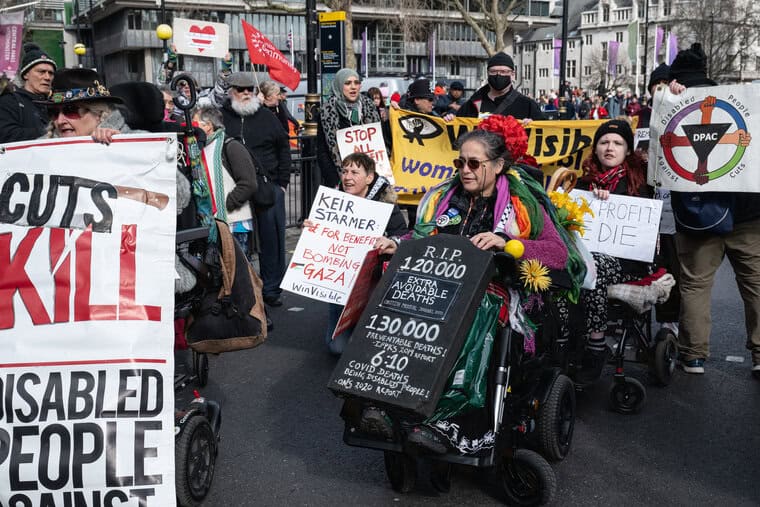
Disabled People Against Cuts (Dpac) protesting against excess benefits deaths in March (Picture: Guy Smallman)
For more than ten years disabled journalist John Pring has been piecing together a story comprising hundreds of deaths. As founder and editor of the news agency Disability News Service, John could see a pattern in suicide notes, coroners’ reports and family statements.
And it became clearer the more he heard disabled activists talking about the governmental department responsible for benefits—the Department for Work and Pensions (DWP). The death toll mounted after Tory austerity took hold in 2010. John saw that a combination of toxic DWP culture, scapegoating politicians and a profit-hungry private sector lay behind the deaths.
I think it’s recklessness and negligence—and there’s bags full of evidence to support that in my book. What drives that negligence goes back a long way. My Year Zero for this is 1989. A secretary of state wrote a memo to John Major, who was at the time Chief Secretary to the Treasury. It said the time to cut spending on disability benefits is now. Within the next few years, the state began to develop its new benefit assessment processes.
That in turn is the grandfather of everything that followed later. In part, negligence results from the culture within the DWP. It believes that many people who claim disability benefits are “scrounging” or “shirking”. The word actually used in a DWP-sponsored conference was “malingering”—and that has been used officially time and again.
The idea behind it is that disabled people are “skiving-off” when they really should be working, even though there’s hardly evidence for this. The DWP’s own figures show that in 2023-24 over-payment of Personal Independence Payment (Pip)—a key disability benefit— due to fraud amounted to just 0.3 percent of claims.
The years of New Labour, that came after the Tories, were slightly different. The government decided that welfare reform was something it should do early to show that New Labour was different from “Old Labour”. New Labour wanted to be seen as “tough” on disability benefits. I have a Cabinet Office memo from Tony Blair in 1997 in which he says, “We have to push on with this because we know we’re right.”
So, there’s the DWP culture and there’s party politics. But there’s also the pressure created by outsourcing. I’ve collected quite a lot of evidence from the National Archives that shows United States insurance multinationals boasted about driving the government towards “benefit reform”. There’s not one single reason for the system’s negligence. It’s a number of things coming together.
That’s a crucial question as Labour faces important issues ahead. For example, what is it going to do with the Personal Independence Payment? Will Labour proceed with the Tory plan to make Pip’s Work Capability Assessments tougher?
What will it do about benefits sanctions? And what will it do with the nightmare of Universal Credit which is now causing genuine safeguarding problems? I’ve covered three suicides related to Universal Credit in the last few years.
It is the background to everything since 2010. That was the year of the first death I write about in my book, which was connected directly to the Work Capability Assessment regime. And it continues today. People fear the arrival of the DWP “brown envelope” through their letterboxes.
They see the letters as state malice against them and their claims. The mainstream media has also played a massive role in increasing that sense of dread. It was happy to blame disabled people for the country’s economic problems. That blaming didn’t just happen under the Tories, it happened during the New Labour years too.
Newspapers were running all these stories that linked disabled people to the economic crisis during a time when there was a rise in government spending on benefits. That can’t be a coincidence. It’s obvious that government ministers were prodding them.
Disabled people have been fighting back for 14 years. Right from 2010 they were a big part of the big, anti-austerity marches and other protests. Activists formed groups such as Disabled People Against Cuts (Dpac) and Black Triangle Campaign, campaigned with the “War On Welfare” petition and used direct action.
There’s been a lot of activity and people are still fighting 14 years on. Part of the problem is that the mainstream media hasn’t been listening. Occasionally, there will be articles in the Guardian and Mirror newspapers about actions by Dpac. But in general, the media ignores disabled people’s fight. Socialist Worker, Morning Star and Big Issue do some very good coverage.
John McArdle, who founded the Black Triangle Campaign, raised more than £7,000 through crowd-funding. That money will ensure that a copy of my book will be given to every Labour MP at the start of the new parliament. That means those MPs will have no excuse for ignorance. They won’t be able to say we didn’t know how disabled people are being treated—because it’s all there in the book.


So much more is possible
Activist for Grenfell justice speaks out
Educational support services are severely underfunded
Cyber-warfare is a ruling class tool