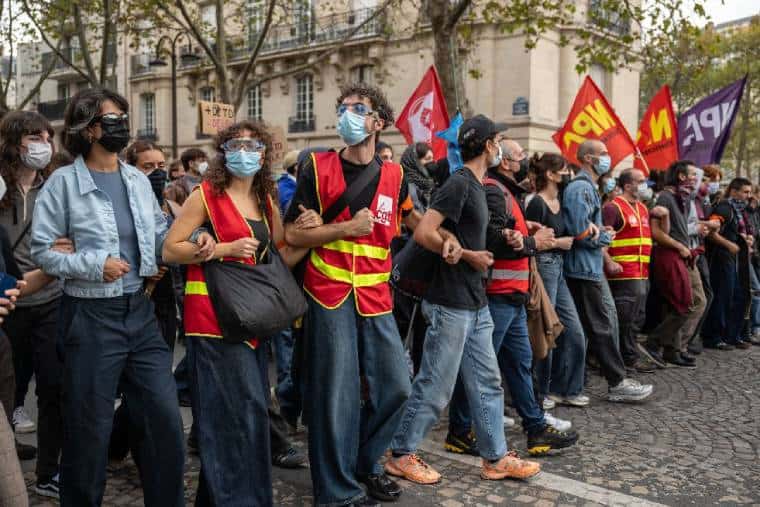
Women and men stand together against sexism at King George Medical University hospital in Lucknow as part of the Indian doctors’ strike (Picture: @drsfaizanahmad on Twitter/X)
Over a million doctors in India shut down the health service on Saturday in protest at the rape and murder of one of their colleagues. Their strikes show the power of workers and how it’s possible to effectively fight for women’s liberation.
The doctors ended non-emergency treatment across India with a 24-hour shutdown on Saturday. They are fighting for better workplace safety—and against a justice system that often lets perpetrators walk free.
Strikes and protests have swept India after the rape and murder of a young doctor in Kolkata, west Bengal. She was found on 9 August, half naked and with extensive injuries after going into a seminar room to sleep the night before.
The doctor was discovered, dead and mutilated, on a blood soaked mattress after going to sleep during her shift.
A police volunteer has been arrested, but the victim’s family believe more people were involved.
The Central Bureau of Investigation has taken over the case after accusations the local police force wasn’t handling the case properly.
“Doctors, especially women, are vulnerable to violence because of the nature of the profession,” said the Indian Medical Association. “It is for the authorities to provide for the safety of doctors inside hospitals and campuses.”
In Mumbai, protesters held up placards saying, “No safety, no service,” “Rage against rape,” and “Her pain—our voice.”
In Delhi, chants of “we want justice” echoed through the streets and doctors held up signs saying, “Will we ever be safe?” and, “We deserve safe hospitals.” Police detained some 1,500 people in West Bengal during the protests.
“As a woman, it boils my blood,” said Dr Richa Garg. “The culprits of this crime should be found immediately—and our workplaces should be made safer.”
Dr Smita Malhotra, a paediatrician in Delhi said, “This incident is reflective of the rot in our society, of the disrespect there is towards women and towards the profession itself. “The attacks on doctors are increasing day by day and they are getting worse.”
The strike continues in some hospitals. In Gujarat, more than 6,000 doctors struck for a third day on Sunday.
Members of the All India Residents and Junior Doctors’ Joint Action Forum said on Saturday they would continue a “nationwide cease-work” with a 73-hour deadline. It is calling for a thorough inquiry and arrests.
Even far right prime minister Narendra Modi was forced to acknowledge the uprising during Independence Day celebrations on Thursday of last week. “There is outrage against this in the country. I can feel this outrage,” he said.
Despite a reluctant and mealy-mouthed acknowledgement from Modi, doctors are coming under pressure from the state and from armed thugs.
At the Lady Harding Hospital in Delhi, cops locked the gates to prevent doctors from marching. And at the RG Kar Hospital in Kolkata—where the doctor was murdered—a gang of thugs set upon protesting doctors and ransacked the emergency department.
Despite this, women are taking to the streets in huge numbers. Tens of thousands of women marched through Kolkata on Wednesday night of last week. Smaller protests were held in many other Indian cities such as Delhi, Hyderabad, Mumbai and Pune.
Many in Kolkata held burning torches on the “Reclaim the Night” march. “We seized the night,” said protester Chaitali Sen. “We’ve never seen anything like this in the city. This is unprecedented. I hope it wakes up the authorities.”
The strikers and protesters know that it is possible to win their demands. The gang rape and murder of a student in 2012 sparked huge protests, eventually leading to sweeping changes in the criminal justice system.
Today’s movement has quickly broadened out to include demands that don’t just relate to the horrific rape and murder in Kolkata. It’s about a wider sense of injustice—and an explosion of anger about the fear that women are forced to experience.
In using their collective strength and class unity, doctors in India are showing how it’s possible to fight for real change. It is a striking example about how collective action can transform the horrors of violence and oppression into a movement dominated by solidarity and resistance.


What causes violence against women?
Is patriarchy the road to women's liberation?
Plus: How socialists can mobilise large numbers of people
A necessary step towards working class power