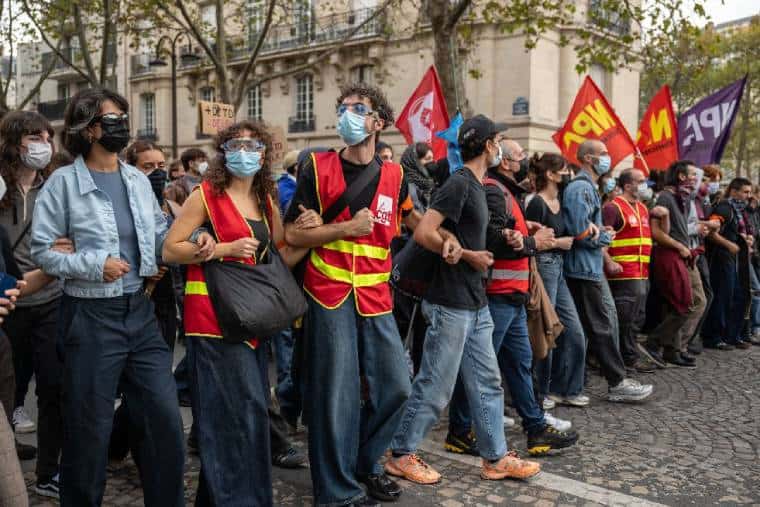
Palestine solidarity protesters rage against Keir Starmer and Labour (Photo: Alisdare Hickson)
Less than a year after a landslide victory, the Labour Party faces a deep crisis.
Even before Labour’s victory, Keir Starmer was a hate figure for tens of thousands of people because of the party’s support for Israel’s genocide. But almost every move that Starmer has made since has widened the gulf between Labour and millions of working class people who believed the slogan of “change”.
Did you hope for a break with Tory austerity and the scapegoating of disabled people? Did you think there would be more action on climate change? Did you expect Labour to stand up to Nigel Farage’s lies about migrants?
Then Labour has made it clear it’s not on your side. But how should the left respond? And what challenges do we have to overcome to build a fightback?
Starmer’s betrayals are part of a right wing trajectory in Labour’s history and flow from the nature of the party. A hundred years before Starmer’s victory, the first Labour government set the mould for the future.
Labour was elected on a wave of hope for “change”. But prime minister Ramsay MacDonald’s preoccupation was proving Labour was “fit to govern”—and that meant leaving wealth and power untouched.
Promises of a wealth tax, nationalisation and public works programmes to reduce unemployment were quietly dropped.
Instead, this was a time for “tough choices” as there was a financial blackhole to fill.
Margaret Bondfield, a future Labour minister and union official, said, “We have taken over a bankrupt machine and we have to make that rickety machine work again.”
The first Labour government was brought down in a no-confidence vote by MPs less than a year after taking office and lost the general election.
The Labour Party’s electoralism is important to explaining its rightward shifts. If the main goal is forming a Labour government, the logic is to search for more votes in the “centre” of politics. And so, the justification goes, you have to tone down left wing policies.
But winning votes is not the key driver behind Labour’s betrayals. After all, a lot of the attacks that MacDonald, Starmer and other Labour prime ministers have pushed have damaged them electorally.
The problems flow from “Labourism”, the idea that parliament is more important than working class struggles outside of it to winning change.
This ideology is linked to the roots of Labour and its orientation on the state. It was set up as the political expression of the trade union bureaucracy, a social layer that negotiates between workers and bosses.
While the party has articulated working class hopes of a better world, it aims to take the reins of the British state and rule in the “national interest”.
The trouble is that there is no such thing as a national interest between bankers, bosses, landlords and working class people.
When politicians and pundits talk about it, they really mean the class interests of big business. Have you ever heard anyone say it’s in the “national interest” to pay people a living wage? No. But your pay or benefits being held down always is.
Any attempt to rule in a “national interest” means working within the parameters of what big business will allow. And the British state is a capitalist state which works to protect their system.
The scale of what Labour delivers is linked to what the super rich deem acceptable—and how scared they are of working class struggles outside parliament.
This contradiction between class and nation is at the root of why Labour fails. The scale of what Labour delivers is linked to what the super rich deem acceptable—and how scared they are of working class struggles outside parliament.
The 1945 Labour government was the high point of social democratic “reformism”. It brought in sweeping changes from setting up the NHS and vastly expanding the welfare state to nationalising key parts of the economy.
At the time, ruling classes across Europe feared revolt from below if they didn’t allow far reaching reforms that they’d previously resisted.
There were still limits to what British capitalists would allow—and Labour still wanted to show it was “fit to govern”.
It used the military to break strikes. And it ended up implementing austerity to pay for British involvement in an imperialist proxy war between Russia and the US in Korea.
Yet the system had a much greater capacity to allow reforms without upsetting profit-making.
That was underpinned by the “long boom”, an unprecedented period of capitalist growth that lasted until the early 1970s.
But when the system goes into crisis, its ability to allow reforms diminishes. Since the 1970s ruling classes pushed neoliberalism, free market policies and dogma designed to boost profitability through squeezing working class people.
For the last three decades, Labour has seen itself as a better, fairer manager of neoliberalism. It sought to become, in the words of Labour-supporting author Jeremy Gilbert, the “corporate social responsibility department” of capitalism.
Today, Starmer has surrounded himself with the ghosts of the Tony Blair era, such as Peter Mandelson. But he’s offering even less than back then.
Under Blair, Labour encouraged a financial boom and used the tax revenues from growth to spend more on the NHS, schools and public services.
The situation is very different today. While Starmer and chancellor Rachel Reeves promised to use the state to boost growth, the malaise of British capitalism means they have little room for manoeuvrability.
The whole system is crisis. Big business is willing to allow very little right now and is demanding Labour waters down the mildest of reforms that could put up barriers to profit-making. And Starmer is happy to oblige.
But why has the right been the beneficiary of Starmer’s failures so far? Labourism runs deep on the British left and labour movement—it holds back and shapes breaks from the party.
The contradiction between class and nation within Labour leads to the party’s left right divide.
The left will emphasise standing up for workers while the right lecture about the need to show Labour is “respectable” and “responsible” enough to run the British state. But both wings of the party are wedded to Labourism.
This means the Labour left seeks unity with the right in the name of having a united party that can win elections. That proved fatal during Corbynism.
Only seven MPs rebelled against the two-child benefit cap and were suspended from the Labour Party.
Only five of them voted against scrapping winter fuel payments. None broke to join Jeremy Corbyn, and many were desperate to get back into Labour. It repeats a historical pattern in Labour.
One of the most significant left wing splits came in the 1930s with the Independent Labour Party (ILP), an affiliate of Labour.
At one point it had over 16,000 members and the backing socialists such as George Orwell. The ILP had hesitated from breaking with Labour at every turn—it was the Labour leaders who pushed it to leave.
It didn’t have the roots to build an alternative and wasn’t able to overcome the obstacles of the trade union bureaucracy. It had adapted to the politics of Labourism. It was too focused on parliament and not enough on agitation outside and eventually disappeared as a force.
Any such break would be a massive step forward today. The problem was that it did not break radically enough with Labour—it broke organisationally but not politically.
A break from Labourism would mean seeing working class struggle as most important in winning change. It means subordinating electoral and parliamentary calculations to boosting the confidence and organisation of the working class to fight.
At all the key points in history, unions leaders have held back struggle to protect “our” Labour government
Here, the trade union bureaucracy is a major obstacle that has held us back. It has played a conservative role and vacillating role whether in the strike wave of 2022-23 or in the Palestine solidarity movement.
It’s tied to Labourism and sees electing a Labour government as the main way to win political change. So, at all the key points in history, unions leaders have held back struggle to protect “our” Labour government.
After Labour’s election victory, most union leaders welcomed Starmer as “our” government and called on people to be patient.
But there are tensions between Labour and the unions because of how right wing Starmer is.
That Paul Nowak, head of the TUC union federation, openly came out against Starmer over the attacks on disabled people reflects the scale of anger.
This doesn’t automatically mean they’ll lead a fight, but it shows they’re open to pressure. It will take grassroots activists organising at the base to push union leaders to action whether over pay, Palestine or taking on Reform UK and racism.
It means opposition to pay deals below the RPI rate of inflation. It means arguing for escalation in the Palestine movement that combines mass and militant action. It means ramping up action against Starmer’s arms spending and welfare cuts around the slogan welfare not warfare.
The Summit of Resistance in London this Saturday is our chance to break the deadlock and lack of a left response to Starmer. It’s the place to organise to overcome the obstacles of Labourism and the union leaders that hold back the fightback we need.
Summit of Resistance, we demand change | Saturday 29 March, The Cause, 60 Dock Road, London, E16 1YZ | 11am-5pm | Book your place at https://wedemandchange.uk


A necessary step towards working class power
Glasgow service users and workers speak out
An interview with historian and author Martin Empson and a review of the new film The Uprising