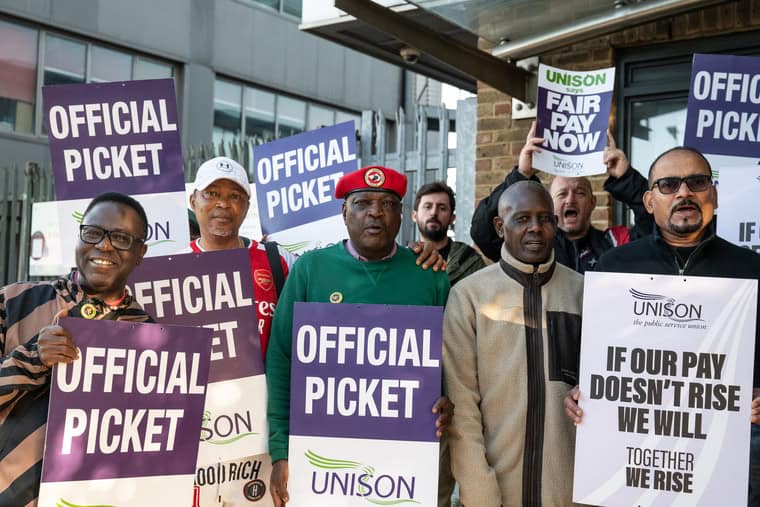
Liverpool dockers and their supporters mount the picket line.
Long and unsociable hours, dangerous conditions and low pay. This is the reality for Liverpool dockers. They have a simple demand—for Peel Ports to give workers a pay rise in line with inflation. And they’re furious that their bosses are continuously pumping out lies, from what they claim the dockers earn to the wage packages they offer.
Jim, an engineer at the dock, told Socialist Worker, “We’re fed up with Peel making huge amounts of money. They’re not sharing those profits with the workforce. It’s just utter greed. Their priority is the shareholders, not us. Yet 18 months ago we were key workers. People are now saying enough is enough.”
Engineer and Unite union rep Phil added, “The whole world is suffering with price rises. Our employer can well afford to give us the deal we want. It’s trickle up economics.”
Steven, a port operative and rep, told Socialist Worker, “They devalue us—allowing us to make this stand while they’re raking it in. We’re sat 200 foot up in the air with winds up to 50 miles per hour carrying 40 tonne containers. One false move and you could kill your workmate. We work in the snow, wind and rain. We just want a bit of respect for what we’re doing.”
Peel Ports grabbed profits last year of £141 million, enjoyed by 12 shareholders. The demands of workers would cost just six days of the company’s annual profit. There is more than enough cash to settle the pay for the 580 port operatives—responsible for loading and unloading cargo from ships—60 engineers and 40 controllers.
Hazardous weather makes life dangerous for dockers. Huge straddle carriers—which carry the boxes around the port—have been known to fall over. Workers have lost fingers in accidents—or slipped discs in their backs from falling on icy ships. And during the pandemic, the port, usually at 85 percent cargo capacity, was pushed to 115 percent—limiting room to move around safely.

But the workers are united on the picket line—and describe their relationship as “like a family”. Port operative Louis told Socialist Worker the pickets have been “fantastic”. Cars and lorries constantly beep to show support for the strikers who keep up a picket for 24 hours a day. And music, burgers, flags and political conversation keep the pickets lively.
“We’ve all met and got to know people we don’t necessarily cross paths with every day at work,” Louis added. “We’ve had delegates from Chile, Sweden, Spain, Denmark, Portugal and America. And a lot of support from Australian dockers.”
This week is the fifth week of action—and the strikers have made it clear they won’t stop until they win. Meanwhile the dock stands still.
Steven said, “We’re being told the business is failing and haemorrhaging money. The question I’d like answered is if you’re a director of a business like that, how can you be paid a £600,000 bonus?
“It’s ridiculous. People above us can still take what they want, but expect us to take a real terms pay cut.”
Louis added, “We’re already struggling to survive working 60 hours a week, and we’ll continue to struggle more. We spend more time at work than we do at home. We shouldn’t be going home at the end of the week still skint.”
Despite the dockers often working overtime, if the extra hours roll on to the next week they are not paid as overtime as pay is calculated by the week. And the expected hours mean dropping family or childcare commitments, or struggling with physical and mental health to be able to keep up.
Louis slammed the “stubbornness” of Peel bosses. “We’re not greedy dockers—we want people to know the facts.” RPI inflation—taking into account housing costs unlike Peel Ports’ preferred lower CPI rate—is now at 12.6 percent.
“They haven’t offered us 12 percent,” Phil explained. “I’ve got a letter from the port director—engineers were offered 9 percent.”
The latest deal Peel Ports offered—which the strikers rejected—was a 9 percent increase on basic pay. It included extra for night shifts and increases that were supposed to be implemented in last year’s pay deal. Peel then offered 10 percent and to postpone redundancies it threatened. This offer was pulled by the board. On top of this, bosses are claiming the strikers earn more than they do.

Steven explained, “They’ve collated everyone’s P60s from last year and created an average of £43,000. Firstly, that is not the average. Secondly last year distorted hours because of Covid.” The workers are clear they want an increase in line with RPI. “That’s the bare minimum,” Steven explained.
“David Huck—Peel’s COO—is coming out in the press fabricating the truth and making us look worse. We’re struggling a bit to get our message out in the mainstream media. BBC, ITV and the Liverpool Echo are based on land owned by Peel in Media City in Manchester.”
The meagre wages workers get means that for the lowest paid, Unite’s strike fund gives them more money on the picket line. “Around 40 percent of us are shiphands—entry level labourers doing the hard work, picking up £371 a week. With strike pay, they’re £27 better off outside of work,” Steven explained.
“Huck’s citing figures for £43,000 for basically working a full and part job in the same place. The maximum salary you can earn is £36,200. An average of £43,000 is ridiculous.”
Some directors handed themselves a 50 percent pay rise on their salaries or grabbed £4 million in dividends. Huck has £100 million investments in the tax haven of the Isle of Man.
Striker Leo told Socialist Worker, “They’re overpaid and yet don’t understand the job because they’ve never worked it. People are doing long hours and still having to use food banks—no one should be having to do that. We’ve been helping the company by working days off. But they don’t want to pay us—it’s one way traffic.”
During the docker’s third week of strikes, bosses announced 132 redundancies in a so-called bid to save money. The company has tried to claim the redundancies are not to do with the strike, “but they came out as soon as we went out on strike”, Phil said. “And that was on Mental Health Awareness Day.”
Jim added, “As long as redundancy is on the table, it’s not going to progress. We’re not going to come to an agreement when they’ve played a very dirty, typical management tactic.
“The company issued whistleblowing hotlines and said to call if you felt you were being intimidated when back at work. I felt like phoning up and saying I’m being intimidated by my employer. They’re insulting me with a derogatory pay rise then threatening me.”

Steven called the redundancies a “scare tactic”. “We understand there’s a bit of a downturn, but in ten years I’ve seen it go back up again. “We’re a union, so it doesn’t matter if someone has been here ten minutes or ten years. If they make compulsory or statutory redundancies we’ll be fighting 100 percent.”
To intimidate the workers, the company rang individuals between strike weeks asking if they would be willing to cross the picket. Dockers say Peel could save money by changing the rotas to four days on and four days off, rather than five on and three off.
“We are guaranteed 40 hours pay in a week, but there’s a flex on us because we’re available for 60. But they know they haven’t got the labour to be able to staff four on, four off shifts,” Steven explained. “They’re just about staffing five-three, and we’re working left, right and centre to help cover the jobs and they’re now threatening us with redundancies.”
Louis added that the docks import and export cars, but an agency is hired to drive them on and off ships. “We could do that,” he said. “Peel’s prices went up nearly 300 percent during the pandemic, and our wages didn’t go up anywhere near.
“They were charging extra so if there is a crash in the economy it’s companies like Peel Ports that have caused it. All they’ve done is prosper off the back of our hard work. Now we’re being punished because we want fair pay.”
For Louis, a victory would be “fair pay for all of us—and not just an average pay, it needs to be a specific pay rise for all of us”. Currently, different skill levels in the same job role are paid the same—as are different roles at higher skill levels.
“We also want the 2021 pay deal honoured that dealt with this, as well as this year’s cost of living pay rise backdated to earlier this year. That’s all we’re asking for. We could delve into all sorts on how much other dockers are paid for the same positions and demand pay parity.
“We’re asking to break even and live how we lived last year—and our names not be slandered in the press. If they really gave us £43,000 there wouldn’t be a soul on the picket line.” And with so many other workers on strike, this “shuts down the ‘greedy worker’ narrative”.
“We’ve been under a Tory government for 12 years. We should be out in the streets. As a country we need to become stronger and more militant—or we’ll get another round of austerity.”
The dockers are resolute in staying on the picket line until their dispute is won. Having struck for two weeks, followed by another week, they plan to return to work after the current two weeks of strikes and come out again.
Some worry that all-out strikes will give bosses the opportunity to hire scab labour. But extended periods out of work will mean damaging the bosses more—and gives them less chance to play catch up.
The strikers are also targeting Peel sites and their shareholders and corporate partners. They’ve protested outside Media City, Doncaster Airport and Peel’s biggest customer shipping line Atlantic Container Line, with more planned across the country.
Liverpool dockers also visited Felixstowe dockers, who were on strike first. Despite some coordinated strike days, redirected cargo from Liverpool was handled in Felixstowe.
Phil explained, “Before we went on strike, we were going to coordinate with Felixstowe so that couldn’t happen. But they’re in the same union, so I don’t understand why that happened.” Liverpool dockers should take their case directly to Felixstowe workers.
Dockers in Hull, Teesport and Southampton have agreed not to touch Liverpool’s cargo. Other ports must show the same strength as Liverpool—and coordinated action would hit the bosses harder still.


Jude Mckechnie spoke to the workers leading the fightback against outsourcing
Judy Cox reviews End Times Fascism by Naomi Klein and Astra Taylor
On the ground in Gosport
Ninety years since the Battle of Cable Street