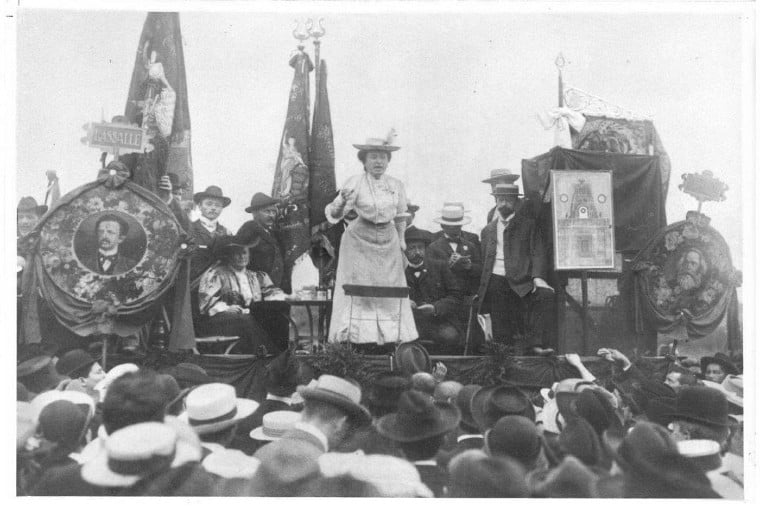
Rosa Luxemburg (right) with German revolutionary Clara Zetkin
In the middle of revolutionary struggle Rosa Luxemburg wrote to a friend in May 1910. “During all of April, I roared through Germany with rallies and public meetings on the electoral issue. Now I am romping around in the press. And always, always in between those things, there was the Russian and Polish work,” she wrote.
“There’s always enough to do. But I am personally satisfied because, after all, I enjoy life most in the midst of the storm.”
The period of Luxemburg’s life from 1910-19 is marked by workers’ struggle and revolution. A newly published fifth volume of her written works details this fascinating part of her life.
Luxemburg was born in 1871 in Zamosc, an area of Poland that was ruled with an iron fist by the Russian Tsar.
She was left disabled after a childhood accident. And she was Jewish at a time of virulent antisemitism. She faced sexist abuse, from both reactionaries and from men in her own party.
But she defeated all these obstacles to become one of the most inspirational of all the great revolutionaries.
Luxemburg was still a teenager when she became an active revolutionary. At just 22 she co-founded the Socialist Party of Poland and the Kingdom of Lithuania.
Still in her 20s, she moved to Germany and became the leading revolutionary voice in the largest socialist party in Europe, the Social Democratic Party (SDP).
Luxemburg was swept up in the upsurge in working class militancy and suffrage campaigning that erupted across Europe before the First World War.
She argued against the trade union leaders and their allies in the SDP. They saw the mass strike simply as a clever tactic to support parliamentary manoeuvres.
For Luxemburg, the mass strike was the motor of working class self-emancipation. She wrote about the mass strike in the Polish town of Lodz in the summer of 1913.
Her articles are a model of how revolutionary journalists can report the spirit of a strike, put it in a wider historical context, analyse what is needed to win and build solidarity.
Growing imperialist rivalries and working-class resistance led to increasing tensions between the moderate and the revolutionary wings of the SDP.
Both sides fought for influence over the thousands of members and millions of workers who voted for the party. In 1910, Luxemburg broke with Karl Kautsky, the widely respected “Pope of Marxism”.
Kautsky wanted to abandon the SDP’s long-standing commitment to working class struggle and focus exclusively on winning change through parliament.
While Luxemburg waged a battle against the right wing in the SDP, she argued against setting up a more revolutionary party. She explained in a letter that, “The worst working class party is better than none. Stay with the rank and file, that is our duty, we are all soldiers.”
Her commitment to working within the SDP was shattered by the experience of the First World War.
The socialist parties of Europe had for years pledged to stand firm against war and imperialism. But each party found an excuse to capitulate to its own ruling class and pledged its support for the war. Anti-war voices were almost entirely silenced.
In January 1916 Luxemburg, alongside German revolutionaries Clara Zetkin and Karl Liebknecht, set up the Spartacus League to organise opposition to the war and fight for socialism.
The Spartacists were persecuted. They were drafted to fight at the front and faced long prison sentences. Luxemburg spent most of the next four years in isolated in prison.
But she never stopped trying to expose the capitalist death machine and to organise growing anger against the war.
The Russian Revolution erupted in February 1917. It was, Luxemburg wrote, an open window blowing fresh air across the stink of decay that hung over Europe’s killing fields.
The revolution was completed under the leadership of the Bolshevik party in October 1917.
Luxemburg’s writings on the role played by Vladimir Lenin, Leon Trotsky and the Bolsheviks brilliantly combine theoretical insights with a passionate commitment to revolution.
Many socialists agreed with Kautsky when he argued that the Russian working class was too weak to propel the revolution to leap from semi-feudalism straight into socialism.
They said workers must limit their demands so they could make alliances with the liberal middle classes.
Luxemburg denounced Kautsky as the “theoretician of the swamp”. He would be right, she wrote, if Russia was located on the moon. But Russia was in Europe and the revolution could be a prologue to a European revolution.
As she put it, “In Russia, the problem could only be posed—it could not be solved there. And in this sense, the future everywhere belongs to ‘Bolshevism’.”
While she criticised some of the Bolshevik’s decisions, she understood the challenge of building socialism in Russia.
Amid the chaos of imperialist mass slaughter, Russia was breaking free from the iron grip of the most reactionary military power in Europe.
She asked key questions about the Russian Revolution. How could revolutionaries ensure that democracy flourished? Could revolutionaries sign peace treaties with imperialist powers? Should revolutionaries support national liberation struggles or oppose all nationalism?
Luxemburg criticised the Bolsheviks because she was desperate for them to succeed, not because she had a different idea of revolution.
She wrote that the Bolshevik’s “October rising not only salvaged the Russian Revolution, it also salvaged the honour of international socialism”.
In the autumn of 1918, the German army and the navy mutinied. Workers’ and soldiers’ councils sprang up. The Kaiser was driven out. Luxemburg was released from prison on 9 November 1918.
She immediately began to warn that these changes must be the only the beginning. The German Revolution, like the Russian, must go further.
Germany’s rulers turned to the leaders of the SDP to save their system.
Those leaders knew how to loudly proclaim the language of socialism to appeal to workers, while quietly collaborating with the embittered military to repress the real revolution.
This confronted Luxemburg and her comrades with a new situation. She explained how the fighters in all previous revolutions bore their colours openly when they went into battle.
The bourgeoisie was “fighting under another’s flag, under the flag of revolution”. Such deceptions made the creation of open revolutionary organisation central to the success of the revolution.
The new government and the right wing press circulated vicious smears against the revolutionaries. Luxemburg wrote that they were creating a “pogrom atmosphere to politically assassinate the Spartacist tendency”.
Luxemburg’s final articles are full of exhilaration and exhaustion. She points to the urgent need to popularise the aims of socialist revolution and explains how mass action must drive the revolution forward.
The German working class faced the choice of socialism or barbarism. In January 1919 Luxemburg took a leading role in the founding congress of the Communist Party of Germany (KPD).
She tried to educate the new party in Marxist theory while getting stuck into the practical work of the revolution.
The KPD was plunged into a series of heated debates and an attempted uprising which was brutally crushed.
Luxemburg knew that Berlin’s smoking ruins, pools of blood and murdered Spartacists showed the SDP government had chosen to rule by the bayonet. The reformist leaders had denounced her as “Bloody Rosa” and claimed to hate violence. Now they sent paramilitaries to hunt down their former comrades.
With great foresight, Luxemburg saw that the military who were helping the SDP to “get off the hook” today, would want to enjoy the fruits of the bloody harvest themselves.
They would use the SDP to derail the revolution, then seize their chance to overthrow Germany democracy and crush the whole workers’ movement.
Luxemburg was murdered on the night of 15 January 1919. Her last article, Order Prevails in Berlin, was published the day before.
It was a cry of defiance against the treacherous SDP and the counter-revolution. She rightly predicted that future victories would spring from the defeat of the Spartacist Uprising.
Her last published words were, “Order prevails in Berlin!’ You foolish lackeys! Your ‘order’ is built on sand. Tomorrow the revolution will ‘rise up again, clashing its weapons,’ and to your horror it will proclaim with trumpets blazing—I was, I am, I shall be!”


Jude Mckechnie spoke to the workers leading the fightback against outsourcing
Judy Cox reviews End Times Fascism by Naomi Klein and Astra Taylor