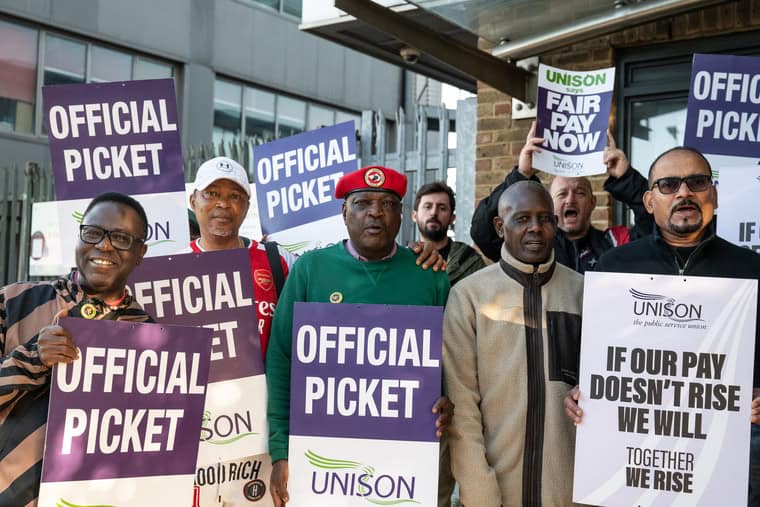
Striking school workers overlaid on striking workers at the Upper
Clyde Shipyard, 1971
The self-activity of working class people is at the core of socialist politics. Strikes are a crucial way in which workers can exercise their power. Strikes can unite and radicalise workers—and they can feed into political struggles on the streets.
The problem is that union membership and the numbers of strikes have been declining for decades.
But today there are examples of workers taking action and winning. Last month school workers in south London won their demands for better maternity pay and union recognition.
Striking university workers in Newcastle and Dundee have successfully fought back against the threat of hundreds of job cuts. Revolutionary socialists have been centrally involved in many of these battles.
Socialist Worker spoke to four trade unionists who have led successful strikes, Jess Edwards, NEU union national executive member, Pablo Phillips, NEU joint branch secretary for Waltham Forest, Matt Perry, chair of the UCU Newcastle University branch and Peta Bulmer from the UCU University of Liverpool.
Pablo said socialists need to take advantage of every workplace grievance. “The first thing to do is recommend a ballot for industrial action. A ballot strengthens the ability of a group to negotiate,” he said.
Jess also argued that workers are strongest when they strike. There is an argument in some unions that workers should hold off from taking action until they have built up their membership.
She explained, “The received wisdom is to ask people to do a little thing and build it up over time until you get a critical mass.
“But the method has got to be to call a meeting and argue that you should ballot for strikes. If you don’t win the argument, you don’t win. But still put it.
“And you need to have a pattern of escalating action. One day, two days, three days. You have to be prepared to stay the course.
“The other side always appears intransigent and strong. But it is always when bosses look at their most intransigent that they buckle.”
At the University of Liverpool, bosses called off plans to make 47 people redundant after strikes in 2021.
Peta said, “We managed to stop any compulsory redundancies. We had a three-week strike in March and more action into August.
“In September, there were two jobs still on the line. That’s when we decided to ballot again. It prompted the university to get it resolved.
“Since 2021 they have not made any compulsory redundancies. Loads of other institutions are making cuts. I think they wouldn’t do it here. It’s put them right off.”
Building collective organisation was key to their success—strikes can encourage people to join the union and get involved.
Peta said, “It was a proper engagement with the membership. We had meetings every day. It wasn’t just the branch committee deciding everything.
“It’s members who will take the pay cut. If they’ve chosen to take action, they are more likely to.
“We had rallies on campus with hundreds of people so members weren’t just sitting at home worrying about the bills.
“We asked disabled members and parents with kids and others who couldn’t picket in the mornings to manage the zoom meeting. Women were very active and vocal during the protests and online meetings.”
Workers use different methods to get their message out and counter arguments from the bosses.
Jess explained, “In schools, management tries to split parents from workers. You have to get your own narrative out. Are there parents, governors or councillors who can start to bring pressure?”
For Peta, “We were in charge of our relationship with the mainstream media. We were sending info to a local reporter. It made it easier to get support from MPs and local councillors and others.”
Matt added, “We maximised the industrial leverage we had. This amplified a wider range of forms of action—political lobbying, press work, petitions and votes of no
confidence in management. We had themed strike days when there were workplace days of action on Palestine or trans+ rights.”
Trade unionists can try to push for strikes to go beyond the limited vision of the union officials and to spread nationally.
Peta explained, “We got very little support financially from the national union. But I went to different branches and spoke and invariably they passed a motion with a donation.
“Also significant was the UCU Solidarity Movement—a grassroots network of activists formed in 2020. It encouraged other branches to support us. It played a role that the national leadership of the union should have done.”
Matt said, “We sought to spread the resistance to other branches also facing job cuts. Networking with others broke our sense of isolation and raised morale.” Pablo agreed, “National action is far better. But you can’t wait for it and do nothing in your workplace. Local disputes have the potential to push people into national action.
“We want schools to win better terms and conditions. But it can’t just focus on bread and butter issues. It has to address wider political issues.”


Jude Mckechnie spoke to the workers leading the fightback against outsourcing
Judy Cox reviews End Times Fascism by Naomi Klein and Astra Taylor
On the ground in Gosport
Ninety years since the Battle of Cable Street