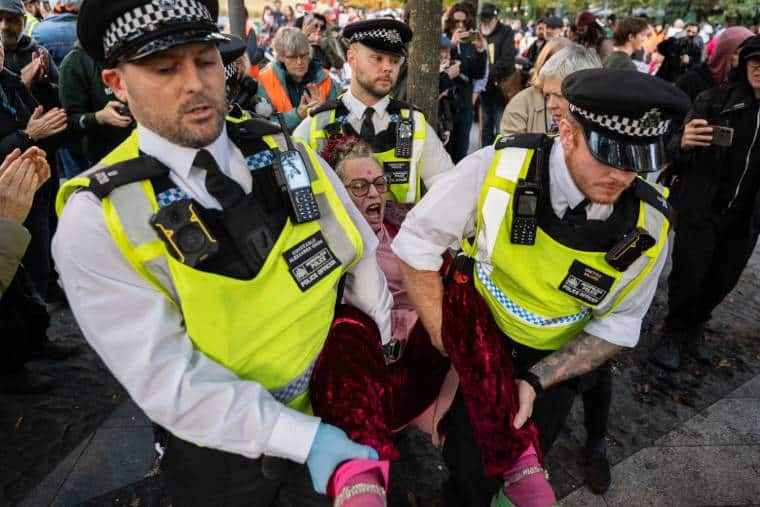
The Palestine movement has brought hundreds of thousands of people onto the streets (Picture: Guy Smallman)
It’s a cliche now that we live in an increasingly dangerous and unstable world. Financial markets anxiously calculate “geopolitical risk”. Europe’s biggest war since 1945 rages in Ukraine. Before our eyes Israel is organising a genocide. And, to cap it all, Donald Trump has been re-elected on an “America First” platform.
These developments represent the complete collapse of the expectations in ruling class circles after the end of the Cold War in 1989-91. Neoliberal globalisation, it was claimed, would bring peace and prosperity to a world increasing organised transnationally, in which nation-states would become increasingly obsolete.
Even some Marxists went along with some of this. In 2000, Michael Hardt and Toni Negri announced in Empire, “Imperialism is over.” This was almost instantly refuted, as the United States under George W Bush reacted to the 9/11 attacks by launching the “war of terror”. The result was defeat for Western imperialism in Iraq and Afghanistan. And now we see the spread of far right nationalism and growing geopolitical rivalries.
We must understand imperialism precisely. Capitalist imperialism in the Marxist tradition is not just one powerful state dominating its neighbours. It’s a product of the development of capitalism—the highest stage of capitalism, as the Russian revolutionary Vladimir Lenin put it. Capitalism is a system based on the exploitation of wage-labour and driven by the competitive accumulation of capital.
Modern imperialism emerged in the late 19th century. Capital accumulation increased the size and power of the individual units of the system. As a result, economic competition between capitals and geopolitical competition among states tended to fuse. Increasingly operating globally, big capitalist firms depended on the support of their states. And, thanks to the industrialisation of war, military power came to rely on a strong capitalist economic base to provide weapons systems, supply lines, and infrastructure.
Imperialism has gone through different historical phases, but its basic logic is unchanged. It is a system of inter-capitalist competition in which a handful of rival states struggle for the domination and exploitation of working people and the poor.
This is why “campism”—trying to identify a more “progressive” power—is so mistaken. Imperialism always exists in the plural, with several powers striving for regional or global domination.
The era of the world wars between 1914 and 1945 represented the struggle of British imperialism to maintain its hegemony. Two newer powers were outstripping it economically—the US and Germany. Analogously, the present is dominated by the efforts of the winner in that past struggle, the US, to hang onto its global hegemony in the face of China’s rise.
The relative economic decline of the US compared to the other leading capitalist states has been slowly unfolding since the 1960s. The US has sought to maintain its hegemony by binding the advanced states together in a liberal capitalist bloc. It did so through institutions such as the International Monetary Fund (IMF), the World Bank, Nato, and other alliances. It also encouraged the development of the European Union (EU) as a junior partner. This is the so-called “rules-based international order”.
The US used its victory over the Soviet Union in the Cold War to seek to entrench its domination by making this order genuinely global. That was especially under Bill Clinton, the Democratic president from 1993 to 2001.
Neoliberalism was exported to the former Stalinist states and the Global South, and the World Trade Organisation was established. The aim was to allow US corporations and banks to move freely around the world in search of profits. Meanwhile, Nato and the EU expanded into eastern and central Europe, despite the protests of Russia—which US president Barack Obama dismissed as a mere “regional power”.
But the US’s strategy blew up in its face. The effort to impose neoliberalism globally has provoked revolt after revolt. For example, we saw the so-called anti-globalisation movement from the late 1990s onwards, the Arab uprisings of 2011, and the upsurge on the eve of the pandemic.
The deregulation of finance precipitated the biggest economic crisis since the 1930s in 2007-09. And the defeat of the US in Iraq and Afghanistan demonstrated the limits of US military power. Slower economic growth since the global financial crisis has, as in the 1930s, intensified geopolitical rivalries.
Most threatening for US hegemony, these developments were accompanied by the emergence of rapidly industrialising China as a “peer competitor”. In the global financial crash’s aftermath, Xi Jinping took charge of what was now the biggest manufacturing and exporting economy in the world. His plans to upgrade Chinese industry technologically threaten a key economic underpinnings of US hegemony—Big Tech in the shape of the “Magnificent Seven”—Alphabet, Amazon, Apple, Invidia, Meta, Microsoft, and Tesla.
The rapid advance of Chinese firms such as BYD as producers of relatively low-cost electric vehicles is a major threat to the US and European car industries. Meanwhile, China is upgrading its military capabilities with the aim of forcing the US out of the Western Pacific. Given that Asia is now the most dynamic region of world capitalism, if China succeeded, this would mark the end of US global hegemony.
Trump’s first administration of 2017-21 was a reaction to these changes. He gave a racist and nationalist spin to the anger created by the effects of the global financial crisis and denounced US “forever wars”. Most significantly he initiated an economic war against China, while threatening the same to other major exporters, notably Germany.
Joe Biden maintained Trump’s tariffs and escalated the economic war by seeking to block China’s access to Western advanced technological products. He also used massive state subsidies in an effort to enhance the competitiveness of US industrial firms against China.
The biggest difference between the two administrations was that Trump was highly critical of allies in Nato and the Middle East. He regarded them as free-riding on US military power and ripping it off economically.
Biden by contrast sought to rebuild the system of alliances the US had developed after the Second World War. In part, this reflected the fact that his national security apparatus was packed full of enthusiasts for the “rule-based international order” from the Clinton and Obama administrations.
It was also out of necessity—ironically as a consequence of blowback from Clinton and Bush’s efforts to expand this system of alliances into central and eastern Europe. The so-called “Maidan revolution” of 2013-14 in Ukraine increased the power of far right nationalists and tipped the bulk of the political elite into the Western camp.
The US and Nato allies began to support Ukraine’s armed forces and reorganise its security and intelligence agencies. Western indifference and nationalist pressure ensured that the Mink II protocol of February 2015, which was meant to allow the reintegration of pro-Russian areas in southeastern Ukraine, was a dead letter.
Since he took command of the Kremlin in 2000, Vladimir Putin has sought to rebuild Russian imperialism through a combination of authoritarian neoliberalism and military expansion. This has been financed by Russia’s energy exports. But he presides over a weak imperialism, what the imprisoned Russian Marxist Boris Kagarlitsky has called an “empire of the periphery”.
Only its nuclear arsenal keeps Russia in the big league alongside the US and China. Spurned by the West, Putin has taken refuge in a version of the Great Russian nationalism of the Tsarist era. He’s also succeeded in projecting Russian power into the Middle East and Africa, exploiting the failures especially of US and French imperialism.
Putin’s gamble in February 2022, that his invasion forces would quickly seize control of Ukraine, quickly went awry. Ukrainian resistance to the lumbering Russian armoured columns was highly effective. And the US and the rest of the Nato rushed weapons systems, technical experts, and special forces to aid the Ukrainian war effort.
The Biden administration’s calculation was that by waging this proxy war it could drain and isolate Russia. The financial sanctions rapidly imposed by the US, EU, Britain, Switzerland, and other Western states were expected to shatter the Russian economy.
The results were mixed. Ukraine’s counter-offensive in 2023 failed. The fighting is bogged down in southeastern Ukraine. The Russian economy hasn’t collapsed. This is partly thanks to the skilful management of Putin’s economic technocrats. But the economic support China has lent Russia has been crucial. Alongside other big Global South economies such as India, it has provided a market for Russian energy once the West started to shut it out. And Chinese firms supply Russia with the high-tech goods it needs to carry on waging the war.
Where the Biden administration has been successful is in brigading together the advanced capitalist states against Russia and potentially China. This started before the war with the 2021 Aukus agreement. This will see the US and Britain will supply Australia with nuclear submarines that will be used to counter China’s growing naval power in the Western Pacific. The war has underlined Europe’s dependence on US military protection and also on the liquefied natural gas produced by the US fracking industry.
Nato historically was a coalition of North American and European states. Now increasingly it projects itself as a Western alliance operating globally against what General Chris Cavoli, commander of US forces in Europe, describes as an “axis of adversaries”. These are Russia, China, Iran and North Korea. What Nato calls “partners”, such as Australia, Israel, Japan, New Zealand and South Korea, now take part in its summits. This global struggle is represented ideologically as a conflict between “democracy” and “authoritarianism”.
We can see the Biden administration as marking the emergence of what might be called “war liberalism”. Liberal imperialism is responding globally to war, or the threat of war, on three fronts. The first of this is Ukraine. The second is the Middle East. The policy of the Biden administration since 7 October 2023 confirmed Israel’s strategic centrality to Western imperialism.
This is partly because of Israel’s historical role as a reliable ally in the Middle East. The Ukraine war has renewed the importance of the region’s energy supplies, especially to Europe. And what Anne Alexander calls Israel’s “digital militarism”—based on massive US aid—makes it a valuable economic and security partner to Western capitalism.

Israel’s assault on Lebanon in autumn 2024 was accompanied by a shift in the US’s tone. There was less hypocritical whining about Israel’s slaughter of civilians while supplying it with the necessary hardware. A there was more enthusiasm for the fantasy that Israeli military power can somehow “re-order” the Middle East.
The third, and potentially most dangerous front, is Asia. It is here that the two biggest economies in the world are making intensive preparations for war. There are several potential flashpoints. It’s not just Taiwan where the dominant political forces campaign for independence, which China says would lead to war. There are territorial disputes in the South and East China seas. International relations academic John Mearsheimer, a strong critic of US policy towards Ukraine and Israel, warns that the greatest danger of nuclear war lies here, not in Europe.
The danger is enhanced by how the different fronts feed into each other. As Mearsheimer points out, Binyamin Netanyahu is trying to draw the US into a war with Iran. But Iran has joined the Brics group of big Southern economies orchestrated by China and Russia. Both Iran and North Korea are supplying Russia with missiles, as well as drones in Iran’s case and badly needed artillery rounds in North Korea’s.
North Korean special forces are also now reported to be operating in Russia’s Kursk region—invaded by Ukraine in August—and to have been targeted by British-supplied Storm Shadow missiles. North Korea’s intervention in the war has prompted the South Korea government to reconsider its policy of not supplying weapons to Ukraine. The sudden, wholly unexpected fall of the Assad regime in Syria is another example. Assad had been weakened by the Israeli assault on two of his main allies, Iran and Hezbollah, and Russia’s preoccupation with Ukraine. His removal is a major blow to Putin, who made Syria a base for operations in the Middle East and North Africa.
It’s important nevertheless not to buy into the rhetoric of an “axis of adversaries” as in any sense a coherent alliance. According to a recent study, “Although China, Russia, Iran, and North Korea are now often viewed as an aligned group, cooperation among them has been almost entirely bilateral so far. By far the most significant instances of their cooperation have been in the context of Russia’s war on Ukraine. Whether this cooperation will survive the war is uncertain”.
All the different imperialisms are, as Marx described the capitalist class more generally, “a band of hostile brothers” with both overlapping and conflicting interests. So, China’s rulers may be quite happy to see both the US and Russia distracted by the Ukraine War. But, according to the Financial Times newspaper, North Korea’s direct involvement in the war may be a step too far.
It writes, “’The North Korean troop deployment is a dramatic step, and China will not like it one bit,’ said Andrei Lankov, a North Korea expert at Kookmin University in Seoul. For China, the deployment … threatens to destabilise the delicate balance of power on the Korean peninsula. Closer Russian-North Korean ties could also spur the US, Japan and South Korea to strengthen their military alliance in east Asia, which Beijing already views as aimed at containing its growing power.”
Beyond the complex chess game of inter-imperialist rivalries, the US and its allies have suffered severe diplomatic and ideological setbacks under Biden. In the first place, the liberal imperialist bloc failed in its efforts to isolate Russia economically and geopolitically after the 2022 invasion. One of the US’s most important Middle East allies, Saudi Arabia, has continued to cooperate with Russia in the Opec+ energy cartel. Two others, Egypt and the United Arab Emirates, have joined the Brics. The group has been expanded to include Ethiopia and Iran alongside the existing members—Brazil, Russia, India, China, and South Africa.
The Brics aren’t a coherent geopolitical and ideological bloc comparable to the US-led alliances. Participating states have conflicting interests and in some cases—Brazil, India, and South Africa—close ties with Western imperialism. Proposals to supplant the US dollar as the main reserve currency are still largely a pipe-dream. Nevertheless, these developments mark a significant weakening of the US grip on the international state system.
This was visible in the recent Apec summit in Peru. Latin America has been traditionally seen as the US’s “backyard”. But China is increasingly active in the region, offering investments and seeking access to critical raw materials. Chinese leader Xi Jinping used the summit to inaugurate the first phase of a $3.5 billion giant port on the Pacific coast. Biden, on his farewell presidential visit to the continent, announced nine Black Hawk helicopters for a $65 million anti-drug programme and a donation of second-hand trains from California for the Lima metro system.
According to Michael Shifter of Georgetown University, “It was such a striking contrast. You have this huge Chinese mega-port project that evoked Peru’s history going back to the Incas and seeking greatness. And then what Biden delivered was some more helicopters for coca eradication. That seems completely outdated and stale.”
This process has been hugely reinforced by the political impact of the Gaza war. Western complicity in the genocide and the encouragement that the Biden administration and the German government have given Israel to defy the efforts to hold it to account under international law have severely undermined the credibility on the so-called “rules-based international order”.
US imperialism has always only respected its own rules when this suited its interests, but the West’s hypocrisy has never been so flagrantly exposed. Germany’s insistence that unconditional support for Israel is its “reason of state” and its cancelling of anti-Zionist Jewish intellectuals have attracted global derision. And support for Israel itself has plummeted in many Western countries as well as in much of the global South. The student encampments and their repression by university authorities and the police simultaneously show how closely Israel is bound to Western ruling classes and how much it is rejected by especially by the young.
The cases being pursued against Israel in the ICJ and ICC courts represent an enormous ideological blow to Israel’s main backers. which parade their commitment to the rule of law. The role played in them by two of the strongest liberal democracies in the Global South—South Africa and Brazil—is a symptom of the cracking of US hegemony.
The issue of arrest warrants by the ICC for Netanyahu and ex-defence minister Yoav Gallant for committing war crimes threatens to intensify this ideological crisis. Financial Times columnist Gideon Rachman warns “Israel will split the West”. “Israel is getting full-throated bipartisan support in the US,” he says. “But most governments in the EU, as well as Britain, Australia and Canada, are likely to respect the indictment.”
Trump’s return to the White House will further accelerate the crisis of imperialism. In many ways what he offers big capital economically is a traditional Republican package of tax cuts and deregulation. But his commitment to imposing higher tariffs—on imports from Canada, China, and Mexico—will disrupt global capitalism as well as US relations with most other major economies. How much difference Trump will make to liberal imperialism’s three-front war is much less clear. As Mearsheimer points out, he usually lost out in his conflicts with the “Blob”—the US national security apparatus—during his first term. In any case, on two of the three fronts—the Middle East and Asia—he is, if anything, more belligerent than Biden.
Trump’s key foreign policy appointments of Marco Rubio as Secretary of State and Michael Waltz as National Security Adviser have been of relatively conventional Republican hawks on China. He didn’t appoint far right fanatics. After meeting his predecessor Waltz said, “For our adversaries out there that think this is a time of opportunity, that they can play one administration off the other — they are wrong. We are hand in glove. We are one team with the United States in this transition.”
Where Trump may make a difference is over Ukraine, where he’s famously said he could end the war “in a day”. The logic of the situation is any case pushing towards some kind of suspension of hostilities. Sheer weight of numbers and material has been working in Russia’s favour, though its forces are advancing very slowly and at a human terrible cost. Biden’s decision—followed by Britain and France—to allow Ukraine to fire Western-supplied long-range missiles deep into Russia is a dangerous escalation. It may indeed be intended to bind Trump to continuing the war. Putin’s response was to fire at Ukraine an intermediate-range ballistic missile that could hit any European capital, but without a warhead. It was a warning. But it is in his interest to wait and see what Trump has to offer.
Trump’s re-election has panicked the EU for fear that he will abandon, not just Ukraine, but also them to Putin’s tender mercies. The Blob almost certainly wouldn’t let this happen. It remains in the interests of US imperialism, as it was throughout the 20th century, not to allow a hostile power to dominate the European continent. But Brussels is seeking ways round its highly dysfunctional financial system to allow member states to divert money to military spending. Britain, one of the most hawkish US allies in Ukraine, will also seek to raise the tightly squeezed defence budget. The prospect is of an escalating arms race at both extremes of the Eurasian continent.
This is a frightening prospect, which explains why some tendencies on the international far left argue that we are already in a World War. They include the Partito Obrero in Argentina and the Tendenza Internazionalista Rivoluzionaria in Italy. This is an overstatement, given the complexities and contradictions we have described.
Nevertheless, it is clear that the dominant imperialist power is responding to the growing challenges to its hegemony by increasingly resorting to force. At best this represents a terrible waste of resources urgently needed to address the growing climate catastrophe. At worst it threatens the destruction of human civilisation.
The increased frequency of sudden shocks—for example, Assad’s fall in Syria and the attempted imposition of martial law in South Korea—underline the rapidly growing instability of the system. There is an urgent need to a worldwide anti-imperialist movement.
One obstacle to achieving this is the commitment of substantial sections of the radical and revolutionary left to one of two versions of “campism”. The more traditional form is dominant in large parts of the Global South, for example, India and South Africa. It reduces imperialism to US hegemony and identifies China and Russia as “progressive” challengers. This is bizarre given Putin’s consistent pursuit of a neoliberal form of imperialism and the increasing pressures on Global South state to align themselves diplomatically and economically with China.
The newer form of campism in effect treats Western imperialism as the champion of democracy against the authoritarian threat represented by the “axis of adversaries”. Influential in Europe and Latin America this tends to take the form of reducing the Ukraine War to a national liberation struggle comparable to that of Vietnam against the US. This ignores the massive role of Nato in training, arming, and financing Ukraine. As the war has continued, this position has lost any credibility it might initially have had. Even Boris Johnson now admits, “We’re waging a proxy war.”
Along with the rest of the International Socialist Tendency, the Socialist Workers Party opposes imperialism as a system. As this article has explained, we see world politics today as dominated, as it was between 1914 and 1945, by an inter-imperialist struggle.
And, in the tradition of revolutionary internationalism, we refuse to support either side and call for the defeat of our “own” government. This reinstates the class approach taken by the pioneers of this tradition such as Lenin and Rosa Luxemburg. Like them, we see the world divided between the capitalist ruling classes that sustain the imperialist system and the vast majority. The way to peace lies in international socialist revolution that sweeps away the bosses and their system.
How can we develop this anti-imperialist movement? In Britain, we work in the Stop the War Coalition and the Palestine Solidarity Campaign. We may also find some allies elsewhere outside the IST who take the same approach. But of fundamental importance is the development of mass struggles from below. In the longer term, these must come from workers rebelling against the privations imposed by imperialism. The inflationary upsurge in 2021-3 will probably be repeated, thanks to the impact of climate change, further geopolitical disruptions of energy markets, war economics, and growing protectionism. This will provoke more wage struggles through which workers can develop the confidence and organisation to take on the system.
There is also the impact of mass political movements. The Gaza war and the worldwide growth of solidarity with Palestine has acted as a year-long education in the nature of imperialism and in how to fight it. Even if that movement recedes, it will leave behind lasting effects that can feed into further upsurges against imperialism. Our task is to build these anti-imperialist struggles but also to ensure that they widen the network of organised revolutionaries that understands they need to target the system.


Why is Labour increasing repression?
Looking at the magnificent mass eruptions in France, one is tempted to ask—'Why not here?'
What did Burnham do?
Learn from mistakes of Corbynism