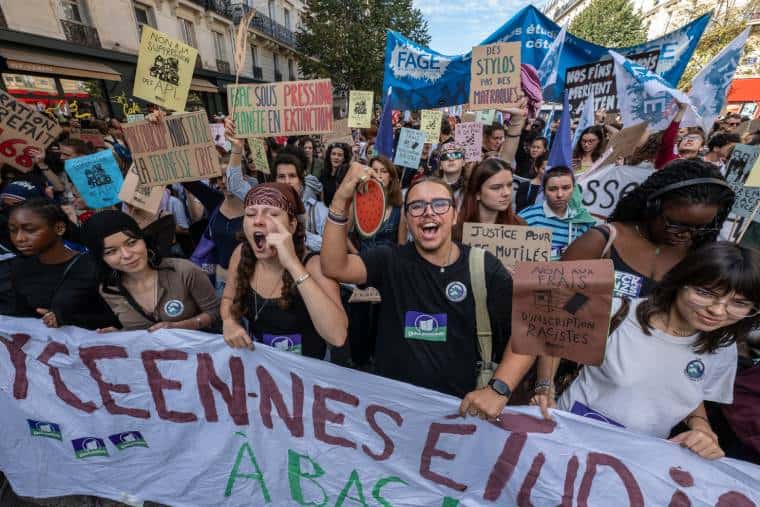
Abortion rights demonstrators face down anti-abortion bigots last year Picture: Guy Smallman
Women’s bodies are battle-grounds. The right to control fertility is becoming an ever-more volatile, often contradictory, political struggle that divides even the ruling class.
But while in some countries bigoted policies continue to restrict all or most access to abortion, the loosening and challenging of these laws is also on the rise.
Anti-abortionists aren’t having it all their way. That’s because of campaigning from below and a ruling class that isn’t united in its stance on abortion and the “correct” place for women in society.
The hard right, from Republicans in the United States to Viktor Orban in Hungary, use abortion as a symbol of the traditional family and values they organise their politics around.
But this far right ideology can clash with other sections of the ruling class who believe abortion, even if limited, should be available. That’s the view of those like Joe Biden, who want abortion rights so women can go to work and be exploited by the bosses.
Women make up 40 percent of the workforce worldwide—and capitalism cannot afford to let the labour of these women go.
This section of the ruling class, while separate from the far right, sees a benefit in having a base of bigots to hold down and challenge mass movements.
It also knows that as the majority of ordinary people support abortion, thanks to campaigning by women, this can be capitalised on electorally.
The current US president, who once said the Supreme Court’s Roe v Wade “went too far”, is now making abortion rights the centre of his reelection campaign. It’s not hard to understand why Biden thinks that abortion is a good way to win the votes.
All women are oppressed under capitalism—although in different ways and to different degrees. Some ruling class women do want to defend abortion rights, but can’t understand other issues working class women suffer from.
The bosses also have conflicting ideas about abortion access. They are those who know that unconfident women, whose rights are constantly being taken away, are easier to exploit.
At the same time other “progressive” companies pose as being on the side of women’s rights. Some major US companies now fund their workers to go out of state to access abortion.
That’s not because they care about access to medical care. Instead they see the benefit of not having to fork out for maternity pay.
For most of the bosses, women not being able to control their fertility, whether that’s through abortions or contraceptives, is a bad thing.
Pregnancies and having to look after children means women are forced out of the workforce. This isn’t great for the bosses’ profits.
Women’s experiences cut through all the contradicting and shifting ideas that the ruling class have about abortion. The dangers and brutality that women face from not having access to abortion match their anger on the streets campaigning for their rights.
The role of the family—and women’s central position within this—is crucial to the system. Women raise, support and care for the next generation so that the state doesn’t have to.
But it’s not true that the state’s priority is merely bringing women back into the home and forcing them to have many children. The pushback from ordinary people would be too great.
That’s partly why the Biden administration has taken the state of Idaho to the supreme court over its abortion ban. The case will rule over a federal law requiring hospitals to provide treatment to any patient with an “emergency medical condition”.
This covers abortion, even in states where the procedure is banned.
For the Democrats, abortion rights are a vote winner—and the Republicans know it too. It’s not hard to see why.
One in eight in the US says abortion is the most important thing in the upcoming presidential election, rising to one in four black women. And 43 percent of Republicans say abortion should be legal in all or most cases.
But, of course, there is still a growing extreme right that puts banning abortion at the centre of their politics. It also hopes that its stance will win it votes and support.
In total 14 US states have total abortion bans, impacting 30 million women of reproductive age. Around 27 in total restrict abortion rights—seven before 18 weeks’ gestation.
In Alabama the supreme court has even ruled that frozen embryos are considered children, and the state can hold people liable for accidentally destroying them. But even in states like Florida, which reduced its 15-week abortion limit to six weeks on 1 May, a vote later this year could enshrine abortion in the state constitution.
It shows that while the hard right wants to use abortion as a wedge issue to coalesce around, the rest of the ruling class knows that the majority of people don’t want abortion restraints.
There are limitations to how far the right can go in outright banning abortion without significant backlash. Yet still for many women, even where they’ve won the right to abortion, the ruling class is holding back access.
That’s because it is reliant on women’s oppression and controlling women’s bodies. Arguments about abortion access are raging across the world. In Italy abortion is available in the first 12 weeks or if the woman’s life is at risk.
However services are severely limited because health practitioners can register as conscientious objectors. Fascist Giorgia Meloni has said she won’t want to roll back the law protecting abortion.
But a new ruling means pro-lifers are allowed inside clinics to intimidate women accessing abortion. Meloni also knows Italy’s birth rate has been falling for 15 years.
For the far right the need to keep the population up is linked with racism at keeping migrants out. That’s why the right hands out incentives, such as tax breaks for women in Hungary who have more than four children to drive up “national” birth rates.
But even the far right, such as Meloni, isn’t rolling out complete abortion bans.
Slowly chipping away at what provisions do exist is an underhand way to limit abortion but also to reduce the uproar that an all-out ban would trigger.
In Italy, 32 percent of people think abortion should be legal in most cases, while 38 percent think it should be legal in all.
Poland still has a near-total ban on abortion, and the state criminalises doctors who perform them. But the right wing Law and Justice Party (PiS) lost its majority, and the new coalition government is under huge pressure to overturn the ban.
Anger has been raging since the death of Izabela in September 2021 from septic shock because doctors decided to wait for her foetus to die before treating her.
Abortion in Germany is illegal except when a woman’s life is in danger, or she is a victim of rape. It’s decriminalised for woman only if they undertake counselling and a three-day wait period.
Now, a government-appointed commissioner is recommending abortion be legalised up to 12 weeks.
In Britain six women have been taken to court since 2022 over “illegal” abortions. But the Tories have been forced to keep at-home abortions available to women even after the pandemic.
And two amendments are looking to overturn the 1861 law that criminalises women for having abortions to limit sanctions on women.
Pro-choice activists are preparing to campaign and protest in support of them.
While abortion is still heavily stigmatised, the confidence of the right to push ahead with bans is becoming more controversial, both to sections of the ruling class and ordinary people.
This can create friction in the mainstream ruling class, who know how vital women are in the workforce. But it’s not an ally of women in the fight to protect abortion, especially in the face of fascists and far right attacks.
When abortion is restricted, it’s women at the bottom of society who are most likely to pay the price—often with their lives.
Decriminalisation has to be fought for, but the legalisation of abortion at any stage of pregnancy worldwide has to be the goal. That’s not as far as the ruling class and big business will ever go.
Defending abortion—both from outright bans and longer-term erosions—has to come from below.


Jude Mckechnie spoke to the workers leading the fightback against outsourcing
Judy Cox reviews End Times Fascism by Naomi Klein and Astra Taylor