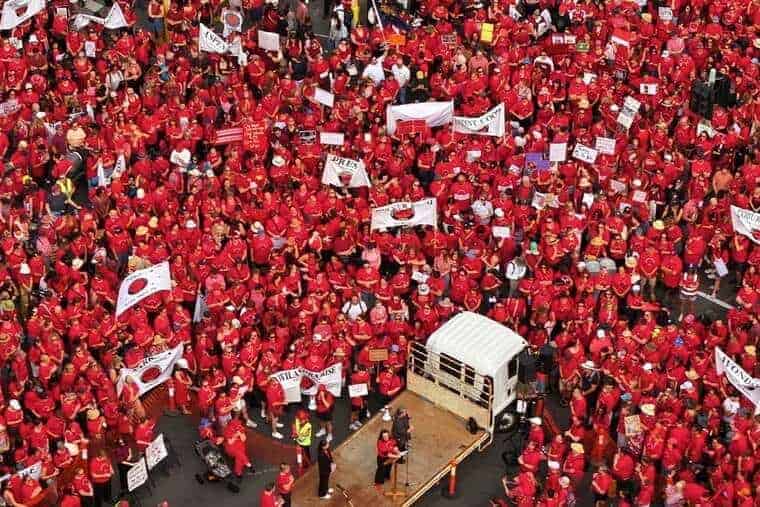
NSEU union members at a strike rally in front of Samsung Electronics’ Hwaseong plant (Picture: Jo Seung-jin)
Workers at Samsung Electronics in South Korea, one of the world’s biggest semiconductor companies, are on an indefinite strike over pay, union recognition and extra holidays. Most of the 6,500 strikers are young—and it was them that pressured the union leadership to escalate the strike to an indefinite walkout.
Samsung Electronics has had a “no-union” policy since it was founded more than 50 years ago. This is the first strike at the company, and the first strike in the semiconductor sector globally.
The industry has recovered from last year’s recession and demand for chips is increasing, especially due to the Artificial Intelligence trend. The strike can impact the supply of chips. It could also inspire other semiconductor workers around the world, including those without union recognition at TSMC in Taiwan and Intel in the US.
The Bloomberg news agency last week worried that “the action may snowball to … trigger similar responses across a recovering tech and chip industry”. The Samsung strike is also part of a global struggle against the rising cost of living. Semiconductor workers at Samsung received no performance pay at all last year.
That “bonus” usually accounts for around 30 percent of their pay. Samsung executives, on the other hand, received tens of thousands of pounds in “incentives”. This year Samsung expects its revenue to be worth billions of pounds. But bosses plan to pay only a pittance in performance pay.
The mainstream media is attacking the strike. It says the strike represents the “selling out of the country” by a “selfish trade union”. In doing so it is admitting its fear of strikes. Scabs According to the NSEU union, the action has caused delays and defective products.
But scabs have ensured that production has been continued at low levels. Bosses are worried because the nature of the production process means their factories must operate around the clock. The union leadership has been holding rallies at key production sites in a bid to spread the strike.
But the leadership of the Korean Confederation of Trade Unions and the Korean Metal Workers’ Union are yet to pledge their support. The strike in South Korea is already becoming a political struggle. If it is to win, it needs to spread and there must be solidarity.
Tens of thousands of workers in Sri Lanka last week joined a two-day strike that brought the country to a halt. Teachers, doctors and civil service workers joined with other public sector groups to walk out last Tuesday. Over 200 unions backed the “sick day” stay-away in a protest at a government cost of living allowance that comes nowhere near to matching the rate of inflation.
And many of the unions also have long standing demands over pay and vacancies. Union leaders said the action was the “biggest since the 1980s”. The strikes are in part a response to government cuts, made under the “guidance” of the International Monetary Fund (IMF).
The IMF agreed a “bailout” loan with Sri Lanka in 2022 but it demanded huge reductions in public spending in exchange. The government, led by technocrat Ranil Wickremesinghe, has been only too enthusiastic to implement the pain.
Presidential Ahian Kadirgamar, a senior lecturer at the University of Jaffna, told Socialist Worker, “Presidential elections are due in a few months, and there are mounting trade union demands to address the huge rise in the cost of living that came with the economic crisis and then the IMF austerity measures.
“As many 1.3 million people have had their electricity disconnected following the price hikes since then.” The scale of the strike took some by surprise. The walkout caused thousands of schools to shut, and there was cargo chaos at all the main ports as customs officers downed tools. Now, many union leaders are saying that last week’s action was just the beginning and that unless the government moves, there will be more strikes to come.
Yuri Prasad


Fascist Tommy Robinson didn’t receive the same treatment
Russia has threatened revenge after British-made drones targeted its oil refineries and transport networks
Progressive candidate has won primary in Republican dominated state
Rank-and-file rebellion secures pay rise