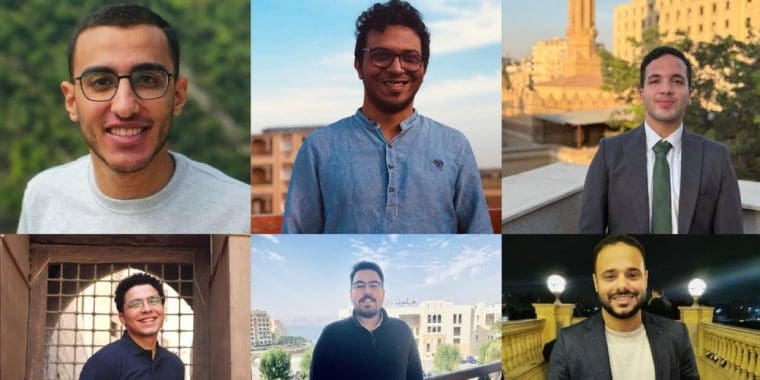
The Matsada2sh journalists (Picture: Egyptian Initiative for Personal Rights)
Egypt’s Supreme State Security Prosecution renewed the pre-trial detention of all six Matsada2sh—Arabic for “Don’t Believe It”—journalists for a further 15 days on Tuesday.
The six constitute the platform’s entire Egypt-based newsroom and work for one of the country’s few remaining independent fact-checking and investigative outlets.
All six have been held in Badr 1 Prison–known as the heir to the notorious maximum security “Scorpion” prison complex–since first appearing before prosecutors. Their lawyers said that their first family visits were scheduled to begin on Thursday and that they would be given dedicated exercise periods.
Between the evening of 28 September and the following day, security forces arrested Abdallah Qadri, Mohamed Ashraf Abu Emeira, Mohamed Adel, Islam Barakat, Mohamed Mahmoud and Omar Helal.
Four were taken from their homes in different governorates, while Mahmoud and Adel were picked up by plainclothes officers from the capital Cairo’s streets. They were forcibly disappeared for five days before they began appearing before the Supreme State Security Prosecution on 4 October.
The Ministry of Interior accused the journalists of “working for an unlicensed, foreign-run platform that spread fabricated information on behalf of the banned Muslim Brotherhood”. Matsada2sh denies such allegations.
Lawyers from the Egyptian Initiative for Personal Rights (EIPR), who form part of the defence team, said most of the journalists subsequently told prosecutors that they had been tortured inside Homeland Security facilities.
They reported being blindfolded, bound with their hands behind their backs, forcibly stripped, beaten and subjected to electric shocks. And they were threatened with harm to themselves or their families.
Most of the journalists also said officers forced them to read fabricated “confessions” from sheets of paper while being filmed during what they described as “sessions with repeated takes” involving “professional filming crews”.
EIPR said the apparent purpose was to manufacture evidence that could later be used against them. The accounts were entered into the official investigation record during overnight prosecution questioning that lasted more than 10 hours for each of the journalists.
The allegations prompted the Journalists Syndicate Council to hold an emergency meeting on 5 October.
After the meeting, it announced that it would complain to the public prosecutor about the reported physical abuse and coerced recordings. The syndicate said it would demand that any confession obtained under duress be declared invalid and seek the release of all six journalists under its guarantee.
The interior ministry issued a denial at about 11.30pm the same day, two hours after the syndicate released its statement responding to the allegations. Citing an unnamed “security source,” it said claims of torture or ill-treatment were “baseless and an attempt by the detainees to evade the accusations against them”.
It described the six journalists as “Muslim Brotherhood elements working for the group”. It added that the case was before the judicial authorities, which “alone had the right to determine the accusations”.
On 7 October, the public prosecution said, “Three journalists who alleged ill-treatment had been referred to the Forensic Medicine Authority.” It said the resulting reports “found no injuries or signs that violence had been used against them”.
The EIPR challenged the adequacy of that response. It said that neither the journalists nor their lawyers had claimed that all the alleged abuse necessarily left visible injuries. And it said prosecutors had refused to hear the journalists as complainants in their torture complaints.
The prosecution’s statement did not say whether the officers accused of the abuse or witnesses had been questioned, it continued. And it said the prosecution failed to acknowledge the allegations that officers forced the journalists to record fabricated confessions.
The prosecution alleged that Matsada2sh formed “part of a Muslim Brotherhood plan to provoke demonstrations and bring down state institutions.” It didn’t publish the evidence underlying that conclusion.
But among the activities it treated as evidence were “highlighting shortcomings—and only shortcomings—in state institutions”, “belittling the roles and performance of their officials” and “highlighting officials’ failures to address them”.
Prosecutors claimed that one detainee admitted joining the Brotherhood’s media committee and implicated his colleagues. The other journalists denied membership, according to the same statement, although one reportedly said that he had previously belonged to the organisation and left before working for Matsada2sh.
Prosecutors also cited “monthly payments in foreign currency” and “closed groups on an encrypted messaging application”. They said there were “emails exchanged with a person outside Egypt” whom they accused of belonging to the Brotherhood.
The EIPR said the prosecution had recast ordinary newsroom practices as evidence of terrorism. The journalists had formal employment contracts, received their wages through bank accounts and used electronic groups and email to coordinate their work.
It added that neither the prosecution statement nor questioning—which lasted almost 30 hours for each journalist over three days—identified a single Matsada2sh report that was false or fabricated.
The rights group also challenged the use of an exceptional provision of Egypt’s 2015 Anti-Terrorism Law to hold the journalists before presenting them to prosecutors. The provision permits such detention when required to confront a danger arising from a terrorist offence.
The EIPR argued that accusations concerning allegedly false reports did not establish what imminent danger justified holding the six incommunicado for five days, despite 18 complaints from their families and lawyers.
It added that the same law preserved their rights to learn the reason for their detention, contact their families and obtain legal assistance.
The EIPR stressed that the prosecution’s press statement set out allegations, not findings established by a court. They “have no legal probative value,” it said. “The purpose of this statement is merely to express the opinion of the Supreme State Security Prosecution and to summarise the state security investigations”.
And the EIPR renewed its call for the journalists’ release and an investigation into the alleged abuses.
The syndicate council also said it would seek to have any confession obtained under duress declared invalid. It would establish a permanent committee chaired by the syndicate head, Khaled El-Balshy, to follow the case.
Of the six journalists, only Qadri is a registered syndicate member. The council described the other five as trainee journalists. Their exclusion is the result of a longstanding contradiction in the regulation of Egyptian journalism.
Digital outlets are recognised under the 2018 Press and Media Regulation Law. But admission to the syndicate remains governed by a law enacted in 1970 and membership practices built around print publications.
Under the existing system, journalists generally need a contract with a syndicate-recognised institution to obtain membership. This excludes many people who work full-time for independent digital outlets.
Former syndicate head Yehia Qallash has argued that the 1970 law’s reference to “printed journalism” should be interpreted broadly enough to include digital publications. But that interpretation remains contested inside the syndicate.
Journalists who practise without syndicate registration remain exposed to accusations of “impersonating a journalist”.
Article 115 of the syndicate law means individuals can be imprisoned for up to one year, fined, or both. The danger is particularly acute for freelance reporters and those working for digital-only outlets that cannot nominate them for membership.
Current syndicate head El-Balshy and other council members have occasionally paid lip service to the idea of extending union protection to digital journalists. But disagreements persist over membership requirements and the risk of “admitting people who are not genuine practitioners”.
The council has also fiercely opposed those who try to organise independently outside the official syndicate’s umbrella, claiming those who try to do so are “contesting the syndicate” and “sowing discord”.
The Egyptian Commission for Rights and Freedoms (ECRF) argued that authorities had turned the journalists’ lack of union membership, the outlet’s unresolved licensing status and payment for their work into grounds for suspicion.
It said regular payments for journalistic work should be treated as wages, not criminalised as “funding”. Egypt’s Labour Law No. 14 of 2025 recognises bank transfers as evidence of salary payment and applies employment protections to new forms of work.
After syndicate members pressed the council to take a stronger position, it declared that the five journalists’ membership status would not restrict its defence of them.
Responding to the characterisation of their wages as “foreign financing”, the syndicate said the six had formal employment contracts and received their salaries through Egyptian banks.
It argued that journalists should be answerable for their published work, not for determining the ultimate source of their employer’s funds. This is a regulatory task that, it said, “belonged to the state.”
The arrests have confronted El-Balshy with the limits of what an elected professional union can achieve in President Abdel Fattah el-Sisi “New Republic”.
El-Balshy, a reformer sometimes described by supporters as the “freedoms syndicate head”, was re-elected in May 2025 with 55 percent of the vote. He pledged after the victory that he would “secure the release of detained journalists”.
Candidates aligned with the Independence Current secured a majority on the syndicate’s council on a platform of “press freedom, editorial autonomy and improved wages”.
But that majority is neither monolithic nor secure. Some of its candidates won by narrow margins. Council members and the wider general assembly remain divided over digital membership, the safeguards required for admission and how far the syndicate should escalate confrontations with the state.

In the Matsada2sh case, for example, organisers pressed the council for stronger action. The council ultimately chose legal complaints and continued monitoring, rather than the escalatory measures some members wanted.
Those divisions have developed under the weight of Sisi’s counter-revolution. Since the 2013 coup, independent outlets have been closed or blocked and journalists have been prosecuted under terrorism and false news provisions. And much of the media market has been consolidated under state and intelligence-linked ownership.
This transformation has weakened the base of the syndicate’s “Independence Current”. Many journalists now work for state-owned or state-aligned institutions, while large numbers employed by the remaining independent digital outlets cannot obtain syndicate membership.
The organisation is therefore expected to defend a section of the profession that its own outdated membership system largely excludes.
In response to the arrests, dozens of journalists have maintained a daily symbolic sit-in at the syndicate headquarters since 5 October, demanding the six journalists’ release.
The Freedoms Committee, headed by Eman Ouf, has also hosted a discussion on imprisonment in publishing cases, attended by families of detained journalists, lawyers, reporters and editors.
The arrests brought the number of journalists imprisoned in Egypt to at least 26, according to the EIPR. They include Haider Kandil, Safaa El-Korbeigy, Sayed Saber, Tawfik Ghanem, and Hamdy El-Zaeem—who faced a decade of arrest, surveillance and prosecution.
He was first detained in 2016, released in 2018, rearrested in January 2021 and has remained imprisoned since then without a final conviction.
Yet journalists, editors and media students continue to gather at the syndicate, while independent outlets keep publishing under the threat of blocking, prosecution and arrest.
The Matsada2sh team belongs to a generation trying to keep the profession alive while navigating outdated labour structures, institutional exclusion and an expanding security apparatus.
As veteran revolutionary socialist Hossam el-Hamalawy constantly says, “In a dictatorship, independent journalism, by default, becomes a form of activism, and the spread of information is essentially an act of agitation.”


French students blockade schools ahead of the general strike on Thursday
Plus readers on fighting the far right in Glasgow, Trump's tariff war and arms spending