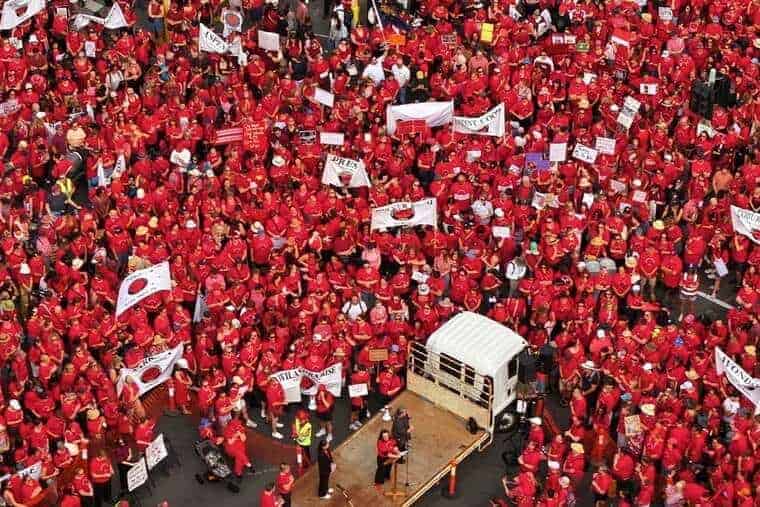
Around one million filled the streets of Seoul demanding that the president resign (Pic: Workers’ Solidarity)
Around one million people took to the streets of South Korean capital Seoul last Saturday, demanding president Park Geun-hye’s resignation.
It was the largest demonstration since 1987, when heated street protests and mass strikes forced the former military dictatorship to concede basic democratic rights.
The march coincided with an annual Korean Confederation of Trade Unions (KCTU) national workers’ rally.
Some 150,000 KCTU members marched, calling for Park’s immediate resignation among other demands.
They were joined by masses of ordinary people and marched on the presidential palace. Protesters demanded equal rights for women and LGBT+ people.
Park Geun-hye’s free market reforms have attacked working class living conditions of men and women, straight or otherwise.
Workers
Having KCTU workers lead the march represented a step forward for the movement.
For many it was their first experience of any kind of political movement. The hope that fills their ranks has helped the movement grow fast.
But the inevitable twists and turns of such movements mean they could be unprepared as it develops.
From the platform the acting KCTU chairperson said unions will strike later this month.
The exact day of a general strike is to be announced by the KCTU’s currently imprisoned chair. He was sentenced to five years for his role in “violent” protests in November last year.
The next step is a day of coordinated local actions this Saturday followed by national action on 26 November.

Rail workers on the protest to demand the president resigns (Pic: Workers’ Solidarity)
Large sections of the ruling class believe that allowing the president to fall at a time of increasing instability could be dangerous.
But keeping Park in place only increases public anger. The main opposition leaders are now all agreed on demanding the president’s resignation.
The ruling Saenuri Party is split. Some of the internal opposition leaders have started talking about an “orderly resignation” or an impeachment of the president.
Sometimes our rulers are willing to eliminate the most hated individuals among themselves to try and resolve a crisis.
Sections of the South Korean establishment seem to be preparing for this, though not all the capitalists are agreed.
Days before the million-strong protest, thousands of construction workers went on indefinite strike and quickly reached a favourable deal.
Hundreds of car workers at General Motors’ Bupyeong factory marched from their workplace to the town’s centre, demanding that Park step down.
Even before the anti-Park movement started, rail workers had been on strike against wage cuts and rail privatisation. The movement needs to deepen its roots in this working class struggle.


Fascist Tommy Robinson didn’t receive the same treatment
Russia has threatened revenge after British-made drones targeted its oil refineries and transport networks
Progressive candidate has won primary in Republican dominated state
Rank-and-file rebellion secures pay rise