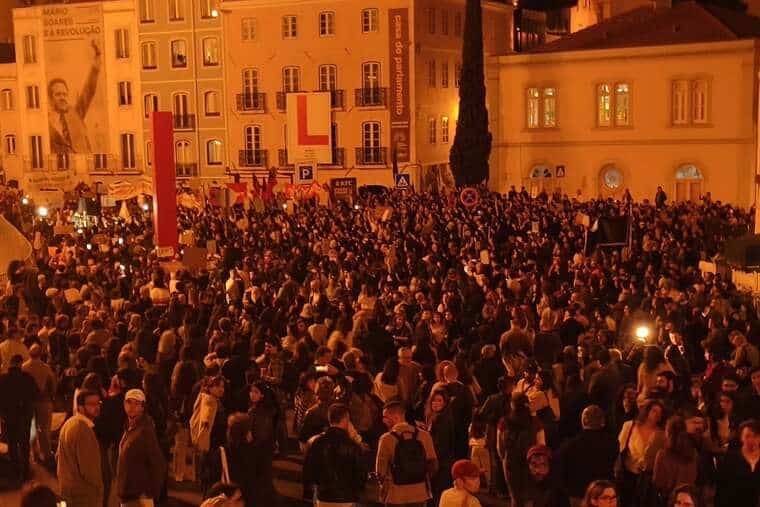
Many of the international solidarity protests took aim at police racism and violence in their own countries—and many defied state repression and bans.
In Mexico, demonstrators linked their solidarity march to anger at the police killing of construction worker Giovanni Lopez.
He was beaten to death in police custody in May.
Some protesters in Mexico City vandalised the US embassy. And some in the city of Guadalajara battled riot police.

In South Africa, protesters likened the killing of George Floyd to that of Collins Khosa. He died after soldiers in the city of Alexandra beat him while enforcing lockdown laws.
Major rallies in Paris followed a protest of 40,000 on Tuesday of last week for Adama Traore, a black man who died in police custody in 2016.
They also come after racist comments on a private police Facebook group were exposed.
Thousands of people gathered for at least two protests in Paris on Saturday—defying a government-imposed ban.
Protests were also reported in about a dozen French cities, including Lyon, Bordeaux, Nice, Lille and Metz. More than 23,000 people participated nationwide, according to the Interior Ministry.
Several thousand people confronted riot cops protecting the US embassy. And there were thousands more in Champs de Mars park facing the Eiffel Tower.
Scandalous
Placards on the rallies read, “Being black is not a crime,” and, “Our police are assassins.” Dior, a Senegalese-Ivorian student, said, “I find it scandalous that all these injustices go unpunished.”
Protesters also defied a ban in Sydney, Australia.
Authorities had to scrap the ban on protests as it became clear the rally would go ahead.
Thousands of people who thought the ban was still in place turned up anyway.
Protester Jumikah Donovan, said, “The fact that they have tried to push us all back and stop the protest, it makes people want to do it even more.”
There were also protests in the capital Melbourne.
Organisers of protests in Derry and Belfast, in Northern Ireland, face prosecution under lockdown laws.
Both were attended by thousands of people. Police said they issued a “significant number” of fines and low-level punishments and threatened to “seek prosecution” of the organisers.
Cops in Stockholm, Sweden, used social distancing rules as an excuse to break up a solidarity march last Friday.
Some 3,000 people marched in Athens, Greece, on Wednesday of last week.
They rallied in the square outside Greece’s parliament building before moving on to the US Embassy.
Police later attacked protesters outside the US Embassy with tear gas.


Sydney campaign has stopped the construction of a environment-destroying data centre
General strike marks the beginning of a new wave of resistance
An encampment remains in Porto, while in Lisbon activists have shifted to mobile protests and a planned general strike
Socialist Worker spoke to striking workers on the streets of Barcelona