One of the sessions at the Summit of Resistance last weekend saw a lively debate over left alternatives to Labour
The Socialist Workers Party (SWP) believes there needs to be a serious socialist challenge to Labour in elections.
SWP members are standing as independent socialists, for example, Jane Hindle in a Chesterfield Council by-election on 1 May. And we support the building of a left umbrella organisation where different forces can work together.
There are two dangers—one is to stand on the sidelines of this debate about elections, the other is to go into it without fighting for revolutionary politics.
Why do revolutionary socialists take part in elections?
Karl Marx and Frederick Engels revelled in pouring scorn on “parliamentary cretinism”—the idea that MPs or councillors are the key actors in winning social change.
Parliament is a tiny elected island in a sea of unelected, unaccountable bureaucracy designed to protect the system. Real power lies with corporations who make the major economic decisions that determine the priorities of our society.
So we look to working class struggle from below—crucially strikes which have a unique power to hit the profit system.
However, at the same time as denouncing “parliamentary cretinism”, Marx and Engels argued that socialists should stand in elections. This wasn’t through illusions in parliamentary politics—in fact, quite the opposite.
It was so socialists could “preserve their independence, to count their forces and to lay before the public their revolutionary attitude and party standpoint”.
To many readers of Socialist Worker, “politics” isn’t something that simply happens in parliament or the council chamber. It takes place day in day out and is independent of the electoral cycle.
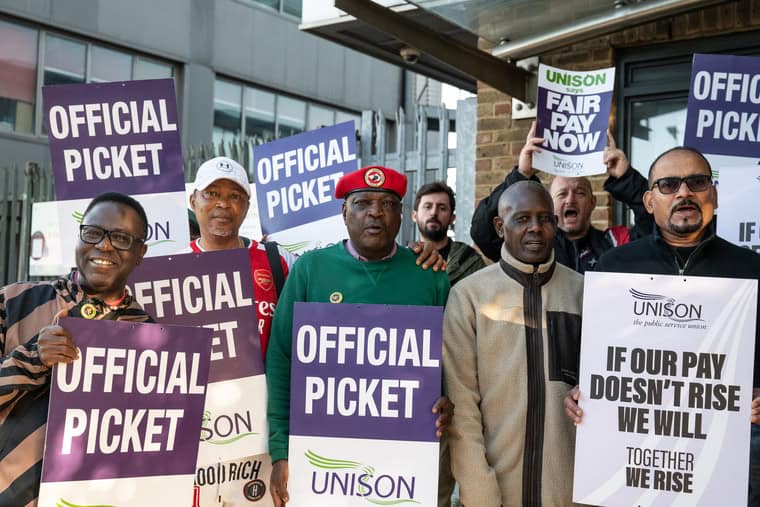
It takes place on picket lines and in union meetings, at protests and student encampments, in housing campaigns against developers or anti-racist activism.
But that isn’t the view of the majority of working class people. Elections are the time when the majority is officially permitted to have a say about politics.
This means they are a terrain of struggle—and an opportunity for revolutionaries to put forward socialist arguments to much bigger audiences.
And, most importantly, they can be a chance for us to champion struggles whether that’s strikes, campaigns or mass movements.
This was the approach of Vladimir Lenin and the Bolshevik party who led the one successful socialist revolution in history in 1917.
That saw ordinary people form their own democratic organisations from below, workers’ councils, that took power in opposition to the capitalist state.
But the Bolsheviks still had MPs in the “Duma”, a parliament set up as a concession after an earlier revolution in 1905. They used their position to champion struggles outside and expose the limits of the parliamentary system.
A revolutionary wave swept across Europe—and mass Communist Parties were founded—in the wake of 1917. There were ferocious rows over strategy and tactics, including whether newly-formed parties should stand in elections.

Lenin said that “parliamentarianism has become historically obsolete”—revolution was the way forward. But he cautioned that socialists “must not regard what is obsolete for us as being obsolete for the working class” as a whole.
If socialists don’t stand, the only voices heard in elections are different types of capitalist politicians.
How does this apply today? There is a strong basis for a socialist challenge to the Labour Party. The political crisis is much deeper than in the 2000s when the SWP was part of left challenges to Tony Blair’s Labour government.
Labour is offering even less than under Blair, who did invest billions into the NHS and education. And, added to how awful the Starmer government is, we face Reform UK—an insurgent far right party with MPs for the first time.
Today, there are two important questions socialists have to answer around elections.
First, how do we fight Reform UK? A mass campaign in the local elections in May and beyond through Stand Up To Racism is vital. It’s a “united front” that involves revolutionary socialists, the trade unions that remain wedded to Labour, the Greens and others.
A socialist challenge to Labour in the elections will bolster such efforts. When we say on the doorstep, “Don’t vote Reform UK, it’s a racist party,” a common response is, “You’re not asking me to vote Labour are you?”
A left alternative is not going to win over large numbers of Reform UK voters. But we can give people who don’t support Farage a reason to come and vote. It’s much easier to do so if working class, left wing and anti-racist voters have a choice worth voting for.
We need a left that says “Tax the rich, no to austerity”, “Free Palestine”, “Refugees welcome here” and “Trans+ rights now”.
Second, if revolutionary socialists abstain from the electoral battlefield, other forces will fill the void, such as the Greens.
The Green Party adapts to both the left and right in order to win more votes. Green councils have implemented austerity, the party backs the Nato warmongers’ alliance and didn’t oppose Starmer boosting military spending.
There are other forces that are principled on Palestine, but will throw refugees or trans+ people under the bus.
Others want to talk about “community” and play down overt class politics that goes after landlords and the rich.
Politics matters—and without revolutionaries the politics will be weaker. We need a left that says “Tax the rich, no to austerity”, “Free Palestine”, “Refugees welcome here” and “Trans+ rights now”.
There are important differences between the time Lenin was writing in and today. He was talking about mass Communists Parties, with deep roots in the working class, standing as Communists amid revolutions.
At the moment, we’re talking about standing as independent socialists. We want to work with the people we’ve fought alongside over Palestine, anti-racism or austerity in recent years.
But there is a wider desire for a new left formation. Here, we’ve got to learn the lessons of the last 10 years.
It is a decade littered with left reformist projects that failed—Syriza in Greece, Podemos in the Spanish state, Bernie Sanders in the US and Corbynism in Britain.
Sometimes revolutionaries use a shorthand that says left reformist parties ignored struggle and just focused on elections—and that’s why they failed. But that’s not true. Many of these projects were the political expression of mass movements.
The key question is, which is subordinate to the other?
For left reformists, the aim is forming a “socialist government” or getting good MPs elected to win political change. Struggle is subordinated to that goal—and can have a dampening effect on it as people wait for change from above.
And there is a rightward pull to tone down the more radical demands as a left reformist party tries to win more votes.

For us, elections are a terrain of struggle always subordinated to the aim of building up working class power to confront capital and the state.
As Lenin writes in Left Wing Communism, “Action by the masses, a big strike for instance, is more important than parliamentary activity at all times and not only during a revolution or in a revolutionary situation.”
So why do we think a left alternative to Labour would be a step forward?
In History of the Russian Revolution, Leon Trotsky described how working class people choose their leaders through a process of “successive approximations”.
In February 1917, workers and soldiers toppled the old Tsarist dictatorship which brought to power a “Provisional Government” that wanted to keep much of the system intact.
People started “not with a prepared plan of social reconstruction, but with a sharp feeling that they cannot endure the old regime”.
But the Provisional Government’s failure to address the social crisis saw workers go through “a change of parties in which the more extreme always supersedes the less”.
Trotsky was writing in a time of revolutionary upheaval—much more favourable terrain. And the process he described is far from inevitable.
But a learning curve has to start somewhere—and a break with Labour could be the beginning of a journey for large numbers of people.
Most socialists who’ve broken with Labour haven’t broken with “Labourism”, the idea that electoral politics is most important to winning political change. But, through working together in elections, we hope to persuade more of the need for a revolutionary break with capitalism.
At our conference, the SWP said a “broad-based, pluralist umbrella” would be the best form for a left electoral project. It hardly rolls off the tongue, but it fits the needs of the movement and the moment.
We want to unite with other forces in elections to offer a left electoral challenge. And we need to build an independent revolutionary organisation within the working class around socialist, anti-capitalist politics.
We invite responses at [email protected]


Jude Mckechnie spoke to the workers leading the fightback against outsourcing
Judy Cox reviews End Times Fascism by Naomi Klein and Astra Taylor
On the ground in Gosport
Ninety years since the Battle of Cable Street