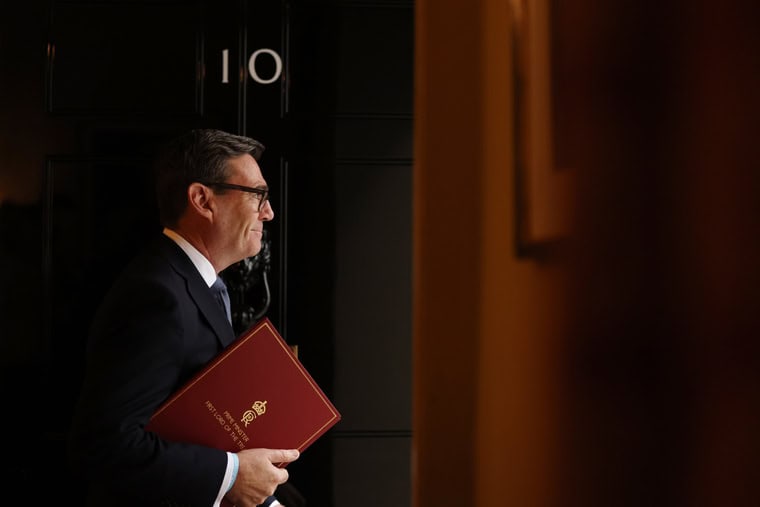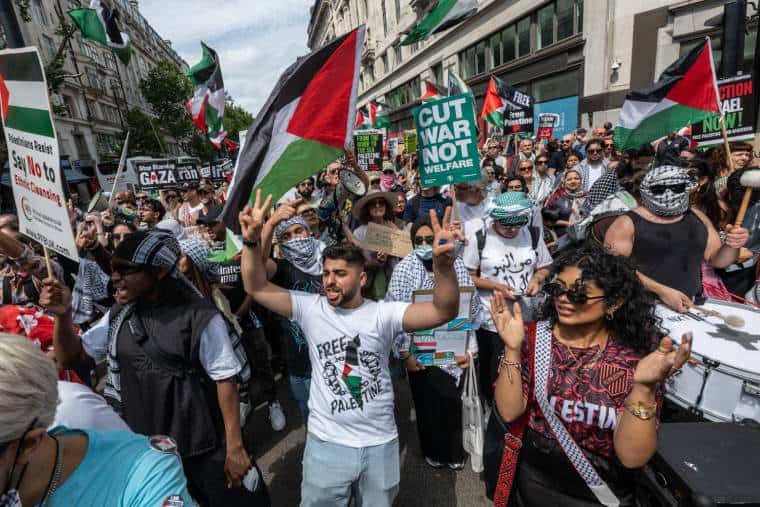
The Palestine march in London on 18 July delivers a message to new prime minister Andy Burnham (Picture: Guy Smallman)
Labour hoped that its recent shift in tone over Palestine would win back voters—and rebuild the legitimacy that the Western “liberal order” and Israel have lost.
But the response from the Israel’s far right leadership has deepened the crisis and opened up opportunities for the Palestine movement.
Understanding the shift—and its limitations—is key if our side is going to capitalise on the civil war in theirs.
Britain was among 12 Western states, including France and Canada, to say it wouldn’t trade with settlements that are illegal under international law. Labour foreign secretary Ed Miliband announced limited sanctions in the House of Commons this week.
Why did this shift take place?
First, it would not have happened without the Palestine solidarity movement, without all those who marched, walked out, occupied and took direct action.
The Palestine movement was the decisive factor that broke Keir Starmer’s premiership long before he had to resign as prime minister. Hundreds of thousands of people broke with Labour to the left, first to independent challengers and then mainly the Green Party. Many will never return.
Around 53 percent of voters who switched to the Greens, Independents, Scottish National Party, Plaid Cymru or the Lib Dems said Palestine was a “factor or a major factor”.
Among Green voters, 67 percent said it was a “factor” and 30 percent said it was a “major factor”.
The same polling asked voters who abandoned Labour since the general election in 2024 what would change their perception of the party. Some 67 percent of those voters said they would “have a much more favourable view” of Labour if “the next leader were to adopt a stronger policy”.
Polling for the Palestine Solidarity Campaign and Friends of the Earth shows the impact of the Palestine movement in the elections on 6 May.
Andy Burnham knows part of his job is to win back voters that Labour had lost to the left.
When Starmer resigned, 14 percent of people who voted Labour in the general election said they would now back Zack Polanski’s Green Party. That figure is down to 9 percent since Burnham took over.
The shift in tone on Palestine will help to sustain the “Burnham bounce” during the autumn.
Labour officials will breathe a sigh of relief as they face the Holborn and St Pancras by election in London on 8 October after Starmer resigned as an MP. Starmer’s majority significantly shrank in the general election as independent challenger Andrew Feinstein and the Greens made gains.
Green Party leader Zack Polanski has said he’ll stand in the by election. If Labour retains the seat, that will further boost Burnham.
The scale of the movement means that Labour was forced to go further on Palestine than before. Miliband acknowledged “that there is ethnic cleansing of Palestinians in areas of the West Bank perpetrated by settler terrorists”.
He accepted the International Court of Justice (ICJ) view that the Israeli occupation of the West Bank, not just settlements, is “unlawful”.
And, in subsequent interviews, Miliband accepted that Britain owed the Palestinians an apology.
But the Labour Party’s strategy goes much deeper than trying to win back voters. This has never been Labour’s only calculation. If it was, surely Starmer wouldn’t have done half the policies he did?
Rather, it is linked to how Israel’s crisis of legitimacy threatens the whole imperialist order that backs it.
The ruling class uses a combination of “force and fraud” to maintain its wealth and power. We can see the “force” on full display on the streets of the US, the war on Iran, and in the repression of the Palestine movement.
But the ruling class also relies on “fraud”, on convincing people to accept—at least in part—the way the world works as “natural”. In times of crisis, however, this acceptance can begin to break down as millions of people come to see through their lies.
The inability of ruling classes to provide solutions to the crises, whether war or climate chaos, fuels such a crisis of legitimacy. But, in the West, it is deeply intertwined with Gaza.
For over 30 years, US imperialism has destroyed Afghanistan, Iraq, Libya and other countries under the guise of “humanitarian intervention”. At the same time, it holds up Israel as a “civilised society” and the “one democracy” in the region.
Many people have always rejected Western talk of “humanitarian intervention”, but millions of others did buy into it.
For them, seeing the West’s premier ally in the dock for war crimes has helped shatter an entire “world view”.
As Israel committed new atrocities every day—starvation, murder, annexation—its claims of “humanitarianism” were barely hanging on by a thread.

In France a decisive 68 percent of people hold a negative view of Israel, in a stark turnaround to before the genocide.
In Britain, 50 percent say Israel is committing a genocide while 62 percent oppose Israeli military action in the West Bank and Gaza and 60 percent in Lebanon.
Almost 60 percent support a total suspension of British arms sales to Israel. That was once a demand that didn’t gain an echo beyond the far left and most radical sections of the movement.
That is what drove French president Emmanuel Macron and Keir Starmer to declare recognition for a Palestinian state in the summer of 2025.
Western leaders were forced criticise Israel action as an attempt to re-establish their legitimacy, fearing their ability to justify imperialist wars in the future.
For the Western governments that announced sanctions, resurrecting the “two state solution” is a vital part of their strategy.
The joint statement from the foreign ministers of the 12 states makes this clear. It opens, “The government of Israel’s actions in the West Bank are undermining the possibility of a two-state solution.
“Prime Minister Andy Burnham, the President of France Emmanuel Macron and Prime Minister of Canada Mark Carney have agreed on the need to take action to prevent further damage.”
Miliband said, “The set of measures I have announced represents a clear message to the government of Israel, to the Palestinians in the Occupied Territories, and to the world that we will not acquiesce in the destruction of the two state solution.
“This is in our fundamental national interest because if there is one lesson of recent decades, it is that we will never have stability in the Middle East without a two state solution.”
The “two-state solution” was a sham that allowed the West to back Israel while claiming a Palestinian state could one day exist on a small portion of the stolen land.
In 1990s, the US promised a Palestinian state based on the West Bank and Gaza, which Israel had grabbed in 1967.
This peace process was the product of Palestinian resistance—and the Palestinian Liberation Organisation (PLO) leaders making disastrous concessions.
The First Intifada, a mass uprising that began in 1987, shook the West and its watchdog state. It saw strikes, boycotts and rallies and inspired resistance across the region in Egypt, Turkey, Sudan, Kuwait, Algeria, Tunisia, Morocco and Syria
Fearing the spread of resistance, the US began talks between Israel and the PLO that led to the Oslo Accords of 1993.
But the agreements in the 1990s only granted Palestinians control of less than 20 percent of the West Bank.
Israel maintained its control and expanded settlements in the West Bank since then. The Palestinian Authority—initially led by PLO leader Yasser Arafat who had heroically fought Israel—became a subcontractor for the occupation.
But the Oslo Accords allowed the West to say it did support the rule of law and justice for the Palestinians, while in practice backing its watchdog state.
When the Israeli leadership has endangered that, the West has sometimes stepped in with criticism.
Ten years ago, US president Barack Obama’s administration chose not veto a United Nations (UN) security council resolution condemning settlements in the West Bank.
US Secretary of State John Kerry argued that the US had to save the “two state solution”—or at least had to be seen to do so. He described a “two state solution” as the “only way to ensure Israel’s future as a Jewish and democratic state” and “an important way of advancing US interests in the region”.
He said the US could not “stand idly by” and “allow a dangerous dynamic to take hold which promises greater conflict and instability to a region in which we have vital interests”.

“It would serve American interests to stabilise a volatile region and fulfil America’s commitment to the survival, security and well-being of an Israel at peace with its Arab neighbours.”
Those interventions came in the wake of the “Arab Spring” that challenged the West and isolated Israel. The revolts shook Arab regimes that are part of the US imperialist infrastructure, and Palestine solidarity ran through them.
Kerry’s aim was to reign in Israeli actions, fearing that the death of the “two state solution” would bring further instability.
Today, Miliband said, “The sanctions regime will target illegal settlements and settlement expansion, not Israel.
“I wholeheartedly oppose the Boycott, Divestment, Sanctions or BDS campaign.”
There is an added dimension. The British state and the Labour government are grappling with how to deal with the breakdown of the US’s liberal world order.
Britain wants to maintain its position as a junior partner of US imperialism. But the Labour government, and other members of the Nato warmongers alliance, have clashed with the Trump White House.
One such flashpoint is Ukraine, where European leaders want to keep the proxy war between Western and Russian imperialism going.
Burnham and Macron are organising those states to lobby Trump for more arms at a meeting in New York in September.
Britain and France hope that being seen to lead on the international stage will bolster their position as they navigate the new order of increasing competition.
British diplomats were clear that the sanctions “are largely symbolic and will have no material impact on the UK’s wider relationship with Israel”.
But the reaction from Israel’s far right leadership has opened up a deeper crisis in the strategy and means they may not get their way.
The Israeli government has reacted with a storm of fury and accusations of antisemitism to the mild measures.
It ordered the British consulate in Jerusalem to shut and banned 12 high profile politicians and activists, including Jeremy Corbyn and Green MPs, from entering Israel. Miliband, who is Jewish, was outrageously labelled an antisemite.
Israel has threatened further measures—and made clear that it will never allow even the sham of the “two state solution”.
Nearly three-quarters of Jewish Israelis favour partial or total annexation of the West Bank, a poll for the Jewish People Policy Institute found.
All leading candidates in the upcoming election on 27 October reject a Palestinian state.
The ascendency of the far right is a product of Israel’s settler colonial society. Each time Israel has been unable to crush the Palestinian resistance, politics and society marches further to the right.
It flows from a basic problem—Israel wants to grab more Palestinian land but has always wanted to maintain a Jewish demographic majority.
This means that Israeli settler colonialism swings between apartheid and genocide as a way of dealing with the “problem” of Palestinians. And since 7 October, it has come down firmly on the side of elimination.
Seize the opportunities, but don’t sow illusions in Labour.
One danger is thinking that Labour, now Starmer is replaced with Burnham, is a friend of the movement.
Middle East Eye ran an opinion piece this week by Chris Doyle, director of the Council for Arab-British Understanding. It is a gushing article, headlined, “Miliband has decisively broken with decades of UK inaction on Palestine.”
“It is a welcome shock to find a government prepared to be bold and take the lead, its moral compass steering the direction of travel,” he writes.
“For this to continue, those in favour of peace and justice in the Middle East will have to work hard to keep it on course.”
But the Labour front bench is not a friend to be gently encouraged to maintain its righteous course.
Labour remains deeply complicit in a genocide it still refuses to call genocide—and saying that is, to use Miliband’s words, simply an acknowledgment of reality.
The fact that the invertebrates of the Labour front bench were forced to act is a sign of their crisis—and the impact of the movement.
The Palestine coalition in Britain says the sanctions must be a “floor, not a ceiling”. “A ban on goods, finance, construction and advertising of settlements is just the beginning,” it says
“While it is right for the government to refuse additional arms export licences, loopholes remain that have allowed the continuation of F-35 components to be exported, even at the height of the genocide. If the government is serious about ending complicity, a full two-way arms embargo must follow.
“Settlements are one part of a wider system of occupation and apartheid across historic Palestine, and extending to the millions of Palestinian refugees living outside their homeland whose right of return has yet to be implemented.
“Israel’s entire system of colonial occupation and apartheid must be dismantled, and we will continue to push for the complete implementation of the inalienable rights of the Palestinian people.
Many people will have had their expectations raised by Starmer’s departure. The left has to argue that they will only be fulfilled if there is a fight on the streets and workplaces, not waiting for the Burnham government to deliver.
So seize the opportunities opened up by the shift to fight for much more than Labour’s attempt to rebuild its legitimacy and safeguard Israel.
Let’s demand Labour stop arming Israel, impose a trade embargo and expel the ambassador. Keep fighting for the British state to sever its links with Israel—and for Palestine to be free from the river to the sea.
Tomáš Tengely-Evans is editor of Socialist Worker and author of newly-released book, Death Rides Out: Imperialism in the 21st Century. Available from Bookmarks: the socialist bookshop
26 September: Tell Andy Burnham, Stop arming Israel, march on the Labour conference in Liverpool, 12noon, St George’s Plateau.
1 October: No to Palantir day of action. Go to the Palestine Solidarity Campaign website for details.
10 October: Palestine national demonstration in London, part of an international day of action
30 October: International day of action in support of dock and port workers. See Stop The War for more info. What can you do in your union branch, workplace or campus?


MioCare strikers in Greater Manchester want answers about proposed National Care Service
What do we learn from his speech?
Interviews with Palestine activists
Arrestee speaks out