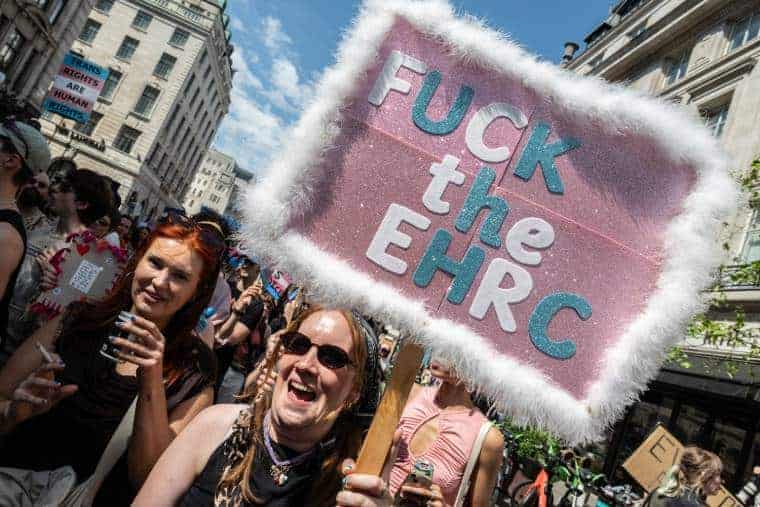
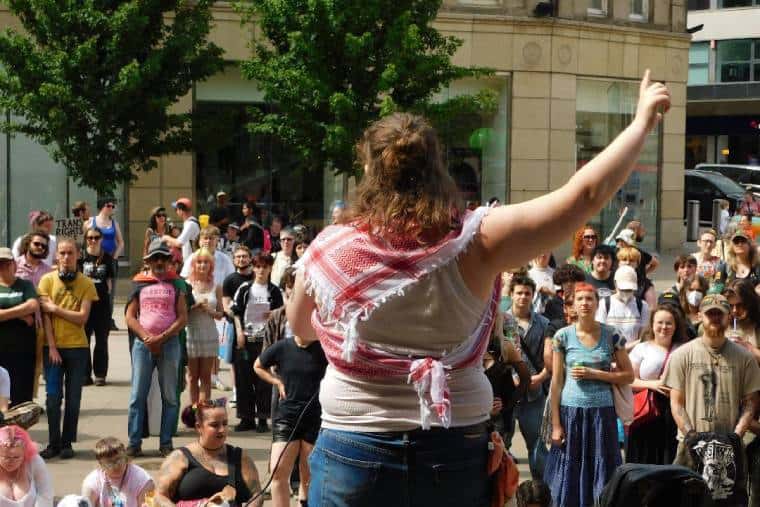
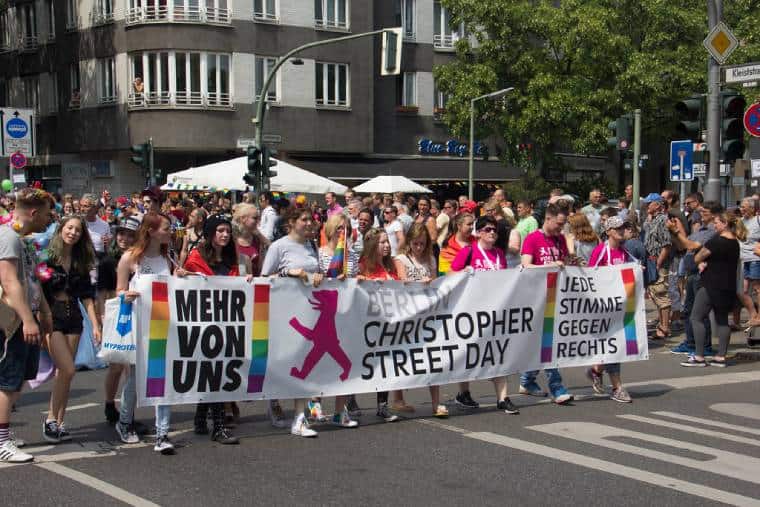
At Trans+ Pride in London (Picture: Guy Smallman)
The avalanche of transphobia in Britain has accelerated after a UK Supreme Court ruling.
Judges ruled on Wednesday that the legal definition of a woman is based on “biological sex”.
For Women Scotland, the group that brought the case, has hailed it as a victory against sexism.
It will do nothing to advance women’s liberation or tackle sexism, whether that’s far right misogyny, attacks on abortion rights or rocketing childcare costs.
It will only embolden the right wingers and bigots who want to attack women’s and trans+ rights.
Judge Lord Hodge concluded that the meaning of the terms “sex”, “man” and “woman” in the Equality Act 2010 refer to “biological sex”.
The ruling claimed that any other interpretation would make the Act “incoherent and impracticable” in a boost to every bigot.
The decision is an assault on the already limited Gender Recognition Act, which allows trans+ people to get gender recognition certificates after jumping through bureaucratic hoops.
The ruling undermines gender recognition certificates. It says, “A person with a Gender Recognition Certificate in the female gender does not come within the definition of a ‘woman’ under the Equality Act 2010.”
“As a matter of ordinary language” cases relating to sex discrimination can “only be interpreted” as referring to “biological women”.
There are nine “protected characteristics” under the Equality Act, including “sex” and “gender reassignment”.
Trans+ people still have some rights under the “gender reassignment” characteristic. But the ruling boosts all those who want to undermine trans+ rights altogether—particularly in the NHS and education.
The ruling doubles down on the British state’s refusal to recognise non-binary people. “The definition of sex in the Equality Act 2010 makes clear that the concept of sex is binary, a person is either a woman or a man,” it says.
The decision is underpinned by “biological determinism”. As the ruling says, “Men and women are on the face of the definition only differentiated as a grouping by the biology they share with their group.”

This dominant view of sex and gender was summed up by the scientist Professor Robert Winston in another case. “I will say this categorically—that you cannot change your sex,” he said.
“Your sex is there in every single cell in the body. You have chromosomal sex. You have genetic sex. You have hormonal sex.”
This sort of view assumes that biological differences determine what it means to be a man or a woman.
But some of those statements simply aren’t true and show that people use sex to refer to a broad range of things. It’s true that we can’t change our chromosomal sex, but people can—and do—change their hormonal balance.

The idea that being a man or a woman is reducible to biology is false.
Firstly, even if we define biological sex as reproductive anatomy, it still isn’t binary. Many women have naturally high levels of testosterone, and one in 1,500 people have intersex characteristics.
Secondly, human biology isn’t fixed and unchanging—whatever the transphobes would have us believe.
The reactionary Cass Review into trans+ healthcare went on about height differences between men and women. But height is in fact an example of something biological that has changed due to social factors, such as diets, over time.
Biological differences between what we define as male and female sex organs are real. But why do they matter so much? The answer lies in socially-made gender differences.
There is no contradiction between women’s liberation and trans+ liberation
Anthropological evidence shows that different biological reproductive capacities didn’t always mean differences in social status or power between genders in pre-class or earlier class societies.
Many earlier societies didn’t have rigid ideas about a gender binary. Anthropologist Will Roscoe’s research suggests that over 150 Indigenous tribes in North America embraced gender variant people. Some tribes thought there were three, four or more genders.
Before the birth of class divisions around 10,000 years ago, societies were organised on more egalitarian lines without women’s or LGBT+ oppression.
But biological differences took on a particular importance in class society because of the role of the family.
The family is the main way that the next generation of labour has been raised and socialised in class societies.
This institution underpins rigid notions of gender and sexuality in our society and plays an important ideological role, particularly for the right.
Our ideas about gender—what a man should be and what a woman should be—aren’t plucked from the air.

Gender is formed and transformed in processes rooted in the social relations of class and capitalist societies.
This includes the needs of capitalism—but also struggles against sexism. And struggles from below have challenged gender norms and sought to broaden and redefine what it means.
Today that should be inclusive of cis and trans women. Socialists should proudly say, “Trans women are women,” “Trans men are men,” and, “Non-binary people exist and should be respected.”
A wave of resistance should meet the Supreme Court decision. Some campaigners are already organising protests—and others should follow their lead.
Socialists have to win the labour movement to wielding its power to fight for trans+ rights like it has done over abortion rights.
We have to resist the attacks on trans+ people in the here and now, but we also have to challenge the whole system to win liberation.
Further reading
Beyond Binaries, a Socialist Worker pamphlet. Available as a PDF
Biology is not our destiny, Sheila McGregor, International Socialism journal
What is a woman? Judy Cox, Socialist Worker


Fight every attempt to exclude, isolate and attack trans+ people
The far right are stoking up fear and hatred of Muslims