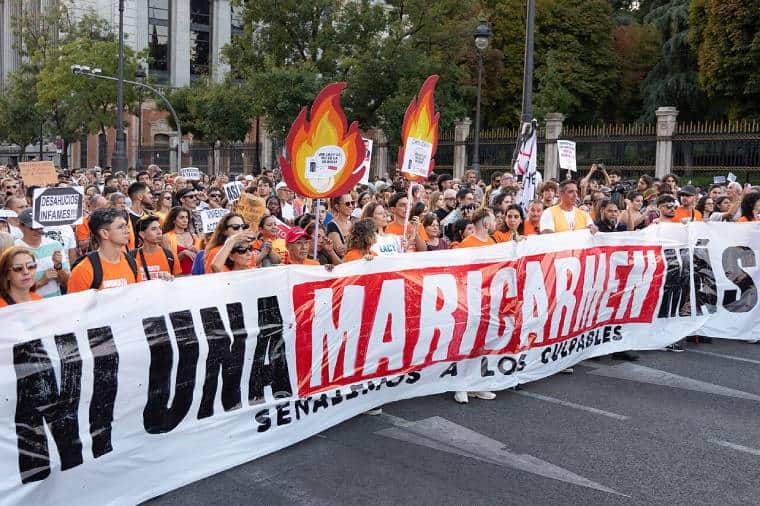
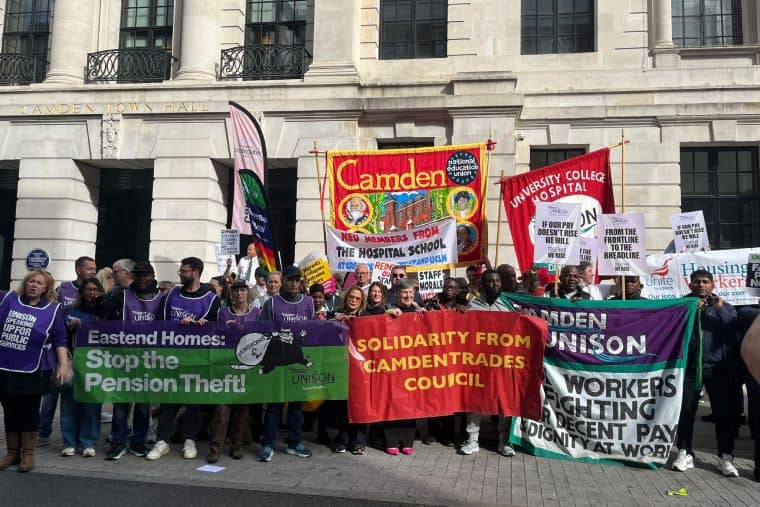
PCS union memebers marching on the TUC union federation demo in June (Picture: Guy Smallman)
Tens of thousands of civil service workers have voted to join the pay revolt, in ballot results released on Thursday.
The PCS union said some 100,000 of its members—including in government departments such as the DWP and the Home Office—had voted to strike. Speaking on a video broadcast, PCS general secretary Mark Serwotka said it was a “historic result,” and “the best result the union has had.”
“We are immediately able now to call industrial action that will involve 100,000 PCS members,” he said. He added the results encompassed “all the key areas that we believe are required to immediately put pressure on the government this side of Christmas and into the new year.”
The ballots were disaggregated, meaning workers in every department or employer each had to pass a 50 percent turnout threshold. Workers in 126 ballots passed the threshold and voted to strike, including the largest department DWP, the Home Office and the Department for Transport.
But the ballot in the HMRC tax office was just 750 votes short of the threshold. And Serwotka said six more were just one vote short.
All of those were nevertheless voted to strike—and the turnout across all those balloted was together more than 50 percent. The PCS says it will ballot HMRC workers again early next year.
The results mean there’s now an even stronger argument across the trade union movement for united, hard-hitting national action over pay. The civil servants join nurses and rail, post, telecoms and university workers in having a mandate for national strikes.
That’s not including important regional fights, such as by the Liverpool and Felixstowe dockers, and transport workers in London, the West Midlands and Tyne and Wear. And even more workers are set to join them, with more health unions running ballots, and a vote by teachers in Scotland expected soon.
Serwotka said he is set to meet with other union leaders in the TUC union federation on Monday of next week who are either balloting or have a mandate to strike. He said the meeting is to discuss “whether it is possible to coordinate all of our campaigns to ensure that any action that is called will be together with other unions.”
Yet the PCS’s national executive committee (NEC) voted on Thursday not to strike on Wednesday 30 November, when university and post workers are already set to strike together. Socialist Worker supporters on the NEC had argued to strike on that day, but were heavily defeated.
Instead, Serwotka said the union would give government bosses in the Cabinet Office a week to respond to the result. The union’s NEC would then announce a programme of action.
Serwotka said the union would only consider holding off action if the government “put on the table the commitment that there is more money available for all members now”. And “that they are not going to cut our redundancy terms and they are going to enter into a discussion to give us job security.”
And, he admitted, “We’re all sceptical as to whether they’re likely to do it.” But, responding to a question from PCS member Kate Douglas, he said the earliest that the union would call action would be early December.
Serwotka also said that calling all workers out together would likely depend on whether other unions were also striking. Instead, he suggested that strikes would focus on “targeted action” in sections or branches the union deemed would have the most effect.
He said the targeted action would be for extended periods, with strikers supported with a strike fund. But action together, where the union can’t pay everyone strike pay, would be left to one or two days at a time, and depend on action by other unions.
Serwotka said, as examples, that strikes in the Home Office would have an effect “given the political pressure on the government around borders.” Or, he said, workers in the Department for Transport might be called out on the same day as a rail strike.
The best way to put pressure on the government would be to bring every civil service worker out together. It would be even more powerful if they came out alongside other workers, such as post and university workers on 30 November.
But, after RMT and CWU union leaders called off some rail and post strikes, it would be a mistake to say PCS members can only strike alongside others. Civil service workers could instead take the lead by calling a national strike—and asking other unions to join them.


Unions have called a general strike
Interview with a member of French revolutionary socialist group Autonomie de Classe