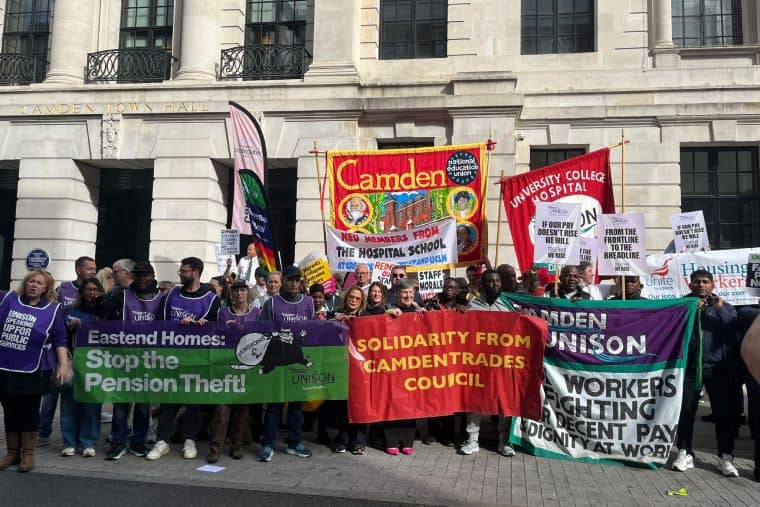
Thousands rallied against Labour’s welfare cuts in central London last year (Photo: Guy Smallman)
Activists are gearing up for a Summit Against Austerity hosted by the Green-run council in Hackney, east London, on Wednesday.
It comes after the Green Party won control of five councils in England after the local elections in May.
The Greens, which promised an alternative to Labour, face a key test. Will its councillors refuse to implement austerity and mobilise opposition outside the council chamber?
Or will they call for more local government funding but argue that “balanced budgets” are the only sensible option in the here and now?
These two visions will be on display at the summit—and activists have to fight for the radical one to win.
George Shelden Grun was elected as councillor for Hackney’s Clissold ward in May. He told Socialist Worker, “The idea started with Greens Organise—a group of Green Party members which is more explicitly socialist than the Green Party as a whole.
“Greens Organise launched the Manchester Declaration to take the Green Party in an eco-socialist direction.
“They campaigned for councils to pledge themselves against austerity and part of the pledge was hosting a summit.”
“Passing a no cuts budgets could work if it is coordinated across councils.
“But some Greens are not that radical and some worry about being put into administration and being run from Westminster.
“Most Green party administrations are not prepared to pass no cuts budgets.
“This is definitely something we will discuss at the summit. Is it just campaigning against austerity which people have been doing and hasn’t worked? Or do we need something more hardcore?”
George added, “In Hackney we wanted to adopt the pledge and it was decided to have the summit in the borough.
“The summit sends a message that we haven’t bought into austerity—and that is the upside.
“The downside is that anything in Hackney faces resistance from the top officers in the council. Their working lives have been under Labour and they don’t all want to do what we want them to.”
George explained that this meant council officials can be “risk averse and have a different ideology”.
It will be a surprise to many activists that Dawn Carter-McDonald, the chief executive of Hackney council, is a headline speaker at the summit.
She has pushed through austerity—including the closure of four schools—and is no friend of the trade unions.
Bosses, who are part of the problem, should have no place speaking at anti-austerity summits.
Many activists going to the summit want a more grassroots and radical vision.

Jordan, the Unison union branch secretary at Homerton hospital in Hackney, told Socialist Worker that she was excited to be speaking at the summit.
“It is great that the council is doing something,” she said.
“This is the first time I have seen something like this being organised by a party which has just been elected.
“We’ve seen our members being made redundant because of council cuts and we don’t want it to continue or escalate.
“So I am excited to see what they are going to propose at the summit and if Hackney will be a leading light for other boroughs.”
She added, “If a few boroughs stand together and pass no cuts budgets, it would be much harder to pick them off.
“We want to get those at the summit to support the budget demonstration” (see below).
Councils say they have a responsibility not to overspend, no matter how much their budgets shrink over time. An alternative is to set an “illegal” no cuts budget.
But council leaders, including left wing ones, say that would only government-appointed commissioners to come and run the council.
“We are committed to setting a balanced budget,” Hackney Green mayor Zoe Garbett told the Hackney Citizen newspaper in a recent interview.
One of the most recent examples of commissioners being sent in is Birmingham, when the council faced bankruptcy.
They were met with very little resistance. But imagine if the trade union movement and community campaigns had mobilised mass resistance in the city?
Unison, Unite and GMB could have organised ballots for strikes and brought thousands of workers onto the picket lines.
That could have galvanised broader resistance in the city—and challenged councillors to stand with those fighting back.
People who use services, whether libraries or nurseries, could have occupied them to block the authorities.
The fact that didn’t happen is a failure of the left and labour movement, but the strategy still gives the best chance of winning.
Millions of working class people desperately need a break with austerity—and that requires the unions and campaigns to organise resistance.
Green councillors should help build that resistance and refuse to implement cuts.
Eve of Budget March Against Austerity, assemble 6pm, Tuesday 27 October, Victoria Embankment, march to Downing Street


Interview with a member of French revolutionary socialist group Autonomie de Classe
MioCare strikers in Greater Manchester want answers about proposed National Care Service