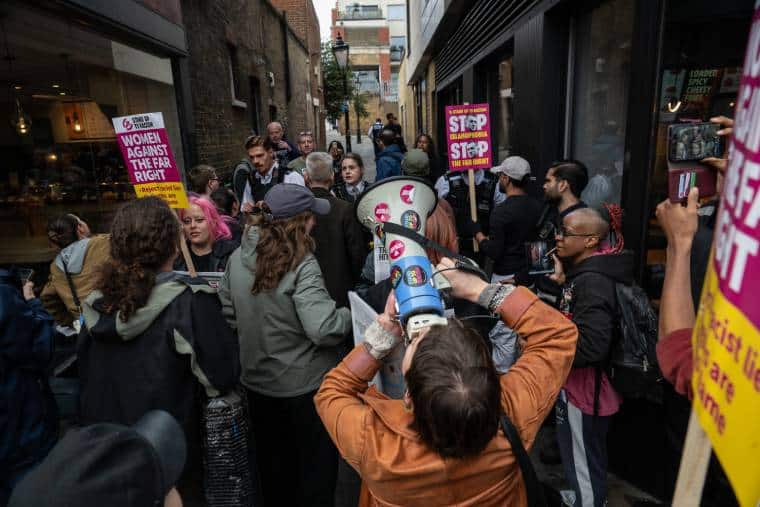
Royal Mail pickets in Northfield, Birmingham, on 13 October (Picture: Brian O’Sullivan)
CWU union leaders have reacted to Royal Mail bosses’ escalation in their war on workers by calling off two planned strikes.
The announcement on Tuesday evening is a further sign that union leaders are preparing a retreat in the months-long battle over pay, jobs and working conditions. It should be met with demands that action is called back on immediately—and escalated to match the scale of bosses’ assault.
In a video broadcast on Tuesday evening, CWU general secretary Dave Ward announced that he was calling off two strikes set for Saturday of next week and Monday 14 November.
It came a day after Royal Mail bosses demanded workers accept a pay cut—dressed up as a new offer—and sweeping attacks on working conditions.
Royal Mail said it wanted workers to settle for a 7 percent rise over two years, plus a lump sum payment of 2 percent this year. That’s massively less than inflation. And it would be paid only if there were worse terms on Sunday working, start times and flexible working.
Bosses also want to tear up years’ worth of protections, slash jobs, and bring new starters in on worse terms and conditions. It’s an assault that CWU union leaders themselves describe as “a surrender document.”
“If the union and its members were to embrace that we would be giving up every single term and condition we have fought for, for so many years,” Andy Furey, CWU acting deputy general secretary for the post, said on Tuesday.
It’s an all-out assault on workers that would best be met with all-out strikes.
Yet Ward and Furey said they would delay action—and put Royal Mail’s offer to workers in a ballot. Ward said the union would instead call strikes for Thursday 24 and Friday 25 November, and Wednesday 30 November and Thursday 1 December.
He also said there would be more strikes in December. But that means, by the time workers strike on 24 November, there will have been more than a month without strikes.
Many CWU members reacted to the announcement with anger and confusion. The CWU’s head of communications Chris Webb had to admit that “loads of members” were demanding that the union reinstate the two cancelled strike days—alongside the new ones.
“People are saying, the union’s bottled it, we’re surrendering, we’re giving up to Royal Mail—why aren’t we keeping the pressure up?”
Explaining the decision, Ward made worrying signals that union leaders wanted to turn away from strikes—and make concessions—amid talks with bosses. “We have really got to take stock of where we are now, and we do have to put on the table other parts of our strategy to win this dispute,” Ward said.
He added, “There will be a hell of a lot of activity we’ll be expecting you to undertake and we don’t want that activity to run in conjunction with the strike action that was planned on the 12 and 14 November.
“Never believe there’s only one tactic that wins a dispute. What we’re putting forward is a rounded strategy. We don’t just get into a cycle where every strike is followed by the next one, the next one. You have to have a wider plan.”
Ward said in place of the cancelled action, the union would write to MPs, asking for a hearing at a parliamentary committee, and trying to get a debate in parliament. He also said union leaders wanted a meeting with Royal Mail’s shareholders where, “We will explain to the shareholders that the CWU is up for change and we will put forward our plan for change.”
He added that the union was “willing to acknowledge” that Royal Mail’s finances are “very difficult at the moment”. Yet that’s partly because Royal Mail paid £400 million in dividends to shareholders last year—worth the vast majority of a £750 million profit.
Those rich shareholders aren’t interested in how the union would run the business if it was in charge. For years they’ve wanted the changes that Royal Mail bosses are now trying to force through. And they’ve got the backing of the Tory government.
Just this week the Telegraph newspaper reported that the government would greenlight a possible takeover by billionaire shareholder Daniel Kretinsky, who wants to scrap Saturday letters deliveries.

That’s just one more piece of Royal Mail’s all-out assault on its workers—making this the worst time to retreat from strikes.
The now-cancelled strikes were themselves called less than a week ago. Union leaders originally called them in place of six days of sectional action they were to cancel after a legal threat from bosses.
Workers have the busy run-up to Christmas—including online shopping days Black Friday and Cyber Monday—to hit Royal Mail hard.
The best way to do that is to call longer strikes, with everyone out together, immediately—and be prepared to defy the law.


Israelis are closing in on Umm al-Khair
Plus: Police repression in Leicester
Far right is still a threat
What now for Greens?