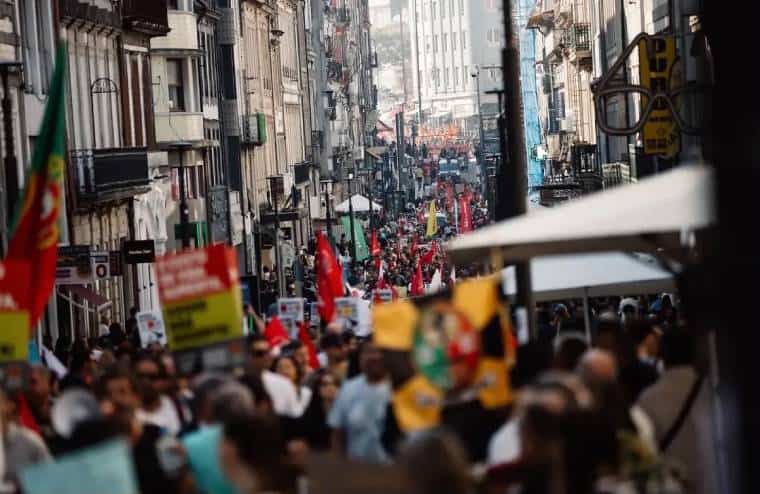
Protests in Porto, Portugal, last Saturday (Picture: CGTP Instagram)
The revolt over the housing crisis has spread to Portugal.
Police are brutalising protesters in dawn raids on their encampments. On Tuesday morning alone they put 30 people in hospital.
But protesters remain determined. Inspired by housing protests and encampments in the Spanish state, activists had set up camp in Praça D João I Square in Porto to fight for affordable housing.
Portugal’s conservative government has introduced policies that favour landlords and make evictions easier, while young people and students struggle to find somewhere they can afford to live.
Throughout the week, police repeatedly tried to force protesters to remove their tents. On Wednesday last week, Porto’s mayor, Pedro Duarte of the conservative PSD, promised to be “absolutely implacable” towards those occupying the city centre.
Around 2am the following day, riot police attacked peaceful protesters, injuring 37 people, two of whom were left in a serious condition.
The protesters complied with the demands but refused to leave the square. And as protesters sang “Grândola, Vila Morena”, the song that became a symbol of Portugal’s 1974 revolution, police charged at the crowd with batons.
Videos show activists linking arms and desperately shouting “peaceful, peaceful” as officers attacked them.
The violence has sparked widespread anger across Portugal.
Most of those involved in the encampment were young people and university students. They are part of a generation increasingly shut out of the housing market, facing unaffordable rents and growing insecurity.
Vasco, a protester and sociology student at the University of Porto, told Socialist Worker, “I joined the protesters last Sunday and on Tuesday night. It’s a peaceful protest, with people that clean the space all the time.
“Police messed with the wrong people—they thought it would be another exhibition of strength and brutality. But they found a movement that will resist until the last breath, if necessary.
“Porto was the city that resisted Absolutism, that started the biggest clashes against fascism decades ago, and that still resists Lisbon’s greed nowadays. It won’t be some police to scare us or discourage us from our commitment to freedom.”
Conservative prime minister Luís Montenegro called on groups not to import “climates of instability and contestation” into Portuguese society. It is staggering for a prime minister who owns over 50 properties to accuse protesters of acting out of “purely selfish reasons”.
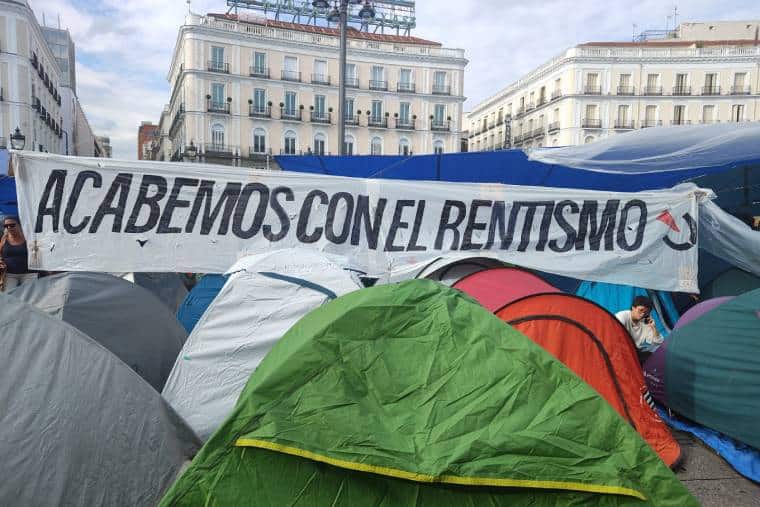
Portugal’s national minimum wage has been reported at around €820 a month after tax, while renting a one-bedroom flat in Porto can cost between €1,110 and €1,215 a month. Rents have risen by more than 100 percent over the past decade.
For many young people, “working hard” is no longer enough to secure a decent home. On average, Portuguese people can only afford to leave their parents’ home at age 29, due to precarious wages and lack of affordable housing.
The new rental laws, pushed through by Portugal’s right wing government and its allies, will only make the housing crisis worse. Landlords can now begin eviction proceedings after two missed rent payments instead of three.
They can demand up to three months’ rent in advance instead of two. And they can refuse automatic rental renewals rather than having to wait three years as previously required.
These changes leave tenants more vulnerable to eviction and housing insecurity.
But people have refused to bow down. Since Thursday, demonstrations have spread to cities across Portugal. Last Saturday, trade unions and left wing parties held a national demonstration. Tens of thousands joined the protests, with major mobilisations in Porto, Coimbra and Lisbon.
Eduardo Couto is the leader of the Left Bloc party in Aveiro and a social educator and LGBT+ activist. He told Socialist Worker, “What we’re seeing in many different cities in Portugal are diverse generations united by a single cry—we cannot live like this anymore.
“The reality is that, beyond the strong desire to take to the streets to demand a better life for working class people, the police brutality has only served to deepen the public’s solidarity with the cause.
“These are remarkable days in our country, days of great resistance against the cost of living that is suffocating everyone. And this is just the beginning.”
Organisers have pledged to continue the encampments in Porto, which have now expanded to the capital, until their demands are addressed.
The movement is demanding a review of rental laws, an end to evictions where people have no alternative accommodation and rent caps.
People want restrictions on housing acquisitions by real estate investment funds, more public housing and a public programme to bring vacant properties back into use as homes.
Protesters are demanding something basic—the right to live in a decent home without being driven into poverty. Police violence will not solve the crisis or silence a movement that is growing across Portugal and Europe.
The task now is to channel this frustration. Trade unions must organise further mass demonstrations—and strikes—to unite workers, students and tenants in a common fight against evictions, rising rents and police repression.


French students blockade schools ahead of the general strike on Thursday
Plus readers on fighting the far right in Glasgow, Trump's tariff war and arms spending