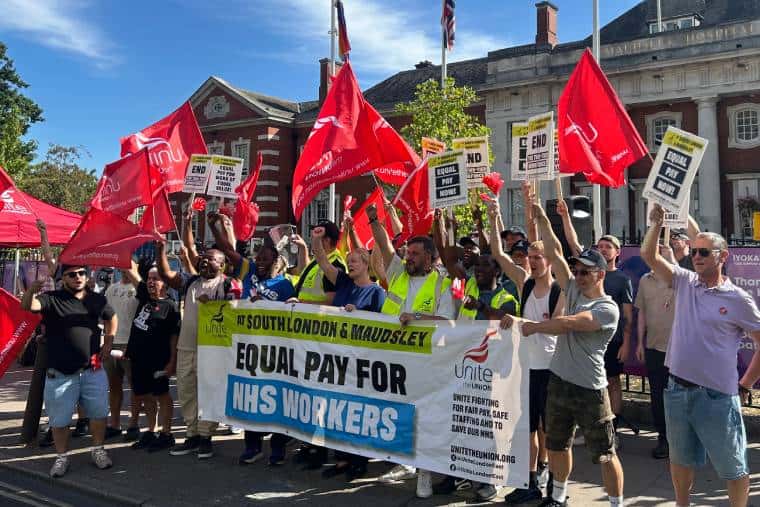
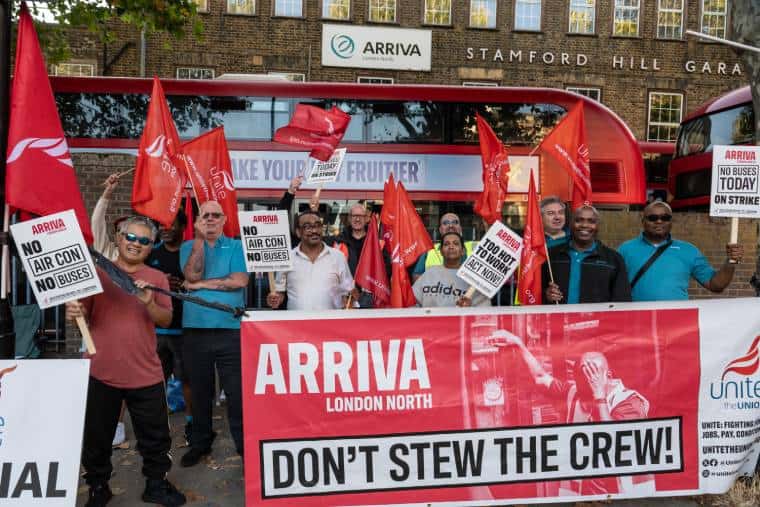
Ambulance workers on strike in east London (Picture: Guy Smallman)
Are the Tories cracking under the weight of the crisis and strikes in the health service?
The RCN union this week said nurses will strike on 6 and 7 February, with more NHS trusts taking part than during two days of strikes in December. Nurses at 55 NHS trusts in England were scheduled to walk out on Wednesday and Thursday this week, but the February action will grow bigger and cover 73 trusts.
Some 12 health boards and organisations in Wales will also take part in the two consecutive days of strikes.
There has been no let-up in the number of stories illustrating the scale of the NHS meltdown, with patients all over Britain describing their emergency departments as like a “war zone”.
Official data last week showed a record 54,000 people had waited in A&E for more than 12 hours after a decision to admit them in December. The backlog has in turn led to a sharp rise in the number of “excess deaths”—the number of people that have died above the five-year average.
Opinion polls last week showed that striking health workers are far more popular than the government. They also show Labour’s lead over the Tories extending. This has led some among Tory ranks to toy with the idea of a partial climbdown over NHS pay.
The Observer newspaper last Sunday said a major rift over this has emerged between the prime minister and his health secretary Steve Barclay. Barclay, said the report, was privately urging unions to help him make a case for extra pay to the Treasury, and that he was urging them to make a deal.
Leaders of the Unison union, which represents many striking ambulance workers, are particularly keen on the story.
That’s despite a filthy interview that Barclay gave last month. Then he said that by striking ambulance workers had “taken a conscious choice to inflict harm on patients”. Following last week’s talks with the government most unions reported their “bitter disappointment” at the lack of movement on pay.
The Unite union even said that the government was seeking “productivity savings” in return for a new settlement that might include a one-off cost of living payment. The idea that health workers, many of whom already work 12-hour shifts that can drag on longer, could work harder is nothing but an insult.

But Sara Gorton, Unison’s head of health, was keen to suggest that the government’s “tone has changed”. She continued, saying that Barclay now recognised a resolution to the dispute “would involve a reach-back into the current pay year”.
That could mean rather than seeking a pay rise at least in line with inflation for the whole of 2022-23, a deal might be struck that involves moving the 2023-24 pay year back to January from April. This is what is already happening in Scotland (see right) and would be a recipe for disaster.
Unless health workers’ pay is restored to pre-austerity levels, it will prove almost impossible to fill the thousands of NHS vacancies. The pressure on skilled and experienced staff to look elsewhere for work will continue.
This week’s planned nurses’ strikes and those by ambulance workers later in the month are showing the spirit of resistance that is needed.
Antonia is an RCN union activist and has been a nurse for almost 20 years. She works in a sexual health clinic and in hospitals on the south coast of England. She told Socialist Worker that the mood for this week’s strikes is “determined”.
“Lots of people I work with came into this strike not very politically aware, but now they want their voices heard,” she said. “In the past, the RCN wasn’t even a trade union and people treated it like a ‘professional body’. But now our members are hyper-aware of union politics and the way pay and patient safety are linked.
“They are realising the value of collective power.” Antonia says that this explosion of anger has made some in the leadership of the union a bit nervous. She added that this has built up tension between those that see the RCN as a union and those that see it as a professional body.
The way health strikes have fed into the wider class anger in society is also important to her, she says. “Solidarity between workers is really important. The media try and play us off against each other,” she said. “So they used to say to striking rail workers, ‘what about the poor nurses that don’t strike’.
“Now, they are trying to pitch nurses against other lower paid health workers. But if we win, everyone on the NHS agenda for change contract is going to benefit—including the lowest paid.” And, after hearing Labour’s Keir Starmer and Wes Streeting talking up the private sector, Antonia also has a message for them.
“I want the health service renationalised,” she said. “All this talk of working hand in hand with the private sector is dangerous ground—it just sucks staff and resources out of the NHS.“If Starmer really wants to know how to fix the NHS, he’d do better by talking to doctors and nurses.”
Trade unionists in Lancaster last week gave us all a lesson in how to raise solidarity funds for striking workers. They organised a brilliant gig attended by over 150 people and raised over £2,200 for the trades council’s solidarity fund. “We only started work on the event a month ago, so we were staggered by the take up,” Eugene Doherty of the trades council told Socialist Worker.
“It was standing room only. And if we can do this, so can you.”
Leaders of the RCN and GMB unions in Scotland shocked members last week by suspending industrial action for talks with the Scottish government. Union members in their thousands had already shown what they think of the deal imposed on them.
They voted by large majorities to reject it and to head out onto the picket lines instead. But on the day the unions were supposed to announce new strike dates, they instead pulled the plug on them. Nurse and RCN member Pauline told Socialist Worker that in her hospital members greeted the news with a mixture of fury and incomprehension.
“It’s taken a lot of courage for nurses to vote to strike,” she said. “There is enormous moral pressure on you not to. And there’s the knowing you are going to lose money too. “Now the unions appear to have done a U-turn and people are confused.”
The suspension of strikes means there will be no action until at least March while talks go on. In return, the government has agreed to move next year’s pay settlement back to January from April. But few people actually expect next year’s offer to be substantially better than this year’s. For many skilled and experienced workers that was far less than inflation.
“The danger of suspending the strikes is that engagement with the union will decline during the six week wait for strike dates,” said Pauline. “I don’t think the numbers of people that want to strike will be affected. But it looks to me like we won’t get the opportunity.”
Pauline said it is vital that union members express their anger at their leaders’ decision. She added that she wants them to bombard their unions with messages of anger and thinks there should be a protest at the decision.
But so far opposition is being stifled by lack of independent organisation and a clampdown by reps loyal to the union machinery. “We know that low pay is having a devastating effect on staffing and our ability to care for patients,” she said. “We know that patients are dying because they are not getting the care they need.
“Unless we win better pay there will be no change to this situation.”


A staffing crisis in the NHS
Health workers set to strike across four Manchester hospitals
Bus workers rejected an offer and came back out