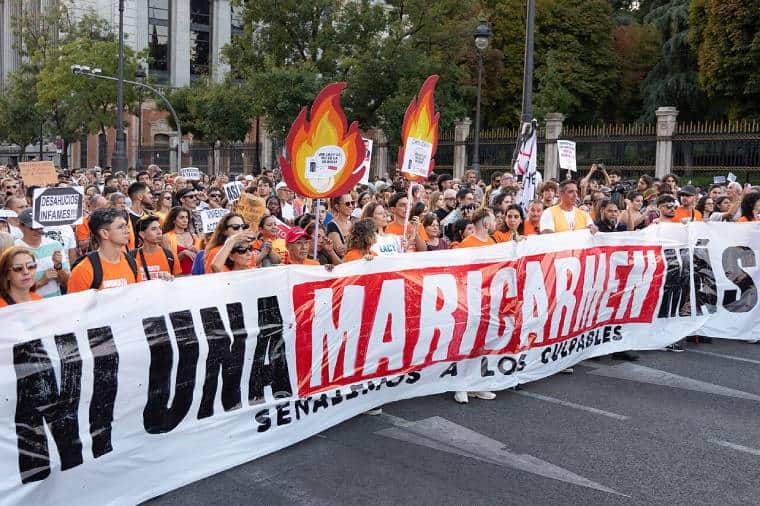
Anger at police after the killing of Sarah Everard (Pic: Guy Smallman)
The police officer who abducted, raped and murdered Sarah Everard should never have been recruited—and three forces missed the opportunity to stop his repeated sexual offending.
That’s the conclusion of Part One of The Angiolini Inquiry into Wayne Couzens’ heinous crimes against Sarah in March 2021. Couzens abducted, murdered and raped Everard after pretending to be an undercover cop arresting her in south London.
Part One of the inquiry, released on Thursday, establishes a timeline of Couzens’ career, examining the circumstances of his vetting, transfer between police forces and his behaviour towards women.
Lady Elish Angiolini said the failures of police investigations, recruitment processes and vetting policy and practices “are a depressingly familiar refrain in policing”. She added that “without a significant overhaul there is nothing to stop another Couzens operating in plain sight”.
Sarah’s family—Sue, Jeremy, Katie and James—said in a statement, “It is obvious that Wayne Couzens should never have been a police officer. Whilst holding a position of trust, in reality he was a serial sex offender.
“Warning signs were overlooked throughout his career and opportunities to confront him were missed. We believe that Sarah died because he was a police officer—she would never have got into a stranger’s car.”
The report examines how Kent Police, the Civil Nuclear Constabulary and the Metropolitan Police facilitated Couzens’ career.
It identifies “how police recruitment, vetting and investigations repeatedly failed to spot the red flags about his unsuitability for office”. And it calls for “a radical overhaul of police vetting and recruitment” and “fundamental changes to the police response to indecent exposure”.
Evidence of Couzens’ sexual offending and preference for extreme and violent pornography predated Everard’s murder by 20 years. Four allegations of indecent exposure had been reported to the cops, the latest just days before Sarah’s abduction at a drive-through.

Here the Met’s investigation “fell below the standards any victim of crime should expect”. The Inquiry found five other alleged incidents of sexual offending which weren’t reported to the police.
Thames Valley Police, who carried out one of Couzens’ vetting in 2011, advised the CNC against him due to his financial situation. Kent Police also failed to investigate two reports of indecent exposure including an incident in 2015.
The Met missed the opportunity to stop Couzens him twice in 2018 and 2019 despite entries on the Police National Database relating to the 2015 exposure incident.
The Met couldn’t confirm whether this wasn’t identified because the correct checks were not carried out or because it was ignored. And even after his crimes, the Met told the Inquiry in 2022 it would still have recruited him if provided with the same information.
The report lays out 16 recommendations for government and policing leaders “to help prevent anyone entrusted with the powers of a serving officer abusing that trust in such a heinous way again”.
The report concludes that “fragility” in public trust “affects us all, including those good police officers who do the right thing every day”.
“What is already clear is how much damage Couzens has done to the social contract on which policing is based,” Angiolini said on Thursday morning.
Couzens “manipulated information of application forms and his troubled finances”. “It also included the way he shared his callous views towards women with only a very small group of like-minded people on a social media group.”
Police investigations of indecent exposure were “poor,” the report added. “These offences were treated as low-level by the investigating officers.
“Attitudes towards the experience of those victimised by alleged incidents of exposure were not commensurate with the harm caused.”
The report explained that “pockets of different cultures exist within police forces”. “Good police officers work alongside those who abuse their powers, behave inappropriately with their colleagues and do a disservice to the profession of policing.”
This analysis—that some bad apples ruin the work of an otherwise good police force—is a disappointing conclusion from the inquiry.
Part Two of the Inquiry investigates police culture and national police vetting and the protection of women in public spaces.
The report says Couzens “was not wholly a product of his working environment”. But that “those environments did nothing to discourage his misogynistic view of women”.
Recommendations on police culture include every force committing to being “an anti-sexist, anti-misogynistic, anti-racist organisation”. Others call for less barriers to reporting sexual offences of cops by other officers, and better recruitment and retention of female cops.
But more female cops, more training and more recommendations won’t stop officers like Couzens from offending. The failures in the police to properly investigate reports of sexual abuse and recruiting sex offenders are imbedded in its culture of institutional sexism.
Crisis after crisis has been unearthed from within just the Met. That’s because it is an institutionally sexist, corrupt, racist and homophobic force that has no interest in protecting ordinary people.
And Couzens, with a history of sexual abuse crimes, was allowed to brandish the power being a cop gave him on women like Sarah. The best way to keep women safe is to abolish the police—starting with the Met.


Unions have called a general strike
Interview with a member of French revolutionary socialist group Autonomie de Classe