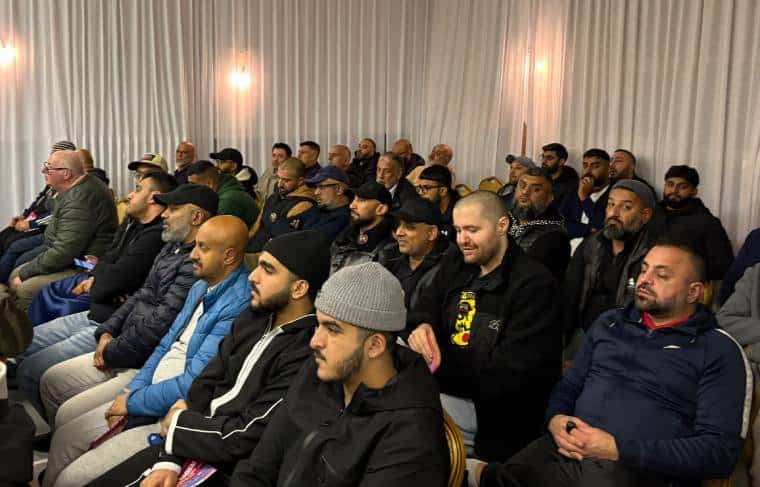
People voting at SWP conference (Picture: Socialist Worker)
The threat of the far right and the crisis of the Labour government dominated discussions at the Socialist Workers Party (SWP) conference last weekend.
SWP national secretary Lewis Nielsen argued that socialists face two major tasks in 2025. The first is to build opposition to Nigel Farage’s Reform UK party through Stand Up To Racism (see below). The second is to take the fight to the failing Keir Starmer government that fuels the rise of the far right.
Lewis outlined the “rapid deterioration” of the Starmer government and pointed to the growing threat of Reform UK. “Nigel Farage is now the main opposition to Starmer,” he said. He pointed to last summer’s racist riots and said there would be “more and bigger tests to come”.
Lewis called for a transformation of how the party operates and renewed audacity. He said that the SWP had to be prepared to launch initiatives capable of galvanising the wider left.
One such initiative is to bring together all the forces of resistance in the streets and workplaces against the Starmer government.
We need to work with wider forces to unite trade unionists, anti-racists, Palestine activists, climate campaigners and others to confront the Labour government’s policies.
This would be a step towards wrenching class issues away from the fakers of Reform UK and towards escalating strikes, protests and campaigns.
This process, said Lewis, “will show that the left is capable of hitting back”.
But he added that the SWP would push for a left alternative to Labour in next year’s elections. “This is not a turn towards electoral politics, but we have to engage in a debate with wider forces on the question” (see below).
Lewis concluded his introduction saying, “None of what I’ve said is possible unless we build a new cadre of activists.”
“The need for new, battle-ready socialists is one that is thrown at us by the crisis in society.”
Jess, an NEU education member from south London, asked, “How do we situate ourselves in order to shape the inevitable break with the Labour Party?”
She argued there needs to be an initiative that not just “brings the left together and attacks the trade union leaders for their lack of strategy, but one that articulates a way forward”.
“For the SWP to be in a position where we are able to envisage being at the heart of something like that is a testament to the work that comrades have done. But it will take quite a single minded focus to make it work.”
Suzanne from north London said, “it’s absolutely crucial that we see the climate crisis as a key strand of all our work”.
She warned that the right “will continue to use the climate crisis as a way of dividing the working class”.
Leeds student Benji spoke about how audacity and political clarity were required for initiating walkouts and encampments over Palestine.
And Stuart from Manchester spoke about his pride at being part of a movement to challenge the far right.
Phil from south London said, “We need an electoral party to be in the argument because Reform UK really is dangerous now”.
Phil argued that not everyone who votes for Reform UK is far right or a Nazi.
“But the country is broke and people are looking for someone to blame. We need to be putting that argument that the people to blame are not the people coming over in small boats.
“I keep seeing that affordable housing is getting built in London but I don’t know who it is affordable for—it’s not affordable for me.
“People say there is no housing because of immigrants. It’s not because of immigrants, it’s because it’s been sold off and hasn’t been built since.”
Chris from York argued that there are objective difficulties in the way of revolutionaries organising and growing.
Paul from Cambridge agreed that there are many real difficulties. But he pointed to some of what the party has been able to achieve, including responding to the growth of the far right on the streets.
Paul pointed to the “glaring omission” of a real fightback against austerity from the movement. “If the left doesn’t respond, that’s where Reform UK can find an audience.”
Paul added that a bringing together of forces of the left won’t be able to call a strike. But it will be able to build solidarity for strikes and call demonstrations, such as around cuts to disability benefits.
Resisting racism, opposing the far right and smashing oppression are key battles for SWP members this year.
“The bulwark to racism is the working class,” argued SWP central committee member and Stand Up To Racism (SUTR) co-convenor Weyman Bennett.
He laid out the task for socialists in Britain—understanding the nature of Reform UK and building a mass movement to take on the far right and racism.
Weyman reflected on the SUTR response to the racist riots in August and said activists were building on this success for key dates this year.
And he said that the anti-Tommy Robinson protest on 1 February was important because it could “build the sinews that could beat back the fascists”.
A key theme of his speech was that socialists should “raise their horizons above what we’ve done before”.
SUTR national organiser Samira Ali said, “This year is going to be a year dominated by the question of the far right.” She called on socialists “not to be formulaic but ambitious about what we can achieve”.
Cath from Leicester spoke about how 200 anti-racists opposed Reform UK’s regional conference. She said, “We had to smash Farage’s confidence. If you can do it in Leicester you can do it anywhere. They were racists and we were calling them racists.”
One speaker suggested targeting key areas for Reform UK by visiting local big workplaces, meeting the best shop stewards to set up campaigns against Reform UK.
Anna, a teacher in north London said that “we need more of building within our workplaces” to get people involved in activity.
Chioma, national organiser for Love Music Hate Racism (LMHR), said that the organisation “should be a key part of our strategy for fighting against the far right” to help build “an exciting and vibrant force”.
Hussein from Cardiff argued that combining “social weight with the “militancy of the left and the Palestine movement gets people involved”.
“When we held anti-fascist demonstrations we had hundreds of people come from the Palestine movement,” he said.
Charlie Kimber from the central committee told conference “building a left electoral alternative to Labour is both possible and necessary”.
Charlie argued that the left urgently needed to wrest the anger away from Reform UK.
“It is appalling that Reform UK is posing as the alternative to Labour for those who are angry over winter fuel payment cuts,” he said. “We believe the best approach would be a broad based umbrella group of left independents, which can mount a serious challenge to Labour.”
“This does not mean embracing elections as the main way to fight—the struggle always matters more”, he said.
There will be council elections in May this year. But most of the seats up for election are Tory seats. It is a big opportunity for Reform UK, with little prospects for the left.
Charlie said, “We will be fighting Reform UK, exposing its racism and its fakery—and this is a very important task. “Proclaiming a left alternative is not magic wand for making Reform UK disappear. But creating a left electoral alternative to Labour is an urgent task.” The next set of local elections in major towns and cities are in May 2026.
Maxine Bowler stood as an independent socialist in the general election in Sheffield, winning 8 percent of the vote.
She explained that socialist politics was central to her campaign, “Trans+ rights were on our leaflet, climate change was on our leaflet and of course Palestine was on our leaflet.
“The imam from the mosque supported my campaign and announced at prayers for people to come out against the racists.”
Sheila from East London reminded conference that in France and Germany the far right are winning mass support even though there is a left party.
She pointed to the dangers of revolutionaries losing their independence within a left reformist party.
Huw from Bristol said, “Things are moving on rapidly. We have to take elections very seriously. We cannot just sit and commentate on what others are doing.”
In the session on Palestine, Socialist Worker editor Tomáš Tengely-Evans told conference, “There are times in world history that mark a turning point—that mean nothing will be the same again.
“People will look at this point, with what is going on in Palestine, as one of those times.”
He argued, “We must come up with a strategy of how we can take that movement forward.”
A myriad of campaigns are taking place alongside the mass demonstrations. “Our vision is to give the movement much more social weight within the working class,” he said.
He argued that the movement should focus on stopping all arms sales to Israel. Crucially, that strategy means the movement can link up with workers within those arms factories.
Simon from Hackney said, “The question of strategy over the liberation of Palestine, and the wider movement for change in the Middle East, has now become quite sharp.”
Amid arguments over the fall of Syria’s Bashar al-Assad regime, “We should be looking to the streets of Cairo, Alexandria and the wider Middle East.”
Anne from north London disagreed with Tomáš’ emphasis around the internal crisis within Israel.
While some Israeli leaders are concerned with facing “perpetual counter-insurgency”, others are saying “bring it on”.
Anne then said it is essential to create a “rooted network of militants in workplaces that can both mobilise for mass demonstrations, push forward days of action and carry out Boycott, Divestment, Sanctions”.
Rob from Dorset stressed the “vital role of political theory and discussion” in the Palestine movement. He described the solidarity movement as “a crucible of political argument”.
Patrick from Glasgow spoke about the crises of imperialism more broadly. He argued that “everywhere, the interests of our class” are being “subordinated to the question of imperialism”.
Students from Edinburgh, Dundee and Leeds spoke about their successes and struggles with student encampments.
In another session Alex Callinicos, central committee member, spoke about how crises of imperialism intersect with other crises such as that of climate breakdown. He described the world “experiencing a polycrisis”.
“History does not stand still. Different crises are interacting with each other and accelerating a general crisis,” he said. “We need to continue to build the Palestine solidarity movement” and also “build a bigger and stronger SWP”.
How can the party turn its members into a new generation of revolutionary leaders? That was the question raised by Joseph Choonara from the central committee.
He said, “We are growing as an organisation, but numerical growth is not enough.
“We have to turn people into leaders within the struggle, within the working class and within the party itself.”
Joseph explained how developing new leaders can’t be a mechanical process, but must involve a shift in the culture of the organisation.
These leaders “are people who are forged in the working class movement who are part of a collective attempt within the party to understand the world”.
Joseph argued that having an education programme is a very important element of this. And so is being active in the movement.
Central committee member Sophia Beach introduced a session on the party’s student work.
She said, “Student work is always central to our perspective and is incredibly important. We think there is a huge opportunity for us to build student groups up and down the country that can take initiatives and shape politics on campus.”
Sophia explained how students have worked with wider layers of people on campus to call actions over Palestine.
Nico from Leeds initiated a debate by suggesting that the SWP is too critical of other thinkers and theories.
Quinn, a student in Manchester, told the conference that “the young comrades need to take themselves seriously”. They said, “We are the future of this organisation. We do believe in a project that we are going to destroy capitalism.”
Sam, a member of the Socialist Worker Student Society in Glasgow, said that “the turn to weekly meetings” had “been a success”, with regular attendance of 40 or 50 people.
At conference there were a number of other disagreements and debates.
Delegates discussed the recent assisted dying bill. Alex from Glasgow said, “The context of the assisted dying bill comes during a period where there is a continuation of attacks on disabled people.
“This followed the pandemic, where Do Not Resuscitate orders were put on disabled people’s records without their consent.”
She said, “We can’t remove the question of disability and disability discrimination from the question of assisted dying.”
But Kambiz, a retired doctor, said he supported assisted dying, “Our starting point is that we are for bodily and personal autonomy. I would assert that there are strong similarities with our unconditional support for a woman’s right to choose on abortion and the issue of assisted dying.
He said, “At present those with sufficient money and resources can travel to Switzerland for an assisted death. To end unbearable suffering, we believe that working class people should have that right too.”
A speaker said there should be a more systematic approach to developing the party’s work around women’s liberation.
Another pointed to Socialist Worker’s in-depth coverage of the issue and the party’s role in relating to the UK Women’s Marches among other initiatives.
There were also debates around the party’s use of social media and podcasts.
Over 500 SWP members attended the conference. Each session saw a vote on a commission that summed up the direction of the SWP’s work. These were open to amendments and voted on.
The central committee (CC) that leads the organisation on a day-to-day basis was elected.
The CC is Alex Callinicos, Camilla Royle, Charlie Kimber, Héctor Puente Sierra, Jessica Walsh, Joseph Choonara, Julie Sherry, Lewis Nielsen, Mark Thomas, Nadia Sayed, Sophia Beach, Tomáš Tengely-Evans and Weyman Bennett.
Conference also elected a national committee to guide the party’s work.
Conference voted to reduce the size of the national committee while increasing the role it plays within party democracy.
A disputes committee was also elected. It deals with disciplinary matters in the organisation.
Conference voted to amend the party’s expected behaviour guidelines to add that party members should always respect the pronouns that people want to use.


Another day of mass resistance
Plus: 500 on Leeds unity march