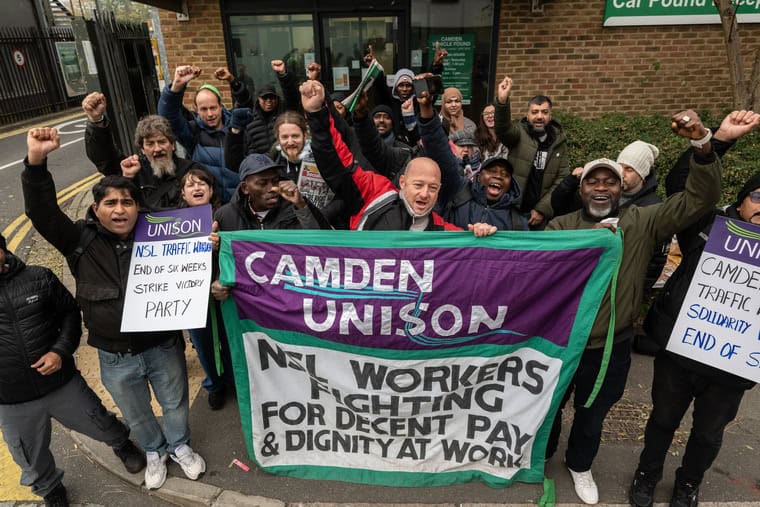
Health workers, such as these ones in Oxford, campaigned to win the Unison NHS ballot but were thwarted by anti-union laws
Anti-union laws—and union leaders’ acceptance of them—are set to blunt the scale of health workers’ strikes, despite massive votes for action on pay.
Ballot results, announced by the Unison union on Tuesday, showed that some 90 percent of those who voted backed strikes. But only eight trusts in England out of 262 employers met the anti-union laws thresholds. They demand a 50 percent turnout and a yes vote from 40 percent of those who could have voted.
Unison says the results still mean, “Thousands of 999 call handlers, ambulance technicians, paramedics and their colleagues working for ambulance services in the North East, North West, London, Yorkshire and the South West are to be called out on strike over pay and staffing levels.”
Overall 81,000 Unison members voted for strikes. This would have led to a national strike before the latest anti-union laws that came into effect in 2017.
Unison members who have spent weeks campaigning to win the strike vote are bitterly disappointed that most trusts missed the thresholds. “I know how much we need a strike, for our pay and for the NHS,” said Sally, an east London health worker. “It’s such a blow that this means our union won’t be calling us out. I know we would have had so much support.
“No action means we are left trying to scrape by on not enough money, more nurses at foodbanks, more people on just over the minimum wage. I’m so angry.”
The government’s imposed deal gives workers in England £1,400 a year. That is just 72p an hour, before tax and national insurance, for full-time workers. It’s far below inflation and means a massive pay cut.
“But I’m not completely surprised at the turnout figures because there were lots of questions about how the process works,” said Sally.
Many activists report that, when they were ringing round to encourage voting, they found that a third or so of union members had not received a ballot form. Postal ballots guarantee that a proportion of people miss out because they forget to tell the union when they change their address. But activists also report that when people rang the union hotline for a new ballot paper they were unable to get through.
There are also more long-term and fundamental factors. The Unison leaders did want to win this ballot. They look weak as negotiators without the potential of strikes to bend the employers.
But many of those same leaders have spent years holding back action and targeting activists. That undermines local organisations, and this vote is partly the payback for that.
Nurses in the RCN union are set to strike on 15 and 20 December. But union leaders announced on Tuesday that they will call out only half the locations where the anti-union law thresholds were secured earlier this month. The number of employers affected will increase in January “unless formal negotiations with the UK government are held”.
Some of the reps in trusts that met the thresholds but have not been cleared to strike are enraged. And in Scotland, the RCN is having yet another ballot after a re-packaged offer from the Holyrood government.
Every health worker, and every other worker, should organise solidarity actions at the hospitals on 15 and 20 December.
Unison leaders should immediately call action where workers have beaten the thresholds and reballot quickly, particularly in trusts that were close to the 50 percent. The best action would be to defy the anti-union laws and call walkouts anyway wherever workers voted for strikes.
The Tories must not be allowed to get away with their assaults on the NHS and its workers. These have left NHS workers in pay crisis, seven million people on health waiting lists, and in the last year 25,000 workers left the Nursing and Midwifery Council register.
England
East Midlands Kettering General Hospital NHS Foundation Trust
East Midlands NHS Nottingham and Nottinghamshire ICB
East Midlands Northamptonshire Healthcare NHS Foundation Trust
East Midlands Nottingham University Hospitals NHS Trust
East Midlands Nottinghamshire Healthcare NHS Foundation Trust
Eastern Cambridge University Hospital NHS Foundation Trust
Eastern Cambridgeshire and Peterborough NHS Foundation Trust
Eastern Cambridgeshire Community Services NHS Trust
Eastern Hertfordshire Community NHS Trust
Eastern NHS Hertfordshire and West Essex ICB
Eastern Royal Papworth Hospital NHS Foundation Trust
London Great Ormond Street Hospital for Children NHS Foundation Trust
London Guys and St Thomas NHS Foundation Trust
London Imperial College Healthcare NHS Trust
London NHS North Central London ICB
London Royal Marsden NHS Foundation Trust
North West Alder Hey Children’s NHS Foundation Trust
North West Health Education England
North West Liverpool Heart and Chest Hospital NHS Found Trust
North West Liverpool University Hospitals NHS Foundation Trust
North West Liverpool Women’s NHS Foundation Trust
North West Mersey Care NHS Foundation Trust
North West The Clatterbridge Cancer Centre NHS Found Trust
North West The Walton Centre NHS Foundation Trust
Northern Gateshead Health NHS Foundation Trust
Northern Northumbria Healthcare NHS Foundation Trust
Northern The Newcastle Upon Tyne Hospitals NHS Foundation Trust
South East Oxford Health NHS Foundation Trust
South East Oxford University Hospitals NHS Foundation Trust
South East Royal Berkshire NHS Foundation Trust
South West Devon Partnership NHS Trust
South West Gloucestershire Health and Care NHS Foundation Trust
South West Gloucestershire Hospitals NHS Foundation Trust
South West Great Western Hospitals NHS Foundation Trust
South West NHS Bath, North East Somerset, Swindon and Wiltshire ICB (BSW Together)
South West NHS Devon ICB (One Devon)
South West NHS Gloucestershire ICB (One Gloucestershire)
South West North Bristol NHS Trust
South West Royal Devon University Healthcare NHS Foundation Trust
South West Royal United Hospitals Bath NHS Foundation Trust
South West Torbay and South Devon NHS Foundation Trust
South West University Hospitals Bristol and Weston NHS Foundation Trust
South West University Hospitals Plymouth NHS Trust
West Midlands Birmingham Women’s and Children’s NHS Foundation Trust
West Midlands Herefordshire and Worcestershire Health and Care NHS Trust
West Midlands NHS Birmingham and Solihull ICB (BSol ICB)
West Midlands The Royal Orthopaedic Hospital NHS Foundation Trust
West Midlands University Hospitals Birmingham NHS Foundation Trust
West Midlands Worcestershire Acute Hospitals NHS Trust
Yorkshire & Humber Bradford Teaching Hospitals NHS Foundation Trust
Yorkshire & Humber Leeds Community Healthcare NHS Trust
Yorkshire & Humber NHS England
Yorkshire & Humber The Leeds Teaching Hospitals NHS Trust
Wales
Wales Cardiff and Vale University Health Board
Wales Powys Teaching Local Health Board
Wales Welsh Ambulance Services NHS Trust Headquarters
Wales Hywel Dda University Health Board
Wales Swansea Bay University Health Board
Wales Cwm Taf Morgannwg University Health Board
Wales Betsi Cadwaladr University Local Health Board
Wales Velindre NHS Trust
Wales Public Health Wales
Wales Health Education and Improvement Wales Health Authority
Wales NHS Wales Shared Services Partnership
Wales Digital Health and Care Wales


Higher education battle plus further education strike ballot and round-up
Health workers want Palantir out of the NHS
Meet the migrants driving wages up
PM Lecornu offers only crumbs