Nigel Farage, leader of the far right Reform UK party, is exploiting the Southport murders
A British teenager, who had become obsessed with mass violence, murdered three girls in Southport last summer.
Axel Rudakubana, who tried to kill a further eight children and two adults, was sentenced to 52 years this week.
The road to the atrocity was paved by the system, from schools to children’s mental health services, failing the family of Axel Rudakubana.
But that’s not the story Keir Starmer, the mainstream media and far right want to focus on. They’ve shifted the narrative to right wing talking points—terrorism and law and order—which don’t address the real issues.
Starmer argued that the Southport murders show “terrorism has changed” with a new threat from “loners, misfits and young men in their bedrooms”. He wants to change the law so people who carry out mass violence without a political or religious motivation can be prosecuted as terrorists.
Starmer’s call was eagerly picked up by the likes of Martin Brunt, Sky News crime correspondent. He said the murders show “the growing threat from young misfits, alone with a computer, their heads full of violent images and evil thoughts”. They are “hell-bent on achieving notoriety but without the fixed ideology of recognised terror groups”.
This false focus on terrorism has opened the door to the far right exploit the Southport murders once again. Reform UK leader Nigel Farage has demanded that Rudakubana should have been charged with terrorism.
But he went further than Starmer and claimed that “this barbaric and senseless attack was clearly both political and ideological”.
Why the obsession with terrorism? It’s got nothing to do with justice for the families or stopping such atrocities taking place again.
Rudakubana was referred to the Prevent “counter-terrorism” programme three times in 2019 and 2021. The first referral was over comments he made about a mass shooting. Prevent officials said that the then 13 year-old was vulnerable, but that there was no extremist ideology.
In February 2021, another pupil said Rudakubana had made a post about former Libyan leader Colonel Gaddafi.
Two months later in April 2021 a teacher made a referral after they noticed he had two browsers open looking at the London Bridge terror attack.
All three cases were investigated and then closed. Starmer has said the decisions were “clearly wrong” and home secretary Yvette Cooper has ordered a “thorough review” of the Prevent referrals.
But why would Prevent have stopped Rudakubana? The British state claims that Prevent is there to stop “extremism” and “terrorism”. The reality is very different—it’s an Islamophobic programme designed to create a climate of fear among Muslims who dare to question British foreign policy (see below).
Prevent forces public sector workers, such as teachers, to spy on people for signs of “radicalisation”. After 2015 public bodies had to incorporate the “Prevent duty” into what should be safeguarding policies designed to keep children safe.
The family of Axel Rudakubana was failed by schools, social and mental health services and the police and justice system.
Rudakubana came into contact with a range of services from 2019, triggered by increasing anxiety and social isolation. He developed “challenging behaviours” and police intervention followed.
On 7 October 2019, police received a referral from ChildLine. Rudakubana had told them that he was being bullied at The Range High School in Formby, near Southport.
He said he had taken a kitchen knife from his home to school several times. When asked why, he said, “To use it.”
Police made a vulnerable child referral to the Multi-Agency Safeguarding Hub (Mash). This body, chaired by the Lancashire Police assistant constable, assesses and shares details with agencies tasked with keeping children safe.
He was excluded and transferred to The Acorns School in Ormskirk, Lancashire. But Rudakubana went back to the Range High School in December 2019 with a kitchen knife in his backpack.
He attacked another pupil with a hockey stick. After police arrested Rudakubana, he was charged and sentenced to a Youth Referral Order.
It was around this time that the first Prevent referral took place. Another incident took place on 5 November 2021 which saw the police called to Rudakubana’s home.
A stranger knocking on the door had made him distressed. He calmed down and his parents told police that they didn’t need to come. Officers made another vulnerable child referral to Mash.
Later that month police were called that month after Rudakubana kicked his father and damaged his car.
This isn’t the story of the making of a “terrorist”—let alone an “ideologically-motivated attack”.
Safeguarding should be driven by children’s and mental health professionals working in well-funded services. This, not the police and counter-terrorism agencies, could keep children safe.
Yet all those services, whether community and youth work or social care, have been decimated during the last 14 years of austerity.
The Southport murders led to an explosion of far right violence in the summer with fascist gangs trying to burn down mosques and refugee hotels. It was all based on lies that the attacker was a Muslim and asylum seeker.
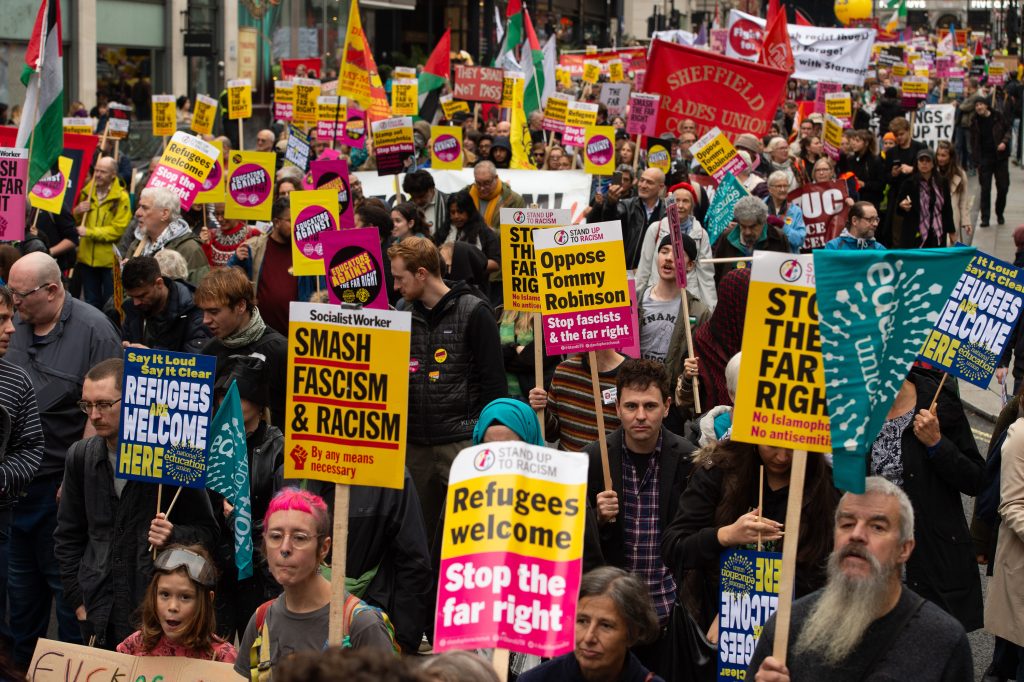
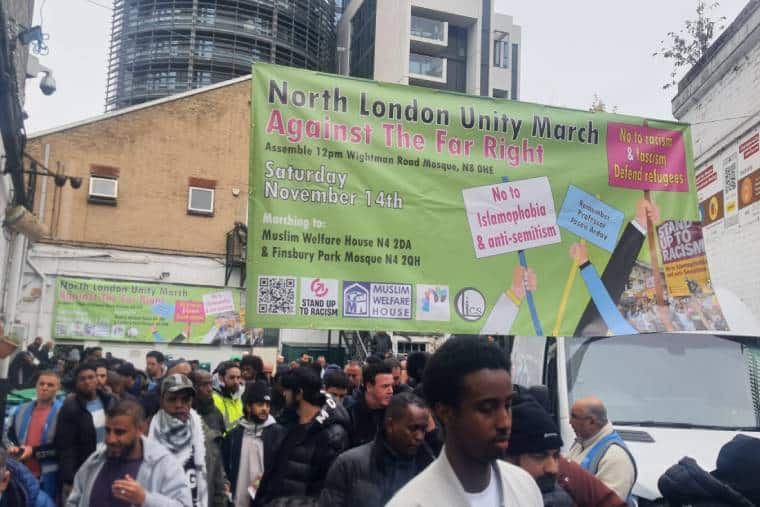
Mass mobilisations organised by Stand Up To Racism (SUTR) pushed back the far right, with thousands of people reclaiming the streets.
But the far right has been looking for opportunities to regain the initiative since. They once again tried to insinuate that Rudakubana was some sort of “Muslim terrorist” when he faced fresh charges last October.
He was charged with producing the poison ricin under the Biological Weapons Act 1974. He was also charged with possessing a military study of an al-Qaeda training manual, which can be downloaded from a US government website, under the Terrorism Act 2000.
And now Farage and others are claiming that Starmer and the British state have orchestrated a cover-up. Farage is only interested in building a mass, far right party through racism—not bringing justice or safeguarding children.
We mustn’t let the right exploit the horror of Southport.
The Prevent programme was first introduced after the 7/7 bombings in London in 2005. It was part of the Labour government’s attempt to undermine the mass movement against the West’s wars in the Middle East.
Labour justified the War on Terror by painting Muslims as an “enemy within”.
But when Prevent was being drawn up in 2005, 72 percent of people thought that British foreign policy had made Britain more a target for terror attacks.
So, alongside state repression of Muslims, Labour dressed up Prevent as being about working with “community leaders”. This was an attempt to drive a wedge between “good” Muslims who support “British values” and “bad” ones who question the British government and its wars.
The Tories’ Counter Terrorism and Security Act 2015 made Prevent legally binding, forcing public sector workers to spy for signs of “radicalisation”.
Prevent isn’t broken and it cannot be reformed—it’s Islamophobic and should be scrapped.


Refusing to stay quiet about Islamophobia
Democrats win in Republican strongholds
Home secretary forced to make concessions
Interview with author Jonathan Darling about his new book