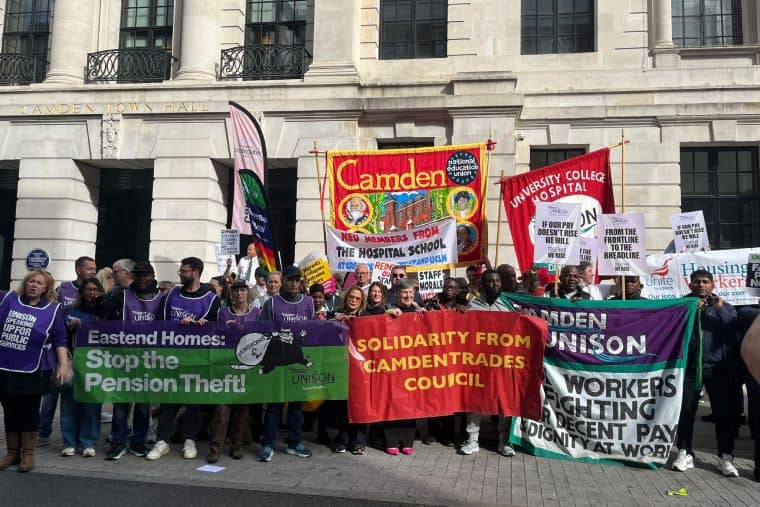
Zack Polanski speaking at the left wing We Demand Change summit before he became Green Party leader (Picture: Guy Smallman)
Zack Polanski’s bid to become an MP could make—or break—his leadership of the Green Party.
He’s announced that he wants to stand in Keir Starmer’s Holborn and St Pancras constituency in London, after the former prime minister resigned as an MP this week.
Polanski, who still needs to be selected by local party members to run as an MP, said, “Too often Labour has stood up for corporations and big money. I will stand up for people struggling to pay their bills.”
The Green Party faces a new challenge. Polanski was elected as Green Party leader just short of a year ago with a radical “eco-populist” message that looked very different to Labour.
Party membership tripled in six months—and now stands at 230,000—and the Greens saw unprecedented electoral gains.
The Green Party has made addressing the cost of living crisis one of its central policies since winning the Gorton and Denton by-election and taking control of five local councils earlier this year.
But the Greens’ dramatic rise has stalled in recent months. The party is down from a high-point of 21 percent in February to 13 percent at the beginning of this month, according the YouGov polling.
It still leads among 18 to 24 year olds. But the gap between the Greens and Labour is narrowing among this group of voters—38 v 32 percent compared to 49 v 13 percent in February.
This is partly down to the “Burnham bounce”. Although the party is still the main force to the left of Labour in England, a section of its voters has started to look to prime minister Andy Burnham.
He hasn’t fundamentally broken with Starmer, but his promises of “the biggest changes in 40 years” have raised many working class people’s expectations.
When Starmer resigned, 14 percent of people who voted Labour in the general election said they would now back Zack Polanski’s Green Party. That figure is down to 9 percent since Burnham took over.
Some Green Party figures are urging Polanski to go further to the left to stop former Labour voters drifting back to Burnham. They include Animah Kosai, a member of the Green Party national council, and councillor Steven Campbell-Robb.
Kosai, Campbell-Robb and others have put forward a motion to the party’s conference, set to take place in Brighton in October. It that says Green campaigning should emphasise left wing policies, such as a wealth tax and criticising Labour for arming Israel.
The five-page motion warns that “unless the key differences in our national policies and principles to those of Labour are also frequently referenced, conference believes that we are likely to see a period of stagnation for the Green vote in local elections”.
“If we are to flip Labour voters likely to vote Green in local elections, campaigning material must refer to some key national issues in addition to local issues, stressing that there will be no real change under Burnham”.
It adds, “The stress on keeping all campaigning material solely focused on local issues is now holding us back.”
But that isn’t the lesson across the Green Party. There are several warning signs that the Greens are starting to step back from the radical approach.

In April, three party officials spoke to the Politico website as they prepared to launch a policy review in the run-up the autumn conference.
Two of the officials said the Greens’ immigration policy was earmarked for change. The Greens say they want to see a “world without borders” while they would implement a “fair and humane system of managed migration” before then.
Why would the party consider changing tack when Polanski’s refusal to accept anti-migrant lies has inspired so many?
There is a left-right split in the Green Party. It has pitched as a left of Labour alternative in the cities and as a greener version of the Lib Dems in rural areas.
The party’s right wing is keen to push back on some of Polanski’s radicalism, but the pressure to “moderate” impacts the whole of the organisation.
This is rooted in the nature of electoralism—which sees social change as coming primarily through winning votes. If you want to run the British state, you’re under pressure to show the establishment a safe pair of hands.
At the time, one official described the Greens policies as “not a policy platform for government”.
In the 2024 general election, Andrew Feinstein stood against Starmer—and came second with 19 percent of vote.
His campaign mobilised large numbers of people and built on the dynamism of movements outside of parliament, especially the mass movement over Palestine.
The Camden People’s Alliance (CPA), which was built out of Feinstein’s campaign, won a seat in the local elections in May.
Feinstein has said he will not stand in this by-election this time. “I am afraid that I am very sadly not in a position to stand this time round,” he said, ahead of a meeting of the group next week.
The left shouldn’t give the Green Party a blank cheque in the by election.
Socialists should work with Greens as part of movements, such as building resistance to austerity, racism and the drive to war.
We will need to put concrete demands on Green Party politicians—for example, its councillors should refuse to implement austerity.
Fighting for an alternative to requires mobilising fightbacks outside of parliament and the council chamber, on the streets and picket lines.


Interview with a member of French revolutionary socialist group Autonomie de Classe
MioCare strikers in Greater Manchester want answers about proposed National Care Service