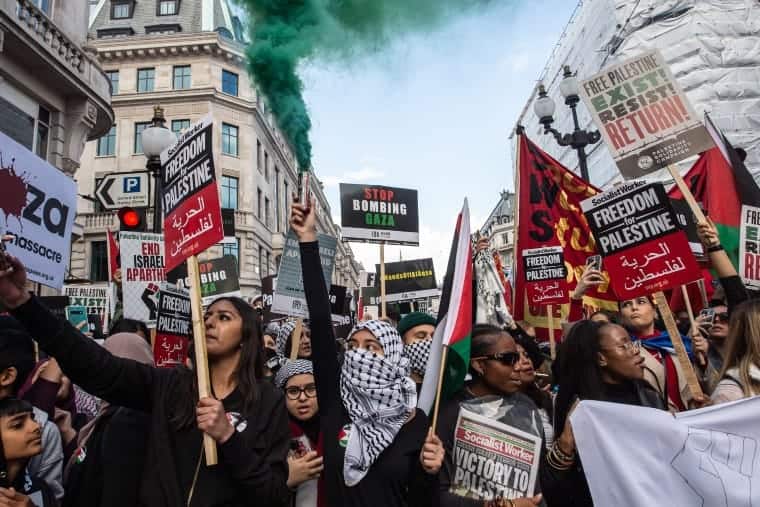
A die-in on one of the mass demonstrations for Palestine in London in the wake of 7 October (Picture: Guy Smallman)
Shaban al-Dalou was a Palestinian student days away from his 20th birthday. He recorded social media videos of his family’s plight in Gaza, desperately trying to raise money to get them out of the open air prison turned slaughterhouse.
But the video of Shaban that we’ll remember most wasn’t recorded by him. It captured Shaban’s last moments—arm hooked up to an IV drip, body burning alive in a fire storm at Al-Aqsa Martyrs Hospital in Deir el Balah.
There are millions of images of horror from the last two years since 7 October, and many people will remember ones that will haunt them forever.
What they have all exposed is the real face of Zionist settler colonialism and imperialism—violent, racist and now genocidal.
“Colonialism is not a thinking machine nor a body endowed with reason, it is violence in its naked state,” wrote Franz Fanon in The Wretched of the Earth. If you ever thought that was just a rhetorical flourish, you won’t after the past two years.
No amount of propaganda, lies or the chorus of “return the hostages” can mask the reality in the eyes of millions of people. That isn’t simply because the genocide flashes on our phone screens everyday, but because of the mass movement of solidarity that has changed British politics forever.
As we mark the 2nd anniversary of 7 October, it’s important to remember that, because Israel feels invincible.
Donald Trump’s “peace plan” for Gaza has rewarded Israeli prime minister Binyamin Netanyahu for genocide with a green light for a colonial land-grab. And, after spreading war to Lebanon, Yemen, Iran, Syria and Qatar, Israel is the ascendent regional imperialist power in the Middle East.
But, at the same time, Israel has also never been more isolated—and it can be defeated.
Never forget that in October 2023 Israel looked weak and humiliated. The fourth largest military in the world, armed with lethal weaponry and cutting-edge technology, was caught unawares by Palestinian fighters.
It was a particularly bitter pill to swallow for the coloniser to be outwitted by people they see as “human animals”. Albeit briefly, the Palestinian resistance retook land that Zionist settlers had stolen 75 years earlier during the Nakba of 1948.
So the Zionist state responded by launching another storm of racist violence, a Nakba 2.0.
Israeli settler colonialism swings between apartheid and genocide as a way of dealing with the “problem” of Palestinians. Since 7 October, it has come down firmly on the side of elimination.
Netanyahu promised “absolute victory” over Palestinian resistance group Hamas. His coalition government relied on far right ministers Itamar Ben-Gvir and Bezalel Smotrich who want to ethnically cleanse and occupy the Gaza Strip.
Sections of the Israeli state didn’t want to occupy the Gaza Strip, fearing it would lead to a permanent state of counter-insurgency.
But the “liberal Zionists” who want a return to the status quo of apartheid prior to 7 October are marginal voices now. Here, we have to ask, how has Netanyahu navigated the divisions inside Israel? Precisely by whipping Israeli society into a war frenzy.
This strategy of spreading war is about much more than internal politics—rather, it’s to do with Western imperialism’s relationship to Israel.
Israel remains the watchdog of US imperialism in the Middle East. But there are tensions in this relationship due to the US’s long and slow decline as a superpower and Israel’s rise as a regional imperialist power.
Sections of the ruling class in the US have feared that the scale of its assaults could spur resistance against Arab regimes in the region.
But Netanyahu has been able to play the US whenever faced with the mildest criticism or calls for “restraint”. He knows, when push comes to shove, the US will back its watchdog state in the region. As a result, Netanyahu has spread war and sought to use each new escalation to lock in Western support.
The Middle East is a site of increasing competition among regional imperialist powers—Israel, Iran, Saudi Arabia, the UAE and Turkey.
After the last two years, Israel is now the ascendent power in the region and has weakened its major rival Iran. It is seeking to take advantage of the chaos to reshape the region in its own interests and those of US imperialism.
Socialist Worker will always back the right of Palestinians to resist by any means necessary. We proudly said, “Victory to the Palestinians,” on our front page in the week after 7 October and rejoiced as the resistance put up a valiant defence from tunnels in Gaza.
But armed struggle, and a reliance on support of regimes in the region, will not defeat Western imperialism’s watchdog state.
Instead, mass movements that challenge US imperialism, Israel and the Arab regimes in the region could open the door to Palestinian liberation.
We saw glimpses during the Arab Spring of 2011 when revolutions brought down Western-backed dictators and isolated Israel. A return of that force, based on workers and the poor in the wider Middle East, has the power to open the door to liberation.
There will be no simple “re-run” of the Arab Spring as the legacy of counter-revolution hangs over the region.
But we have seen more advanced capitalist development in key states in the region that neighbour Israel. This, ultimately, helps create and imbue with power a larger working class able to challenge its own rulers and the imperialist order across the Middle East.
In the West, too, the hope lies with infusing the Palestine movement with the power of workers.
Two years ago in Italy the Palestine movement was small, the left virtually non-existent, and the fascist-led government’s repression was working.
In the last two weeks, we have seen the way forward with the general strikes for Palestine that have rocked Italy.
In Britain we have seen the rise of a huge movement, but not mass workers’ action yet. But the crisis of legitimacy facing the Labour government over its support for genocide is deepening—and that opens up opportunities.
There are other sorts of images that millions of us shall never forget. As Shaban burned in Deir al-Balah, Labour’s Emily Thornberry took to TV screens to tell us, “There are war crimes being committed by Hamas, by Iran.”
If these ghouls are to pay, we have to do all we can to escalate and deepen the action.
We will be publishing analysis and interviews with Palestinians and people in the solidarity movement every day around the two year anniversary of 7 October. Stay up to date with our latest articles


Learn from mistakes of Corbynism
Build for the Palestine national demonstration on 10 October