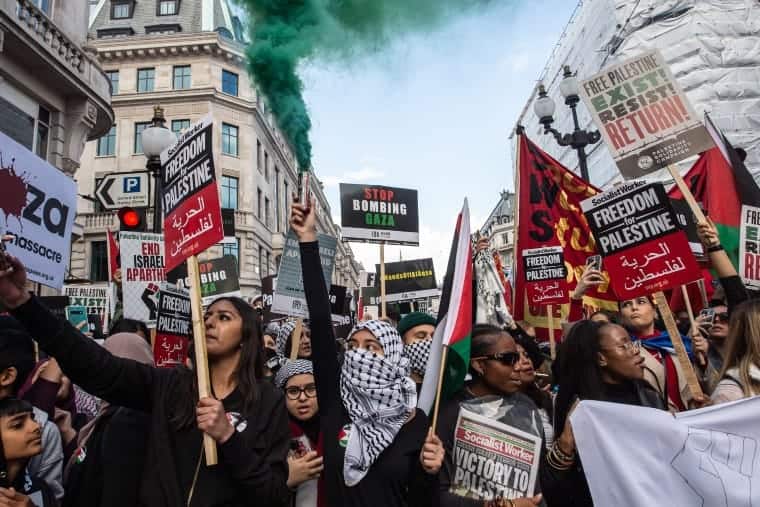
One of the mass mobilisations for Palestine in London after 7 October (Picture: Guy Smallman)
The Palestinian attacks of 7 October were a turning point in world politics. Since then, we’ve seen a year of genocide and resistance that’s isolated Israel, exposed the West’s hypocrisy and spurred a mass movement of solidarity.
The Palestinian resistance had breached Gaza’s prison walls in the early hours that morning. For a short time, they retook land that Zionist settlers had stolen from them 75 years earlier during the 1948 Nakba—the storm of ethnic cleansing that gave rise to Israel.
Last October, the apparently mighty Israeli state stood humiliated in the eyes of the world. Its infamous military and intelligence establishments were caught unawares and were slow to react.
For Israel’s racist rulers, it was a particularly nasty shock. Defence minister Yoav Gallant likes to describe Palestinians as “human animals”. But the attack showed them outwitting him.
The Palestinian attacks shook the entire Israeli ruling class. So, with the backing of the United States and Britain, it lashed out with all the deadly weaponry the West had provided it.
Israel launched a genocidal war against the Palestinians. So far, it has murdered at least 41,000 people—and injured almost 100,000—in Gaza alone.
It cut off water, electricity and power. It bombed schools and hospitals. It blocked aid and then massacred people grabbing desperately at what little it let through. But, one year on, Israel has been unable to decisively defeat the Palestinian resistance.
Amid the rubble, fighters—and the vast networks of people that support them—have held out with immense bravery.
And even after waves of carpet bombing, Palestinians can still emerge from their tunnels to blow up armoured vehicles and troops from Israel’s supposedly invincible forces.
The 7 October didn’t just cause a crisis for Israel. Before the war, United States imperialism was already grappling with the challenge of China and was bogged down in a proxy war in Ukraine. And since the attacks, the US has faced a triple crisis with fire spreading in the Middle East.
For decades, the US had tried to isolate the Palestinians by “normalising” relations between Israel and the Arab states. President Joe Biden wanted Saudi Arabia to sign a treaty with Israel. That hope is in tatters, at least for the foreseeable future.
The year of war has also confirmed the decline of US global power and has led to tensions between the US and Israeli governments. Biden is caught in a contradiction.
He supports Israel as the West’s key regional power. But he fears that the scale of its assaults could spur resistance across the region, triggering a repeat of 2011’s Arab Spring. So far, he has been unwilling or unable to reign in Binyamin Netanyahu—even on the rare occasions that he has wanted to.
Instead, the Israeli prime minister has been able to play him, by spreading the slaughter to Lebanon and forcing the West to back him “against terrorism”.
Contrast that to Israel’s invasion of Lebanon in 1982. The then US president, Ronald Reagan, initially supported the invasion.
But when Israel began an intensified bombing campaign against west Beirut, he feared it would make the whole region unstable. He called the Israeli prime minister Menachem Begin to demand he stop the assault, describing it as a “holocaust”. Israel ceased bombing within hours.
The difference between then and now shows how US weaknesses open spaces for regional imperialist powers—such as Israel and Iran—to further assert themselves.
It underlines that we live in a dangerous world of growing inter-imperialist rivalry that could spill over into a devastating, wider war.
And the West faces another crisis—one of legitimacy. For over 30 years, US imperialism has destroyed Afghanistan, Iraq, Libya and other countries under the guise of “humanitarian intervention”.
At the same time, it holds up Israel as a “civilised society” and the “one democracy” in the region. Many people have always rejected Western talk of “humanitarian intervention”. But millions of others did buy into it.
For them, Israel’s daily toll of war crimes has come as a shock. Seeing the West’s premier ally in the dock for war crimes has helped shatter an entire “world view”.
The International Court of Justice (ICJ) is usually an echo chamber of Western interests. When the South African government brought a case of genocide against Israel, many weren’t expecting much from the judges.
But because of the clear, genocidal nature of Israel’s attacks, and the international movement of solidarity against them, the ICJ said Israel had a “case to answer”.
The West’s hypocrisy has also been exposed. For the West, Russia bombing a Ukrainian hospital is a war crime but Israel bombing a Palestinian hospital is “self-defence”.
That’s why, to millions of people, Joe Biden will forever be known as “genocide Joe”. Nor will they forget now prime minister Keir Starmer saying that Israel had “the right” to cut off water and electricity to Gaza.
No wonder Britain has become a Palestine protest capital of the world. In the face of the most extraordinary repression, and government and media slurs, the movement has stayed on the streets.
A year on, we must keep fighting to stop the murderers in Israel, bring down the dictators of the Arab regimes—and defeat their backers in Britain.
We will be publishing analysis and interviews with Palestinians and people in the solidarity movement every day in the run-up to the one-year anniversary of 7 October. Stay up to date with our latest articles by going to Palestine: one year on


What did Burnham do?
Learn from mistakes of Corbynism
Build for the Palestine national demonstration on 10 October