Ghada Karmi at PalFest (Photo: flickr/PalFest)
How significant do you think the last year has been for the Palestine movement?
It’s been really quite unpredictable and quite interesting. At times, very heartening. At times, very depressing. The sufferings of people of Gaza and the genocidal war which we’ve all seen on our screens has been absolutely terrible to watch.
One the one hand, this is the worst aggression against the Palestinians I’ve seen in a long time. On the other hand, it has been quite uplifting to see the amount of global support for Palestine.
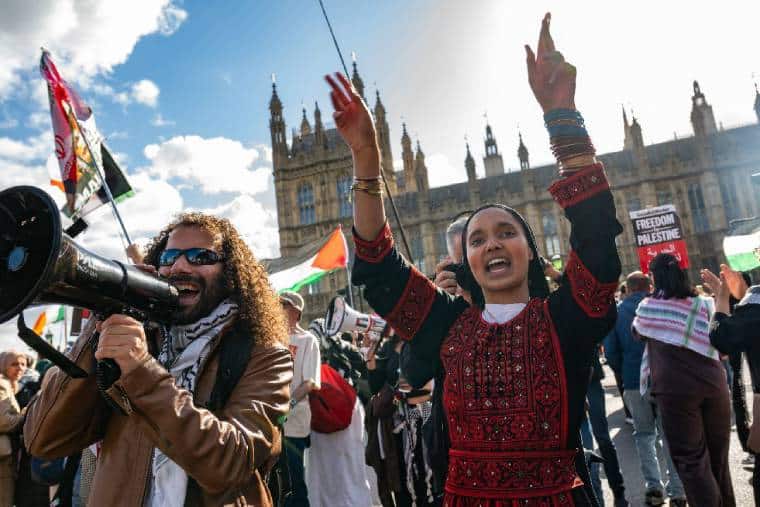
There has been an extraordinary popular level of support. Clearly that is not reflected at the official, formal state level.
However, in terms of ordinary people or students across many universities in the West elsewhere, the support and the promotion of Palestine’s case has been quite honestly unprecedented in my lifetime.
I obviously have seen times when there has been an upsurge of sympathy for the Palestinians—but never really like this and never sustained in this way.
What do you think of the resistance in Palestine itself and other Arab states?
Well, it’s quite obvious that Hamas has not been defeated, so the Palestinian resistance movement in Gaza is alive.
The killings of resistance fighters have been very difficult for the people of Gaza, which I am not ignoring at all. But this does not mean that the resistance of Hamas has been destroyed in any shape. So this is one aspect of resistance which has remained strong.
At the same time, Palestinian communities all over the world have been energised and have almost had their identities reinforced as Palestinians.
This has been the effect of 7 October and that’s actually quite important. I can tell you that from personal experience. I spent the summer in Jordan, and the Palestinian community in Jordan is huge and generally fairly acquiescent. It doesn’t have uprisings or strikes or things like that.
But this summer, I saw tremendous vigour on the part of particularly young Palestinians—very active, ready to go out on demonstrations, trying to join different groups.
There’s a whole different atmosphere in Jordan and that’s an example where I have personal experience. I cannot consider that a coincidence. It’s definitely a result of what happened on 7 October.
And, of course, if we have that sort of activity going on in Jordan, it must be replicated in other Arab countries and Palestinian communities worldwide.
Where do you see the solidarity movement going now?
I think it’s very difficult to tell. But one thing I can say is, I know where I’d like it to go—it needs to move from support for Palestine at the popular level towards affecting government.
I can see how that might happen. If a movement of support is as vociferous and as long-lasting as this one has been, it would be very strange if that did not affect the government.
We’ve seen it already. If you take Britain as an example, I think it’s very unlikely that the government would have approved a suspension of arms sales to Israel—even though it is very, very modest and almost a token. Nevertheless it happened.
And of course, the other example is that Britain was preparing to object to the International Criminal Court’s arrest warrants for Israeli leaders. It was aiming to make some legal objections which have been dropped.
I don’t think either of those things would have ever happened without popular pressure.
When we say a free Palestine, what does that look like from your perspective?
If there is one lesson to be learnt from what happened on 7 October and subsequently it is this—there is no future for Zionism in our region. Israel as a Zionist, apartheid state is not something that Palestinians or Arabs or anybody in this region wants to have in their midst.
The difficulty here is that we’re dealing with not just a government. If we’re talking about Binyamin Netanyahu’s government, or a particular Israeli regime, then that’s one thing. But here we’re talking about the Israeli people. There’s a tiny minority who are anti-Zionist and who are very active in opposing their government’s policies. These people are comrades.

But most of the population—and opinion polls have shown this several times—is completely behind the genocide in Gaza. That is based on a very long-standing idea, the Zionist idea, that Jews have the right to take over Palestinians’ country and make it their own. And not only do they have that right, but there is a kind of supremacy. It’s the enjoyment of a sort of colonial rule with all the advantages in terms of resources and denial of other people’s rights.
The lesson of 7 October is that this is not a mind-set that we can accept. So, the future I see is for Jews and Palestinian Arabs to share the country. There is, for me, no option to divide the land and have a Palestinian state and an Israeli state.
For people like me, it was never an option. The slogan of a two-state solution implies the creation of a Palestinian state. But it also means the preservation of a Zionist state of Israel, which is an apartheid state with the attitudes I’ve just talked about.
That is not acceptable. In other words, the future I would like to see is two peoples living together in a democratic framework where you have equal citizenship, equal rights and people are represented in a democratic way. It’s a future where nobody is supremacist over anybody else, and nobody goes around with an ideology which says this is mine and it’s not yours. This is the future that I would like to see.
One State—The Only Democratic Future for Palestine-Israel by Ghada Karmi Available for £14.99 from bookmarksbookshop.co.uk
We will be publishing analysis and interviews with Palestinians and people in the solidarity movement every day in the run-up to the one-year anniversary of 7 October. Stay up to date with our latest articles by going to Palestine: one year on


Review of Channel 4's Britain's Gaza Secrets
But where there is repression, there is resistance.
Learn from mistakes of Corbynism
March marked three years of genocide