
Socialist Workers Party (SWP) branches across Britain hold weekly meetings where we talk politics and discuss campaigns. These events are open to everyone. Use the map below to find your nearest one.
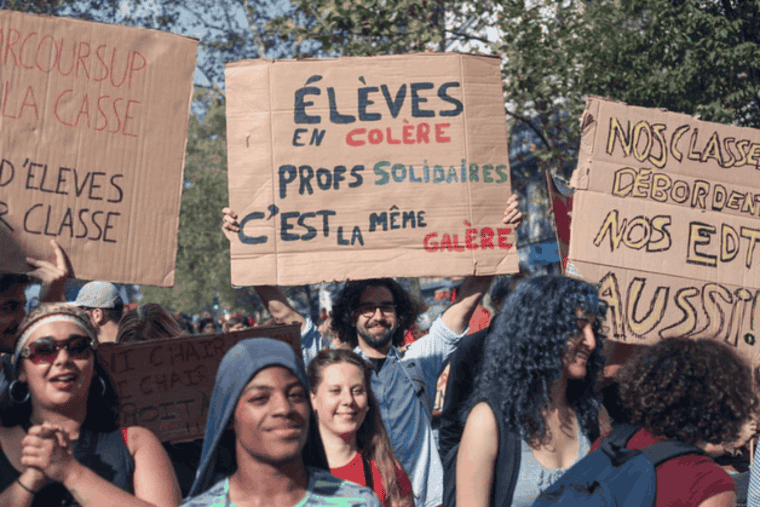
The wave of school strikes across France is growing in size, confidence and anger.
The revolt spread to universities on Thursday after several days of school student protests in the face of police brutality.
Students blockaded around 30 university campuses from the morning, the UE national student union said. They included campuses in Paris, Strasbourg, Marseille, Lyon, Reims, Poitiers and Nanterre.
And, the day before teachers, hospital workers and civil service workers struck over low pay and working conditions as school students fought cops.
Secondary school student Niouma said, “Frankly, the system for students from the poorer suburbs like us is completely broken.
“We study in awful modular classrooms and we don’t have all our teachers or enough teaching assistants.”
Around 600 schools were blockaded across France on Thursday. Hundreds of pupils blocked traffic and a tram line and set rubbish ablaze outside the Couffignal secondary school in Strasbourg.
In Saint-Denis, a northern suburb of Paris, students faced down police and tear gas with mortar fireworks.
After blockades, secondary and university students joined forces and marched on the streets.
At one school in Paris, cops shot a tear gas grenade at point-blank range at a 14 year old’s face, fracturing their jaw and breaking several teeth.
In Le Havre, trade unionists formed a human chain to defend school students from police violence.
The revolt is rocking president Macron and prime minister Sebastien Lecornu, who is pushing through £46 billion worth of cuts.
Details of the cuts were set to come out in the budget on Thursday.
Wednesday showed the anger of public service workers, who struck after receiving their eighth pay freeze since president Macron entered office in 2017. Public service unions are demanding a 6 percent pay increase.
Over 300,000 people took part in more than 180 rallies. The CGT union federation said this included 70,000 in Paris, 30,000 in Marseille, 10,000 in Bordeaux, 8,000 in Lyon, 7,000 in Toulouse and Nantes and 5,000 in Rouen and Rennes.
Struggle is rising with key flashpoints coming this month. Protests against sexist violence are planned on Monday and the USL student union has called for a national protest on Tuesday.Energy workers are set to strike on Tuesday and TotalEnergy workers on Thursday—and there is a day of action on 17 October.
Anti-fascists are planning to demonstrate against the far right RN party’s conference on 24 October.
Melenchon has slammed the police violence against the students, saying, “We are proud to stand at the gates of high schools to defend our children from police brutality. Parents, activists, mobilise to stand in the way.”
Struggle shows the power to win change in the run up to the election—and it must now deepen with more workers coming out.
Emil, who is involved in his neighbourhood union in Paris, told Socialist Worker, “People in the workplace want to mobilise themselves. A lot of people want to fight politically against racism and against fascism.
“It’s an extraordinary context—normally during election year people just want to vote.”
A day of action on 17 October has the potential to be a catalyst for a much higher level of struggle.