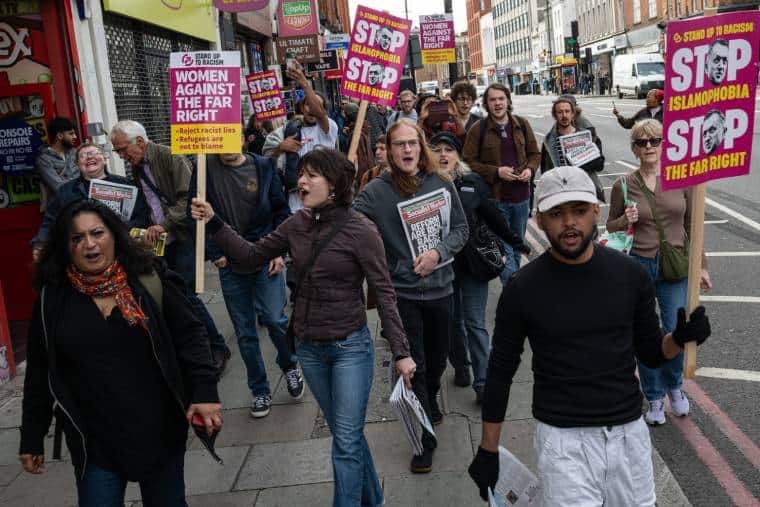
Hundreds of people outnumbered the fascists in Epping this weekend. It’s time to build anti-racist groups in every local area to take on the far right (Pic: Guy Smallman)
Anti-racists can be proud of the role they played in Epping, Essex, last weekend.
Hundreds of people outnumbered the fascists, preventing them from terrorising refugees living in The Bell Hotel.
Events like this matter. They show that anti-racists are the majority. They can leave the far right feeling miserable and help to break away the “softer” racists who join the far right protests from a harder Nazi core.
Marching against the far right in large numbers also gives confidence to our side. People who support refugees will feel that they are not alone and will be more able to speak out.
Almost exactly a year ago, the far right rioted across Britain. They hoped to use the horrific murders of young girls in Southport to build support for pogroms against Muslims and migrants. Mass protests organised by Stand Up To Racism and others were able to turn the tide.
Epping was a crucial battle. But it is not the end of the war. The far right are still looking to spread their violent hatred and are targeting hotels housing refugees around the country.
Reform UK is building its forces and has shifted to supporting the far right mobilisations. And Keir Starmer’s Labour government bows to the idea that we need to listen to people’s “legitimate concerns” about immigration. All of this creates an atmosphere for racism to grow.
There needs to be a sustained anti-racist movement in workplaces, campuses and communities to defeat them.
This could mean rallies and meetings that bring anti-racists together to discuss the way forward. Motions in trade union branches can bring the social weight of the labour movement to the next counter-protests.
It could also mean carnivals and cultural events that celebrate diversity. In the 1970s, Rock Against Racism played an incredible role in making it fun and attractive to be anti-racist.
And it could mean taking small steps like wearing a badge at work, speaking to colleagues, or even organising a bake sale or a collection in your college or workplace to support refugees.
All of this helps build a network in local areas that can confront racism on the streets or in the next elections. Movements with deep roots can drive out the far right.
It needs revolutionary socialists at the heart of the movement, putting an argument to blame the billionaires and the bosses, not the migrants.
Keir Starmer is now “weighing” up the recognition of a Palestinian state. But so far, officials say, Starmer has not recognised Palestine as it’s a “performative” measure.
But it’s hard to believe he’s rejected recognition on the basis of performativity. Between October and December last year, Starmer signed off on £127.6 million worth of military equipment to Israel.
When pressure from the Palestine movement forced Labour to suspend some arms export licenses, Starmer made sure it was only 10 percent and kept F-35 murder jets exempt.
Starmer’s excuse? Because other countries wouldn’t be able to use those parts if Britain stopped selling them to Israel.
It’s not just arms. Britain’s air force conducts surveillance on Palestine, passing on deadly information to the Israeli occupation.
And Starmer has consistently refused to admit Israel is conducting a genocide. He called Israel’s actions “appalling, counterproductive and intolerable”. But he deliberately stopped short of “genocide”.
Even Israeli-based groups have now recognised that Israel is ethnically cleansing Palestinians.
Starmer’s only response has been to attack the Palestine movement and criminalise those who stand against genocide.
But he now may recognise a state of Palestine because the solidarity movement has shamed Western leaders and driven a crisis of legitimacy for Israel.
That crisis at the top is an opportunity for the movement to ramp up action to stop all arms sales.
But he’s right. Palestinian recognition alone is performative, not least because he’s proved he’ll back Israel’s genocide until the end.


Plus: Why Britain's war drive comes at a cost to us all
Andy Burnham said he could 'go all the way' to rejoin the EU—but what does it really stand for?
End the use of British airbases for the US’s wars in the Middle East
Three reasons we were right to chase them off the streets