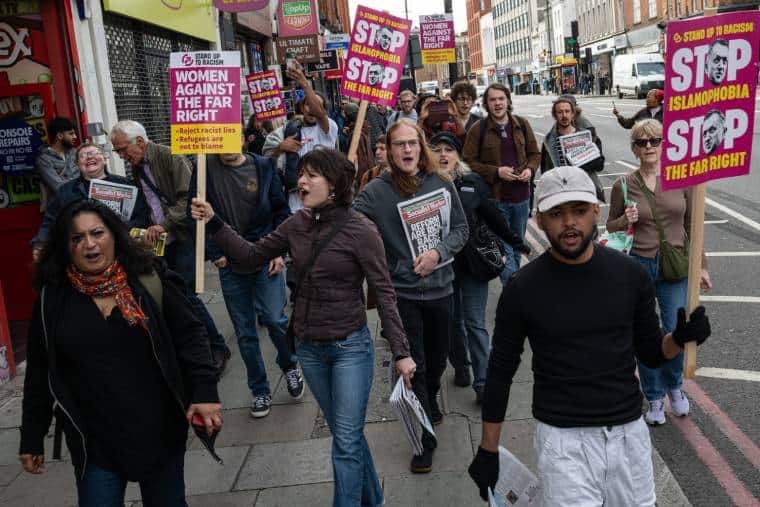
The violence of the far right is bubbling up again and it will take mass anti-racist action against the far right and scapegoating to stop it. (Pic: Flikr)
Epping has become a focal point for the British far right. Fascist thugs have gone on the rampage against refugees at the Bell Hotel in the Essex town three times—and they want to do it again on Sunday.
The eruption of racist violence on the streets has not come out of nowhere. Who has emboldened those fascist thugs?
Decades of mainstream politicians, the Tories and Labour alike, scapegoating migrants and refugees has laid the ground for the rise of the far right. They blamed migrants to deflect from their own failures, which legitimised racism and drove politics rightwards.
The result is Nigel Farage’s far right party Reform UK topping the polls and replacing the Tories as the main force on the right.
Its impact on British politics is toxic—and the violence in Epping hammers that home.
Reform UK and the networks of fascist thugs that Robinson mobilises represent different dynamics of the British far right.
And Farage has tried to maintain a separation between Reform UK and Tommy Robinson’s supporters who want to build a violent street movement.
But Epping marks a shift, with Reform UK directly lending legitimacy to the fascists. Farage claimed that the racist thugs were “genuinely concerned families.”
He asserted that “simmering anger” over the arrival of refugees would result in what he called “mass civil disobedience”.
His comments came after Reform UK MP and deputy leader Richard Tice called the rioters “decent law abiding British folk”(see page 3).
This highlights that racist scapegoating is the thread that binds together Reform UK’s political project.
The party feeds off the anger at Labour’s austerity and the failures of neoliberalism to reverse “national decline”. But anti-migrant racism, which blames immigration for that decline, is the key driver of its rise.
Reform UK has helped to create a political climate where anti-migrant racism dominates.
When Farage is constantly taking to our airwaves to spout lies and hatred towards migrants and refugees, it helps to open up the space for fascists to go on anti-refugee rampages.
The far right’s rise is also being fuelled by the Labour Party.
Every time home secretary Yvette Cooper announces a new crackdown on migrants, whether that be a tightening of visa restrictions or a new deportation plan, it lends respectability to the ideas of the far right.
And when Labour fails to “stop the boats”, the far right can turn around and say they’re the only ones who’ll take the “necessary action”.
It means we cannot rely on Labour to stop the far right—we have to do it ourselves.
The violence of the far right is bubbling up again and it will take mass anti-racist action against the right and racist scapegoating to stop it.
The spate of racist violence across Britain has exposed the rampant racism at the core of British politics. Voices against racism in mainstream politics are sparse, and people watching Essex in horror have no organisation to look to.
As the saying goes, politics is all about timing. If ever there was a time for a left alternative, it is now. By standing in firm opposition against the racist pogroms, it could build up an anti-racist base.
Any new left formation should be principled on the question of racism. It should be clear that refugees are welcome and migrants are not to blame.
But crucially, it could be a party that rallies for people to do something. A left alternative could galvanise those who want to act and create a network of activists, but aren’t sure what to do.
In this instance, it could call on people to attend the Stand Up To Racism counter-demonstration. Building anti-racist struggle outside of the toxic cesspool of parliamentary politics is urgent.
But a new left party is a crucial tool to amplify that fight. With the current racist violence, the parliamentary left is missing the opportunity to build.


Plus: Why Britain's war drive comes at a cost to us all
Andy Burnham said he could 'go all the way' to rejoin the EU—but what does it really stand for?
End the use of British airbases for the US’s wars in the Middle East
Three reasons we were right to chase them off the streets